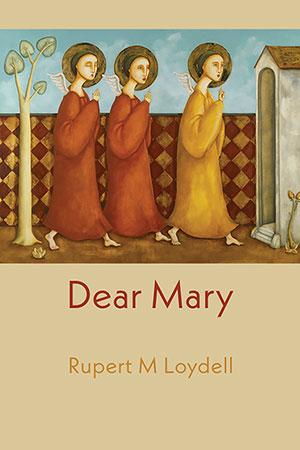
‘Dear Mary’ by Rupert M Loydell: a review as letter

mary

Dear Mary,

I am writing about Rupert Loydell’s love letter to you and want to share my views on this. I have questions to ask and observations to make. I trust this is OK – doing it like this?

Needless to say, his writing always demands attention. The words are suffused with thoughtfulness, and this is expressed with the most palpable honesty.

Please take these notes for what they are – plotting a journey through the book with immediate reactions and recurring celebrations. Even when my own doubts are unmoved by the moving declarations of his possible faith. I think this is one of the book’s great achievements: to not alienate when so much else in this world on religious revelation is a meaningless diatribe.

I’ll begin with a question:

If the shipping forecast is a presaging of discovering God and/or faith, is that discovery as surreal and/or complex as this? As inherently irreverent and comical? Those of us who read on shall see, if we listen further to the announcements, this radio’s shifting annunciations.

The poet, reader of poetry and painter will try to discover by capturing what is seen and read, but will this be faithful, a realist’s representation or the hot sunshine light of Tuscany blurring out the colours with its glare? When the poet scares a reptile in the swimming pool with the splash of his dive, we hope it isn’t the Lizard King who will seek revenge.

As the poet asserts itself over the painter, there is a clash of expectation, and it is the writer who needs-must put this into words,

Now I’m reduced

to black and white:
shadows on the page,
cold lines of type,
pale marks and
faint grey stains.

Lost in colour,
I don’t have
the words
although words
are all I have.

[‘Lost in Colour’]

Annunciations repeat themselves, varyingly. It haunts as much as it conveys – all the empty rooms waiting to be filled.

If colour has its own meaning, I must read on to experience this. Yes?

If Italy/is a love letter to God these poems about Italy have fallen deeply.

Finding angels in a museum is connecting to the meaning of life, and in this respect I can acknowledge the act of faith, even if I do not personally believe.

When the paintings spoke to him, their clamour said more than he needed to write or paint himself. Then. But now he has, it makes sense how their

….Frozen movement
implies captured noise….

[‘In the Dark, Listening Carefully’]

I like the sound of that, and much else that I read, discovering then and again later.

At times, like ‘Tonight’, the observations are soothing. They are not searching, but simply seeing and that announces its own kind of calm and acceptance of what is, without the need to explain further.

When the churches close for repair and their frescoes are inaccessible, is this the diminution caused by a secular world, or the last vestige of preserving a secret?

Grey is grey is grey is grey is gray.

While it rarely rains in Tuscany, when it does it is the wettest rain ever, a fluid/flowing/seeping single line about this as the perfect way to teach the rhythm of a complex sentence. Then there’s that last declarative. [‘Rain in Tuscany’]

I think, Mary, there is a poem about your pregnancy which makes great claims for its ultimate altruism. It is a glorious idea, and I wish I could believe it.

I understand the wonder and awe and beautiful simplicity of the recognition and transference. For me, the paintings resonate with the belief in their colours. There are all kinds of inspiration.

I like the idea in ‘Taken Up’ where the profound is presented in the metaphor of the ordinary. A ruse, yes, but it works to make all of this writing work at many levels,

Her heaven may be imaginative
rather than something literal,

her annunciation not historical
but cultural, a folded paper note
passed along the back row of class
under the eyes of Joseph and God.

[‘Taken Up’]

I didn’t know angels could be found on Tinder.

‘Shadow Triptych’ is a major piece – at times meditative; at times raging in its painterly imaging,

Step into the shower through smeared
stripes of curtain, and shout at yourself
being crucified.

At times it is philosophical,

In the corner a man on a red sofa scratches
at the air, revealing the links between
power, metaphysics, theological realism and
visual pleasure. We can see right through
elaborate ideology to the painter’s mark.

At times the horror is painted as a presaging you’ll not hear in the weather forecast,

Tread the bed with bare hands, avoiding
the corpse spread out across your duvet.
The slatted blind is crimson in the centre
of the window. If human blood can be
contaminated, what is to prevent the global
economy from contracting a deadly virus?

[‘Shadow Triptych’]

Mary! He was once abducted [is that what it means to be ‘taken up’?].

Earlier, I did my best Gertrude Stein impression. Did you get that? Well, forget it. I didn’t know there were actually so many different types of grey. Excusing the paradox, it is a colour of many variable depths. Some are comic; some strike to the core of our own grey thoughts.

That ‘Silent Annunciation’. It reminds me of his White Album poem. I think that is what it was called.

Dear Mary, ‘Dear Mary’ is like many songs sung while smiling.

I think it is possible to get carried away with a metaphor. I do it all the time, a spinning top spun on a marble surface forever. But this is taking the piss,

….absence makes

the heart grow fondue…

yet it did make me laugh.

[‘Her Room’]

‘Surveillance System Annunciation’ does go some way to contemporising belief and understanding, and it would be ironic, therefore, to call something so technically visual as ‘blind faith’. Is this what ‘taken up’ means? And no, I’m not implying ‘taken in’. I am too respectful of the honesty to be cynical; too endeared by the beauty of expression. Not believing does not mean not getting it.

‘My Paper Aunt’ sounds flimsy, but this is a substantial relative ruse: the poetry of this superb – sustained quatrains of insight and meditative thinking aloud, language balanced throughout, occasional playful rhyme, and always the ruse ruminating.

I think there is a sermon made of poetry which is probably the best kind, especially his as I don’t think it is moralising, or even trying to persuade others, rather just himself – or not, this is up for negotiation it seems – and wearing the blue dress after dancing all night is the sweet normalcy of it all, but I still cannot accept the resignation of,

her only answer is through obedience

and I can’t ask you directly, Mary, as that would be a cheat too big even for paradox.

[‘Sudden Impact’]

I don’t think one would find this in Collins or the Oxford Concise,

Colours have psychological and moral overtones,
are vessels of a transcendental essence,
a synchronicity between the sonic and visual

[‘Remarks on Colour’]

But we should.

A list poem Mary! I love these. So much packed into repetition, pattern, building blocks, relentless focus.

The final poem, ‘Evidence’, asks the obvious questions about finding/having faith in a secular and technological world. Renaissance art had no such qualms about representing what it believed in, and perhaps one does need to travel to another world – not just the physical otherness of Italy – in order to distance oneself from doubt and look closely at the confident colours of others’ believing. So we have travelled too through these words and honesties. And if the attempt ‘to write about faith today’ is swept up and flown with its angel wings of this writing, I am happy to admire the flight.

You know, Mary, one comes to the end of this collection and there is very little sense of darkness. Grey, yes! But not the black of despair. That in itself is uplifting.

Yours, as ever,

MF

For further details and where to order, visit here.
Nebraska 22 – ‘Holy Smoke’ by Clark Coolidge

Mother, mother, burning bright, in the sink piece to my right.
I talk to no-one, I’ll live longer. Who wants to. How about
instead of wishes favors grant me. The magic hand always out
in the door. Farms on the mind, a song I heard once on an itchy
Nebraska station rationing away as I drove west. The bird laid
three crystals and dissolved in my face. I looked up, only sky,
plain as a nose. The effort proved not even enough to rest the
one tire I needed from the field of junk. The other birds had all
thithered away. They, I suppose, got the call. I couldn’t hurry
enough to receive, I could only wait. A blur of neon on my hand,
green, the palm, the back gold. You wouldn’t believe me if I
told you so I’ll tell you, the first lie that comes along.
The god goes out like the sun might in time.

from Sound as Thought: Poems 1982-1984 (Sun & Moon, Los Angeles, 1990)

Thanks to RL for the poem

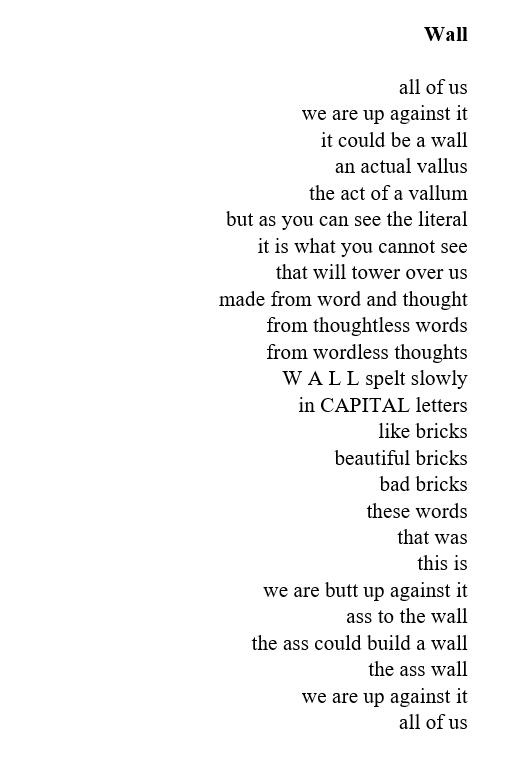
Walls

Recently removed from this blog and rewritten, I post the revised version of Wall on the day White House press secretary Sean Spicer had these incoherent words to say about Trump’s promised border wall after showing slides of fences to journalists:

“That is called a bollard wall. That is called a levee wall. There are various types of wall that can be built, under the legislation that was just passed.”

“What I’m telling anybody is that the president said he was going to build the wall and he’s doing it, and he’s using the best technology.”

wall 2


Lemn Sissay – ‘The Report’ and ‘Gold from the Stone’: an appreciation

P1010231

Though wanting so much to attend, I was unable to go and see Lemn Sissay’s The Report at the Royal Court theatre in London. This was a ‘live’ show in which a genuine psychologist’s report about the abuse he suffered as a child and teenager over eighteen years in the care system was read aloud to an audience. More importantly, this included Lemn Sissay himself on stage. This would be the first time, quite remarkably, he as well as all those others would hear this information. The report had been ‘lost’ for years but recently discovered [that, presumably, a whole other story]. Sissy organised for its findings to be revealed on the night of the show, the role of the psychologist reading the contents played by actress Julie Hesmonhalgh. To refer to ‘played’ and ‘actress’ in this context is, obviously and poignantly, to engage in the most profound paradox.

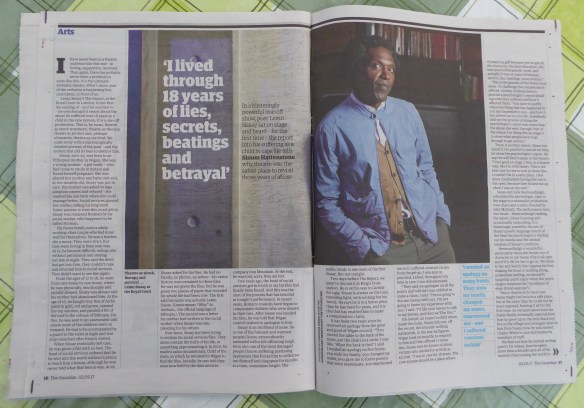
I was therefore thankful to read such a fine review of this event by Sissay’s friend Simon Hattenstone in yesterday’s The Guardian, and it is much more a personal, empathetic response to the occasion than the more conventional, critical observation of a theatre review. I would urge anyone interested to read for themselves [I bought the paper precisely for this, but it can be read online here]. There is an opening, touching summary of Lemn’s Sissay’s early life and move into care, as well as an affectionate appreciation of how this has impacted on his friend’s life as an adult to this day.

Hattenstone refers caringly to his friendship with Sissy and states he is one of the funniest and warmest people I know, extraordinarily animated with a life-affirming laugh. I know Lemn a little, and to know Lemn even a little is to know a lot because he is a genuinely huge character. Much of this comes from the sheer human energy of the man, but it is focused most impressively through his creative energy: he doesn’t just talk – he impassions, constantly, and observes so often through the poetic prism of poetry, and I don’t mean in his writing, though clearly it is here, powerfully, and in his performance of this. Ask Lemn about words, or just a single word, and you’ll hear what I mean. Ask him about anything and you’ll hear!

Hattenstone is also most honest in referring to the damaged side of Sissay’s life, and again I would urge reading what he has to say in his article for that empathetic insight. I have only ever been on the positive and uplifting receiving end of Lemn’s energy, enthusiasm and generosity of creativity and attention.

I first met Lemn 27 years ago when he visited and worked in my school, running a writing workshop and performing/reading his poetry. That time is a little vague [the intervening years sandpapered away by a different culture to those heady days of being largely creative]. I am reasonably sure, however, that he attended on one of the first Comic Relief Days, and his evening reading for students and parents ended up as a riotous stand-up routine, loved by all there, much to do with his experiences of being a black guy in Devon, yet also a mix of anecdotes and amazing performances of his poetry, written then in particular to be performed – most recited rather than read. It was stunning, and it was inspiring. How sad but also triumphant it is to read now about how much he would also have been suffering as a person then.

I have had the pleasure of working with Lemn a few times since those earliest encounters: he generously gave two poems for me to include in my GCSE teaching text on examination poetry [I don’t believe he got paid much at all for one, if at all; the other was definitely a freebie]. The poem that appeared in the main text was the powerful The Waitress and the Knights of the Round Table, a poem about racism, included in his collection Morning Breaks in the Elevator [1999]. The issues it raises are as pertinent today as then [and before and beyond, sadly] and if you ever get the chance to hear Lemn read this aloud, you must. The poem carries dramatically on a personal reading – and it is poetically so delicate and vivid as it sets its scene – but a performance from Lemn delivers with such an evocation of their madness the lines that truly stab you through your anti-racist sensibilities, and indeed any caring about abuse to another one you could and should always have. Hearing about Lemn’s own abuse in the care homes and how it has affected him throughout his life has added a further level to my understanding of how that poem resonates, over and above the racism he encountered in his life.

The second poem, also from …Elevator is Sandwich Love and this was printed in my Teacher’s Guide where ideas for creative writing were offered, this delightfully playful poem from Lemn demonstrating the richest possibilities of using simile and similar.

10443237_10155002852388125_1230493295414555266_o

I’m obviously proud to mention these poetry gifts from Lemn, and to quickly add I had the pleasure more recently of working with him where my co-author and I filmed Lemn for a major online digital resource [for Cambridge University Press] to illuminate and expand on ideas presented in our GCSE book about Writing in the new examinations [being assessed for the first time next month]. Another reason is that the two poems mentioned above are also published in Lemn’s recent collection Gold from the Stone.

P1010232

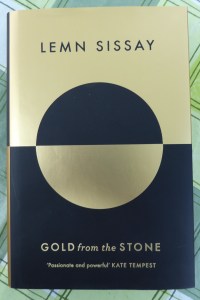
This is a career-spanning collection of Lemn’s poetry and is a major work from one of the UK’s leading writers and performers. And let’s just pause a moment on that assertion: among the many formal and informal accolades awarded to Lemn over the years – and he will no doubt value most those from friends and those he has supported who have been and are still in care – he was the official poet of the 2012 Olympics [his poem for this in the collection], was awarded and MBE in 2010, and is the Chancellor of the University of Manchester, this latter a role he takes on with passion and active energy. And this really does just scratch the surface.

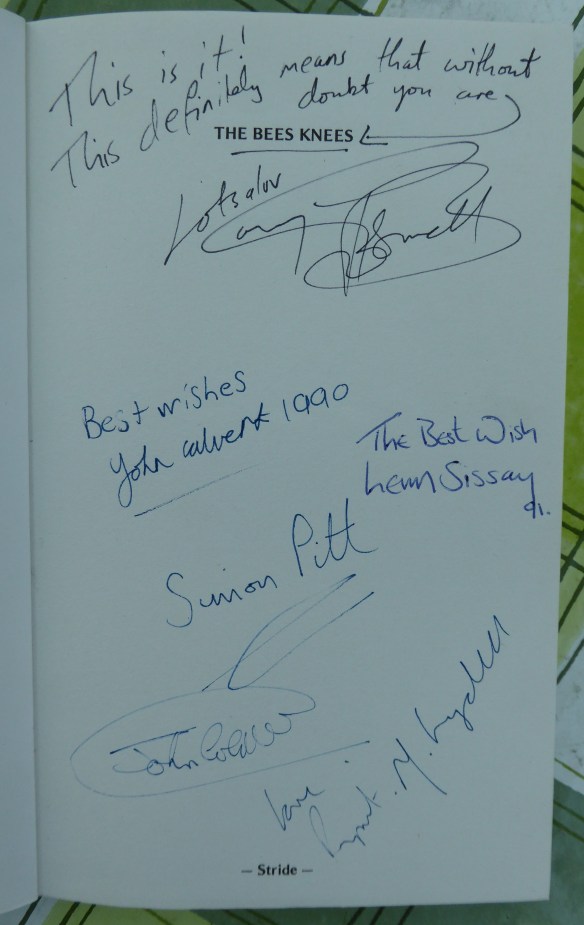
I can imagine those who might denigrate such awards like the MBE [and I am generally no great fan], but for me, and in Lemn’s particular case, this one and other recognitions respond to the complete honesty of their earning. From a ‘jobbing’ poet with a first book published in 1988, Lemn has undertaken the hard, intermittent and itinerant journey of the aspiring writer, often unrecognised by a larger public but never ever unappreciated by those lucky enough to experience his readings and workshops. He now travels the world to deliver these same enthusiastic readings and workshops to that wider and very often adoring contemporary public. Lemn’s commitment to this – especially the constant travel that isn’t as romantic, no doubt, as it might seem – fully earn these public recognitions. My main point, and something I have wanted to say since first reading Gold from the Stone, is that Lemn has popularised poetry: made it accessible and enjoyable and inspiring for many. There are poems in the collection that are clearly written for performance, and equally for entertainment. His ‘wordplay’ poems are great examples of this, but they can and do also work for their convictions, like Airmail to a Dictionary from Rebel Without Applause [1992] but which I first read, and how I first came to know of his work, when it appeared in the wonderful Stride collection of poems for young people The Bees Knees [1990]. This is when Lemn, and other poets from this collection, came to work in Devon schools, Lemn to also work at mine solo.

P1010233

P1010234

I was lucky to grow up at the time of The Mersey Sound where poets like Mitchell, Patten and McGough were making poetry fun and meaningful and inspiring. There hasn’t been this kind of popular-culture aspect to poetry for some long time since. Rap and rap-poets, poetry slams and other performance elements to more recent poetry [and its spread on YouTube and social media] have raised the profile. Indeed, in last Sunday’s Observer Magazine the lead article was all about Kate Tempest and how she has brought poetry back to the ‘masses’ [well, sort of…]. Whilst I’m sure she has played her part in this, and I am mindful that Tempest has written a promotional blurb for Sissay’s latest collected works, I would have to say it is Lemn who has consistently brought poetry to the widest possible audience and to provide a significant range in doing so. If you want to read one of Lemn’s ‘popular’ poems packed with craft and meaningfulness try his one for the 2012 Olympics, The Spark Catchers.

I could go on, and had in fact some months ago been thinking of saying similar and more in a fuller review of Gold from the Sun, but yesterday’s Guardian article on The Report has expanded away from that intended poetry focus. And I am glad.

It also allows me to close on a final ‘I know Lemn, even if a little’ anecdote, and I will frame and justify it with a quote from yesterday’s newspaper article. There is a quote from the Report in that article which I will edit for my purposes, and it reads He meets some of his needs for acceptance and love through the superficial and impassioned relationships he forms through being famous and I now appropriate this affecting observation for a more playful purpose – one I’d like to think Lemn would smile about – and that is how I once made him a cheese sauce when, invited for a meal to his place then in Manchester, his had failed. It is an anecdote in my craving for some vicarious feed off knowing the now famous Lemn, if only a little, and I have told it many, many times.

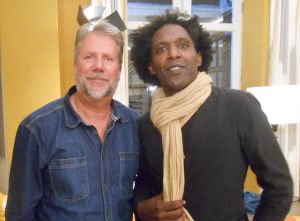
I also saw Lemn reading a few years ago at The Budleigh Salterton Literary Festival, he quite unaware I was there and our not having seen one another for many years. Early in that reading he stopped, having suddenly spotted me in the audience, and said hello and had the briefest but very public catch-up. It was so warm and friendly and unexpected – and ego-boosting, for me of course! One of the funniest and warmest people I know says Hattenstone, and this demonstrated that warmth and generosity for me in that one small surprising moment.

I know the immediate above is the more meaningful anecdote, but I remind you I do make a great cheese sauce, and did so once for Lemn Sissay.


Watch Channel 4 News’ segment on The Report broadcast last night here. It is moving, and the interviews with Lemn show him also moved, and angry, but typically upbeat and perhaps a little freer after his experience.

House of Commons education committee advises banning of KS2 SPaG, nearly

As reported in today’s Schools Week, the House of Commons education committee has published a report on primary school assessments which is largely critical and therefore substantially challenges their sustainability. Whilst not calling for them to be scrapped – could you imagine such a sensible but politically unique conclusion – the criticisms would logically suggest so for those of us not encumbered by the traditions and conventions of committees reporting and governments ignoring.

Of most interest to me, and perhaps the most scathing, is the criticism of the KS2 SPAG [or GPS, I think it is actually now termed]. Whilst the natural ‘conciliatory’ recommendation from the committee is that these fundamentally useless tests be made non-statutory, rather than scrapped, this is nonetheless a trenchant dismissal of their value. Should the Conservatives be imminently re-elected, this advice will no doubt be ignored.

This is the key English subject observation and criticism from the report, in Section 3 Design and development, under Writing:

‘34. However, moving away from the ‘secure fit’ model will not remove the focus on technical aspects of writing, something that was raised in evidence to our inquiry. Professor Dominic Wyse, UCL Institute of Education, wrote:

The assessment of writing in statutory tests in England in 2016, and for some years previously, suffers from two major flaws: 1. the undue separation of the composition of writing from the transcription elements of grammar, spelling and punctuation; 2. An undue emphasis on decontextualised grammatical knowledge. Both of these flawed features of assessment are contrary to research evidence.

35. The Minister said that the focus on spelling, punctuation and grammar had arisen following the Bew review. However, the review specifically stated “writing composition should always form a greater part of overall writing statutory assessment.”

36. The balance of evidence we received did not support the proposition that focusing on specific grammatical techniques improved the overall quality of writing. We support the Department’s proposal to use a ‘best fit’ model for teacher assessment of writing. We recommend the Department should make the Key Stage 2 spelling, punctuation and grammar test non-statutory, but still available for schools for internal monitoring. As well as short term changes to writing assessment, the Government should carry out a thorough evaluation of the reliability of teacher assessment judgements and reconsider whether it is appropriate to use these judgements for accountability purposes.’ [Their bold print].

You can read the full report here.

Kellyanne’s Vacation

kellyanne

‘She isn’t around anymore.’

‘I don’t like the sound of that.’

‘She isn’t around anymore, Mr President.’

‘That’s not what I mean. When you say isn’t around I don’t think I like the sound of that. Or I should say I don’t like you saying that to me.’

‘She is no longer with us, Mr President.’

‘Is that bad? That sounds bad.’

Bad, Mr President? Do you mean bad as in not good or as in terrible?’ Spicer rather than the secret service agent asks.

‘I don’t understand what you are asking, but I don’t like being told she is no longer with us. I don’t mind that she isn’t here anymore, but I don’t understand what this agent is telling me. Is she dead? Did we – I mean – did someone have her…,’ he inflects his voice upwards, ‘… removed? That would be bad,’ the President says.

President Trump pouts with pursed lips but the others in the Oval Office are not yet sure if this is just his normal face or one of concern. If Kellyanne was there she would probably let the others know, as she was always in the know about these kinds of things, but she is no longer around anymore.

‘She just isn’t here, Mr President,’ Spicer tells him. ‘No one had her removed, Sir.’

‘Are you sure, Spicer?’ the President asks. ‘You aren’t always sure about things,’ the President adds.

‘I’m sure about this, Mr President, and I don’t think…’

‘….gas,’ the President interrupts. ‘That was bad.’

Spicer looks down at his feet, but at least he is standing on them. Not like Kellyanne who had hers curled up under her ass sitting on the Oval Office chair. That was the beginning. That’s when others – not the President – suggested it was time for her to go, not that they suggested this to the President. He hadn’t noticed. It was like a lot of things the President didn’t notice. Like not noticing if Kellyanne was around anymore.

‘You can sit down Sean,’ the President tells Spicer, pointing to the chair where Kellyanne sat on her feet.

‘I’m fine,’ Mr President, Spicer says.

‘I liked having Kellyanne around.’ the President says to anyone listening. ‘She made me feel good.’

‘You mean not bad?’ Mr President, Spicer asks.

President Trump looks at Spicer with an empty stare that Spicer interprets as normal on one of the few occasions when he is right.

‘She is secured,’ the agent who was earlier speaking with the President speaks again.

‘Secured?’ the President asks.

‘Not here anymore,’ Spicer interjects. ‘At the press briefing today I will be informing everyone that Kellyanne is taking a well-deserved vacation, Mr President.’

‘Is she having a vacation?’ the President asks.

The agent looks at Spicer who looks at his feet – his own feet – and shuffles them a little.

‘It’s the last day of National Poetry Month today, Mr President,’ Spicer continues. ‘I’m going to read the poem Vacation by the former US Poet Laureate Rita Dove, Mr President, and then I’m going to make a seamless reference to the fact Kellyanne has gone on vacation and make it sound relevant and intelligent.’

The President looks at Spicer with an empty stare. So does the agent. So does everyone else in the Oval Office.

‘Today’s my 100th day in office,’ the President says, looking confused and disappointed.

‘That’s why I’m reading a poem, Mr President,’ Spicer tells him. ‘It was Kellyanne’s suggestion, Mr President, one she made 100 days ago. A bit of foresight I think. She had some good ideas, but in the end she had to go, Mr President.’

‘Is Kellyanne not with us anymore?’ the President asks.