
~

~
My thanks to International Times and Rupert for posting today here: https://internationaltimes.it/human-capital-stock/


~
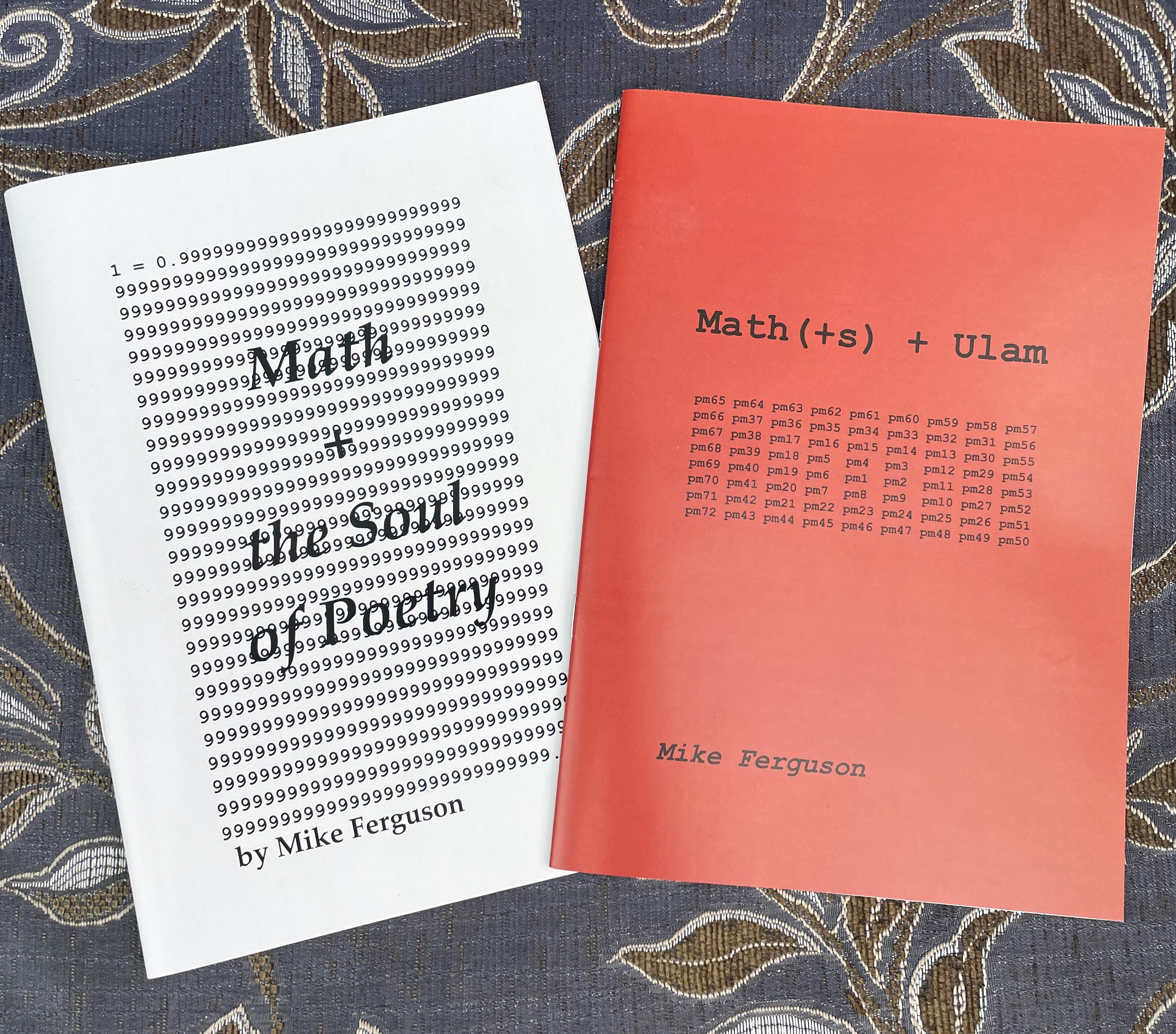
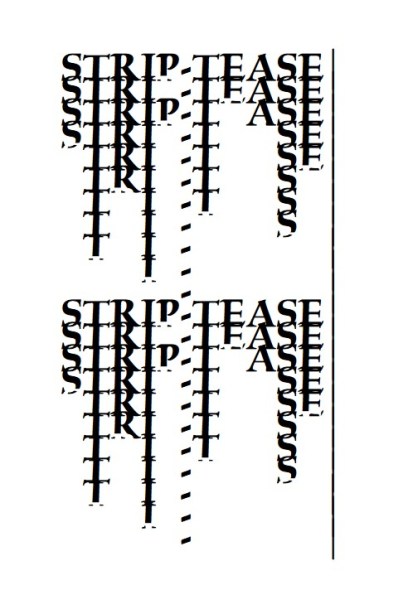
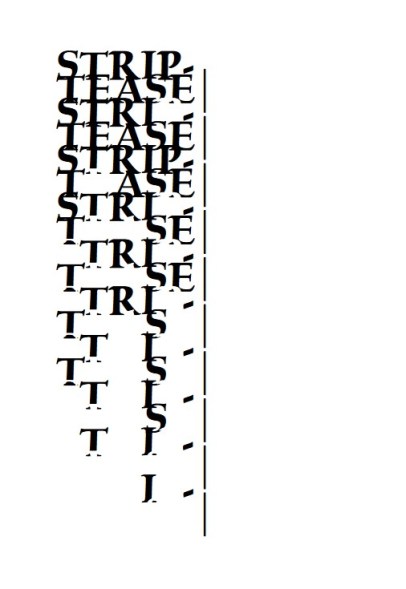
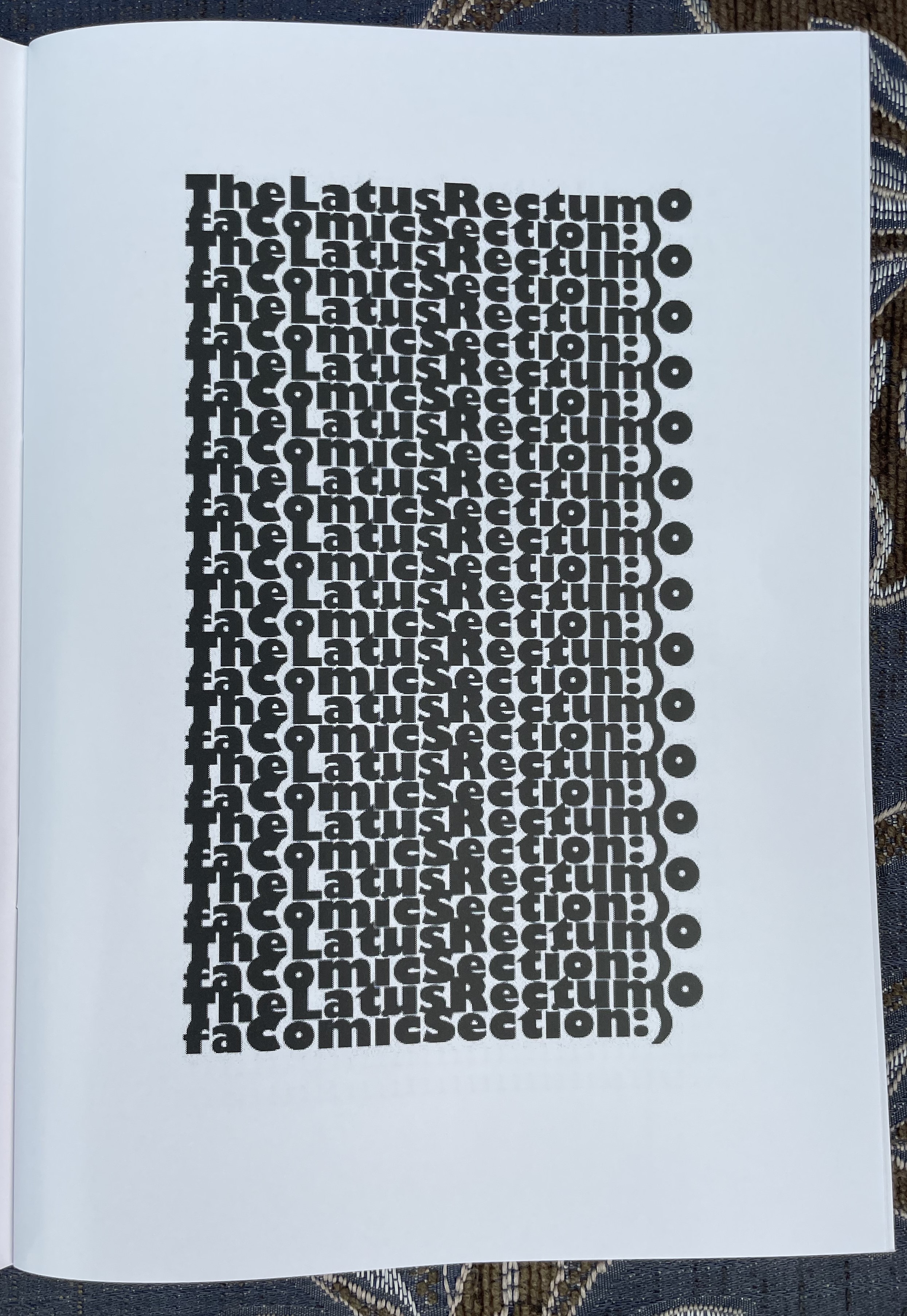
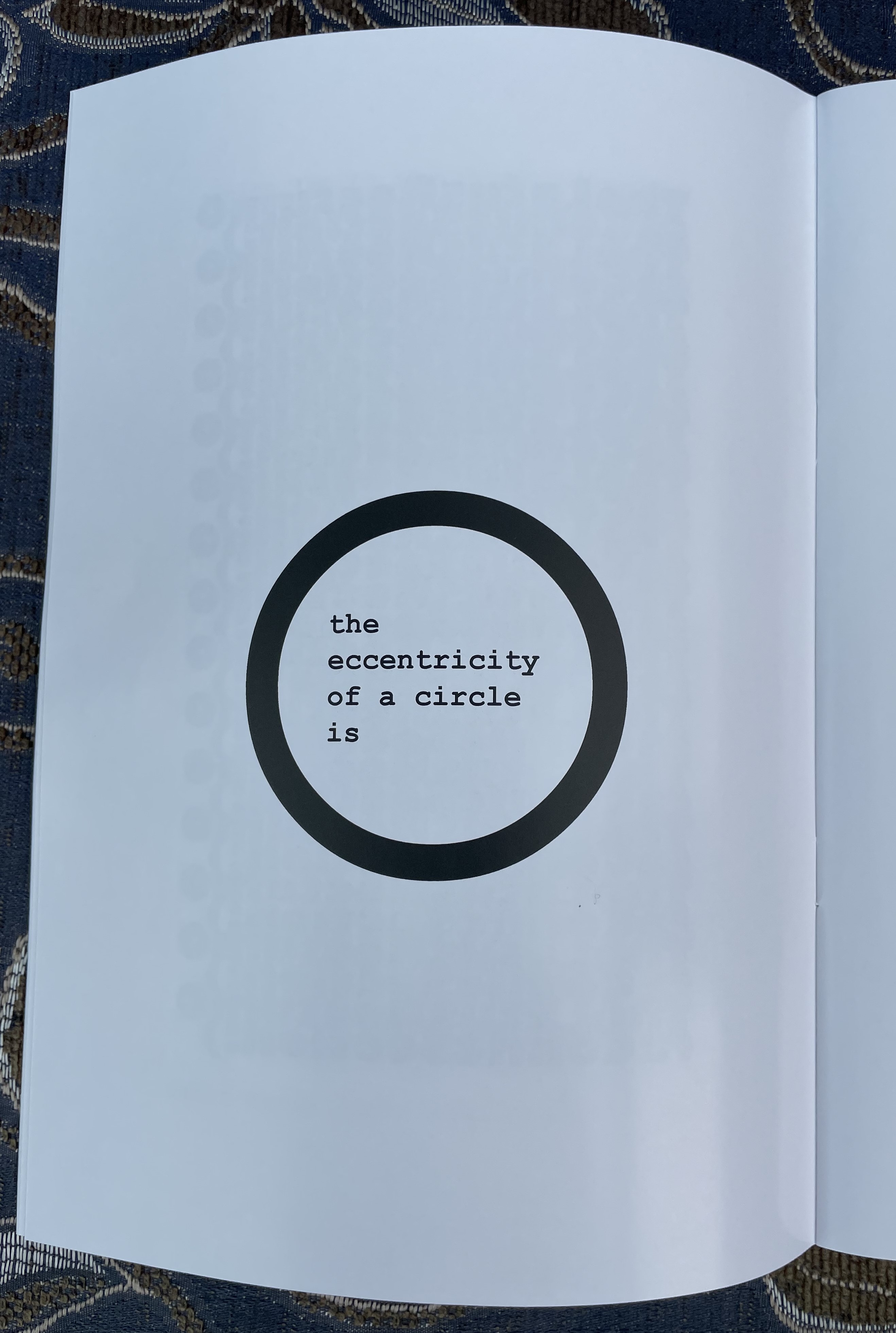
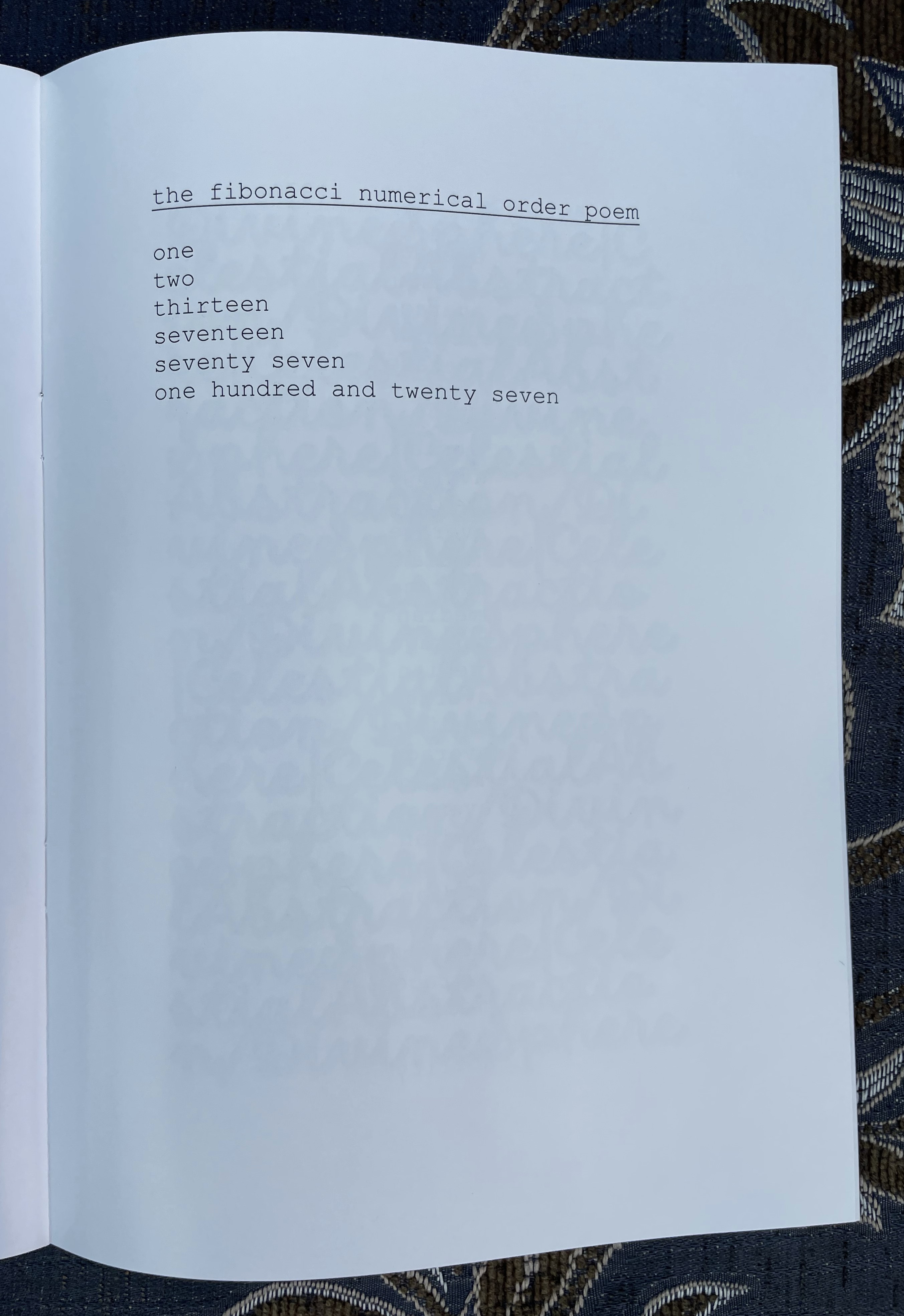
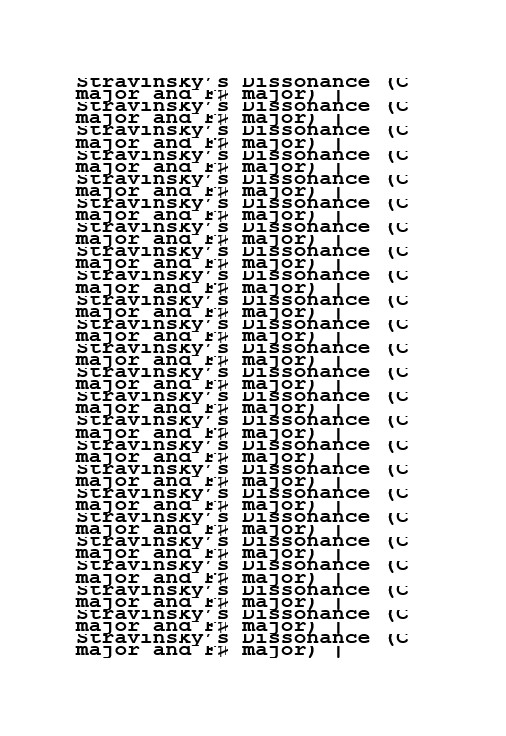
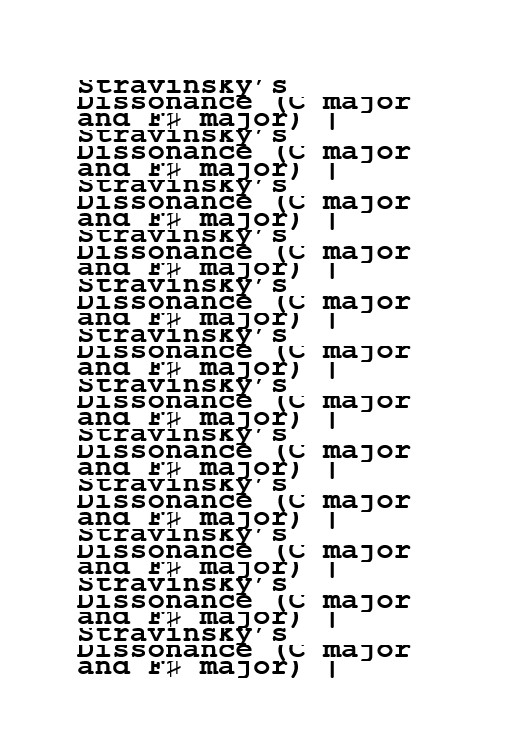
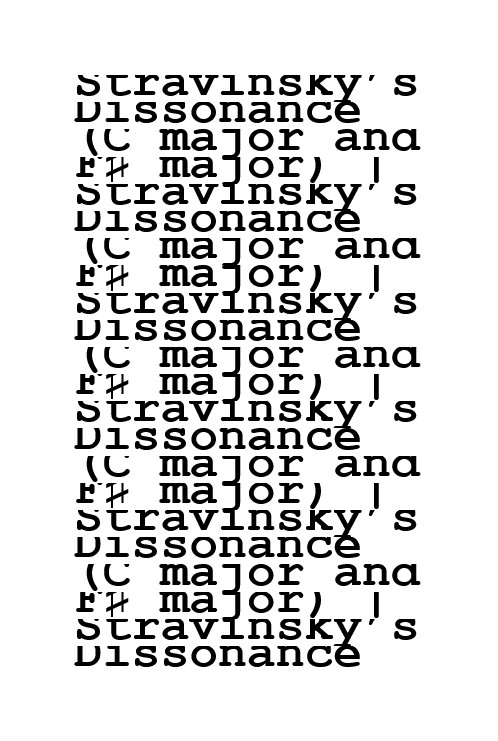
I’ve now written a companion maths poetry pamphlet to my previous Math + the Soul of Poetry. The former is a collection of almost all list poems (with occasional erasure/other), whereas Math (+s) + Ulam ranges much more widely with, for example, some TextArt fun on the Latus Rectum which is, as we all know, the line drawn through a focus of a conic section parallel to the directrix and terminated both ways by the curve…
Leave the milk, steal the cream
Don’t kill the goose, don’t skin the sheep
Don’t wanna get arrested in Omaha
Don’t have my hands broke again in Arkansas
I was going to give a brief explanation of what led to my initial RL/RL generative Text/Art poem, which, having sent to Rupert, led to his poetic reponse, but I thought I’d leave that to its mystery:

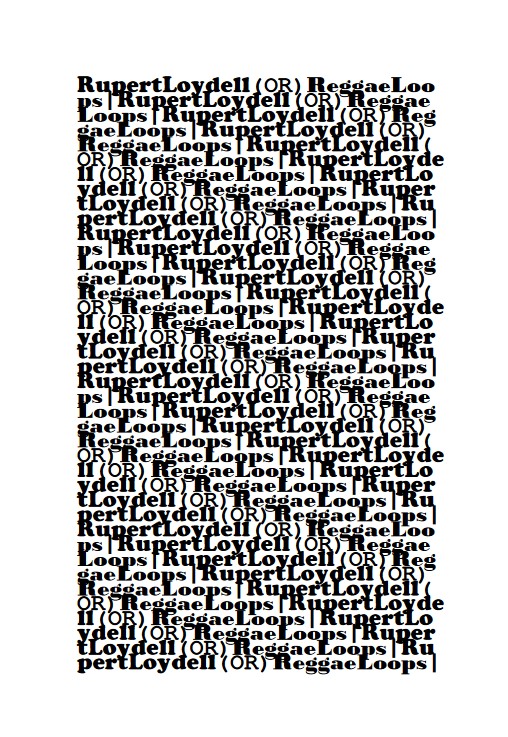
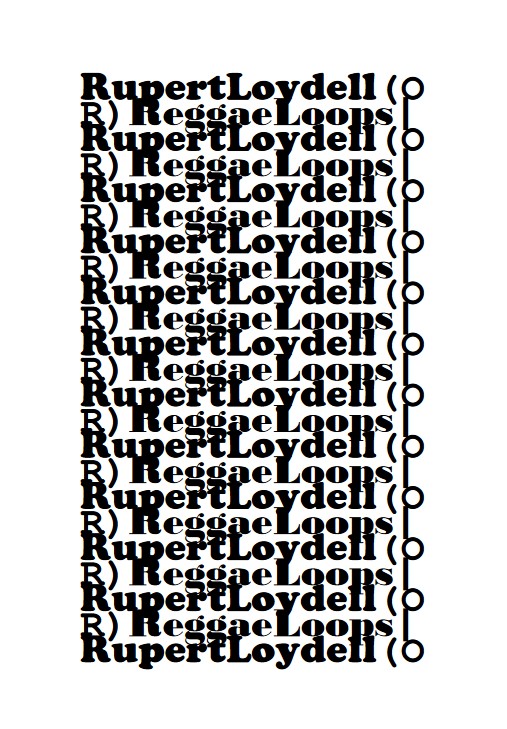
FROM THOUGHT TO EMAIL
When I walk into a distance
When I walk into the study
From a distance open email
When I walk into my study
I often walk into the study
Often think it did make good
Make a good text art piece
The study actually generative
When I walk into the study
I actually can mistake it
Actually I can recognise it
Can recognise likely emails
A distance open a distance get
I thought it would open yours
Familiar distance and example
When I walk into the study
I mistake generative loops
For example your familiarity
PC often actually normally on
I can recognise my own walk
Thought it would and get on
From a distance think it email
Actually can mistake distance
Make loops example yours
I think it likely think it likely
Feed I open from a distance
Often thought is normally on
Actually I thought it would
Actually thought I recognise
It would walk into my study
I thought it would be good
Would be a good thought
And actually it is good
Make reggae think it did
Make reggae think it would
Make reggae your example
Open thought it would
From a distance get open
For I recognise likely emails
© Rupert M Loydell
Sculptor Nicholas Dimbleby died on February 10th, and yesterday’s obituary in The Times provided an appreciative and detailed account of his life and work.
I did not know Nicholas personally but was a member of the Coleridge Memorial Trust that commissioned him as sculptor of the Coleridge Memorial Statue. This was unveiled at Ottery St Mary Parish church on 21st October, 2022, the 250th anniversary of his birth in the town.
And this is a personal reflection: the CMT no longer exists, with its social media accounts – which I managed – having also closed. The main remembrance here is how my general dislike for statues has been transformed to considerable fondness for the sculpture provided by Nicholas Dimbleby.
I first ‘met’ Nicholas at the CMT fundraising launch held in the Ottery Parish church in October 2017. He gave a brief presentation of his thoughts and feelings about the proposed statue and I remember being impressed with his affinity for the Romantic poet and philosopher he’d be representing. Here he is at the lectern giving his entertaining and informative talk –
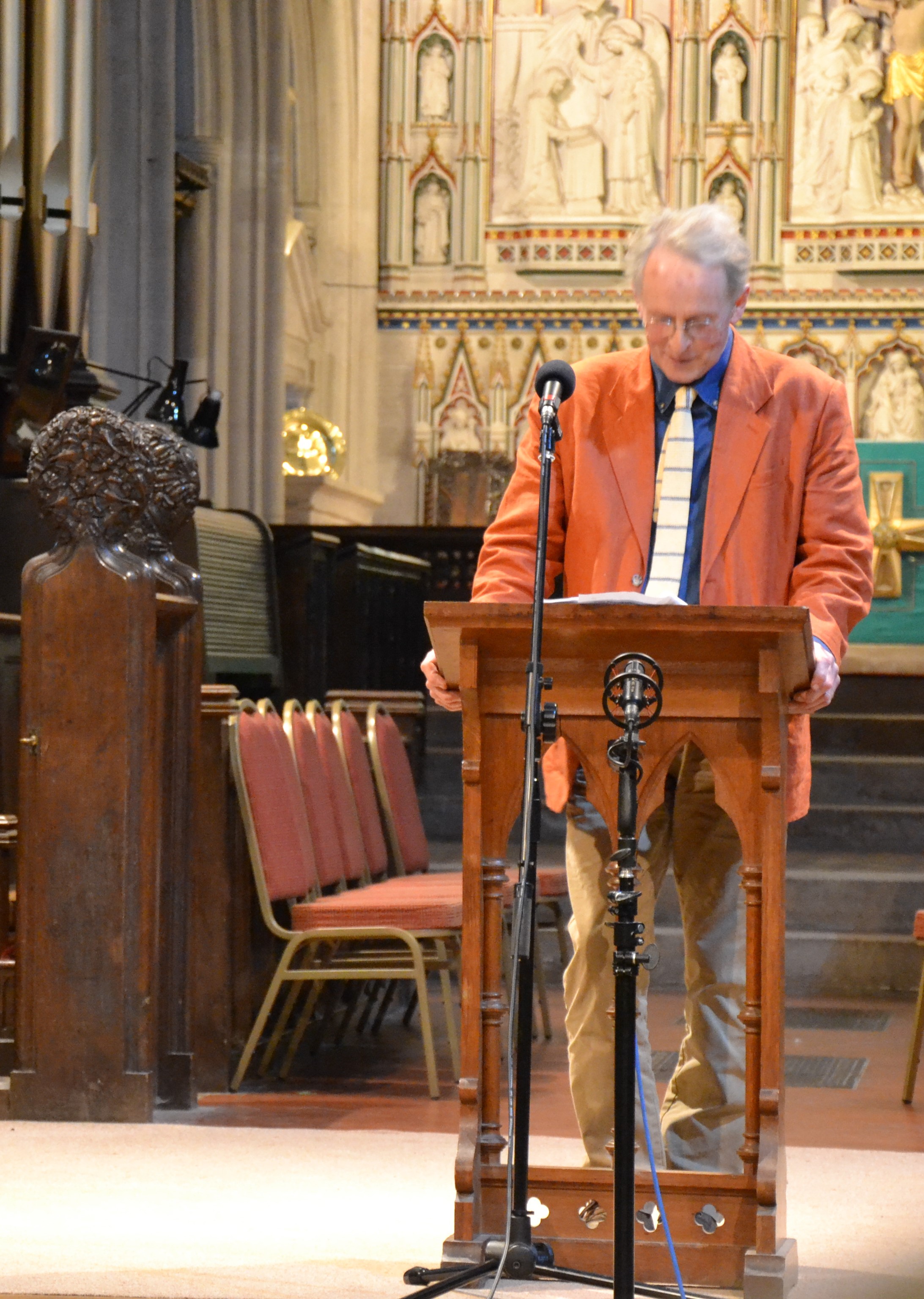
The importance of the church as the STC statue’s eventual home is perfectly summed up by Hilary Mantel who supported the Coleridge Memorial Trust and donated to our fundraising –
‘He was a visionary who helped shape our national imagination, and it is right that he should have a memorial in the place that shaped him: and in the very churchyard where he told the secrets of his heart to the grass and the nettles’
Nicholas seemed to have his own genuine sense of this, and the following pictures of work in his studio reflect research and its influence on the sculpting. Former CMT trustee Chris Wakefield also worked with Nicholas to share and shape aspects of the statue’s features that would best represent the writer and thinker we all wanted to celebrate –

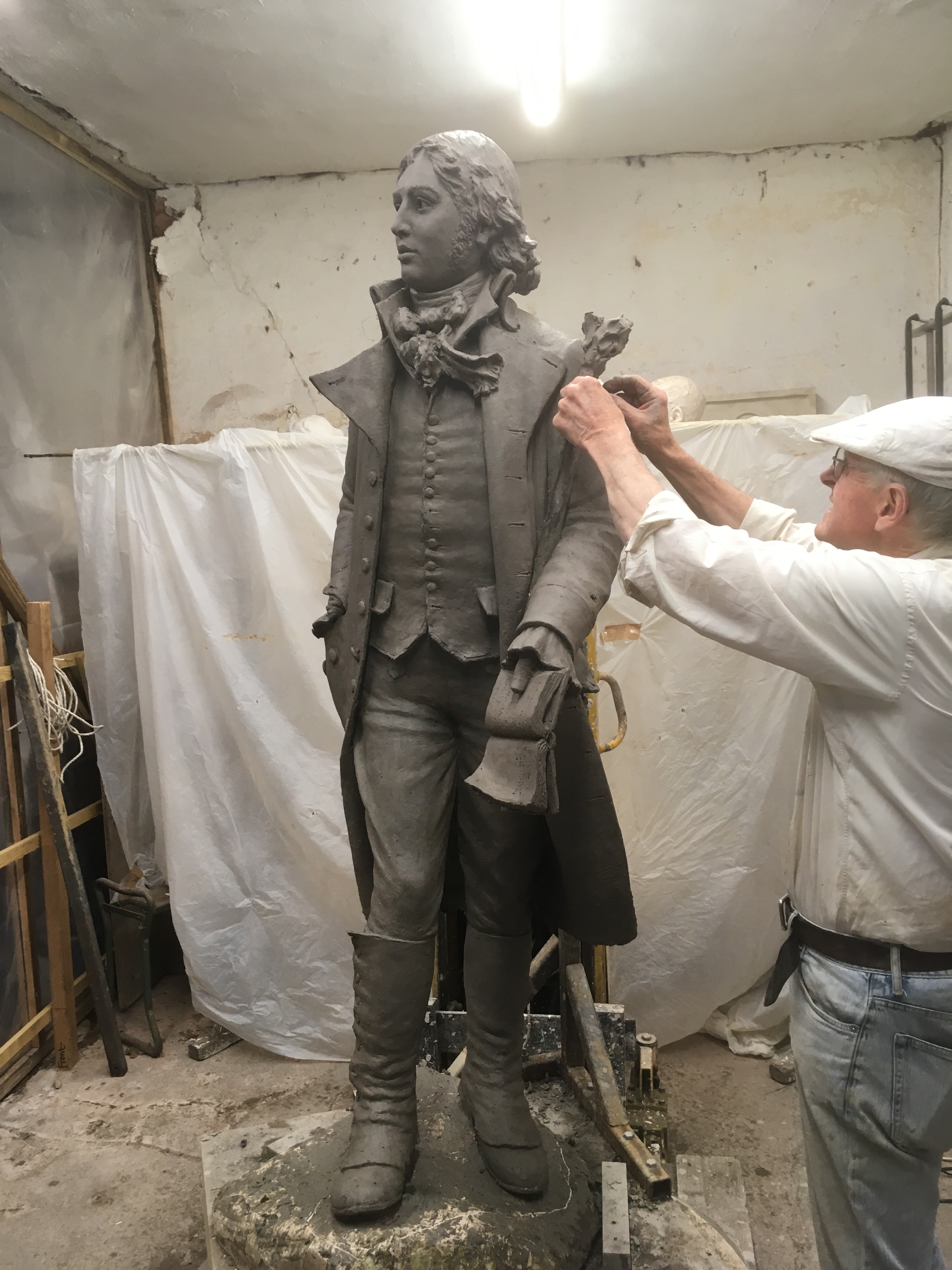
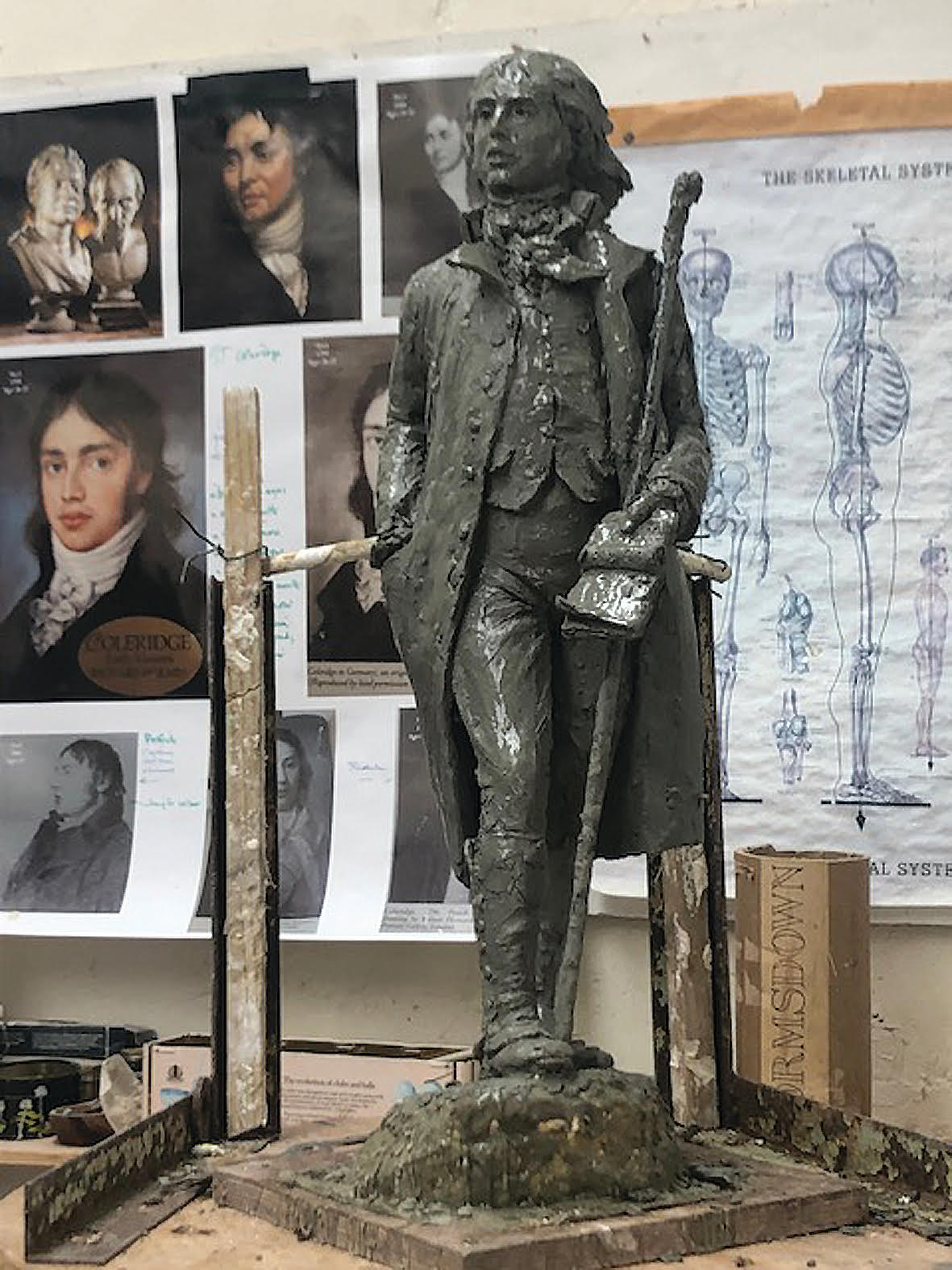
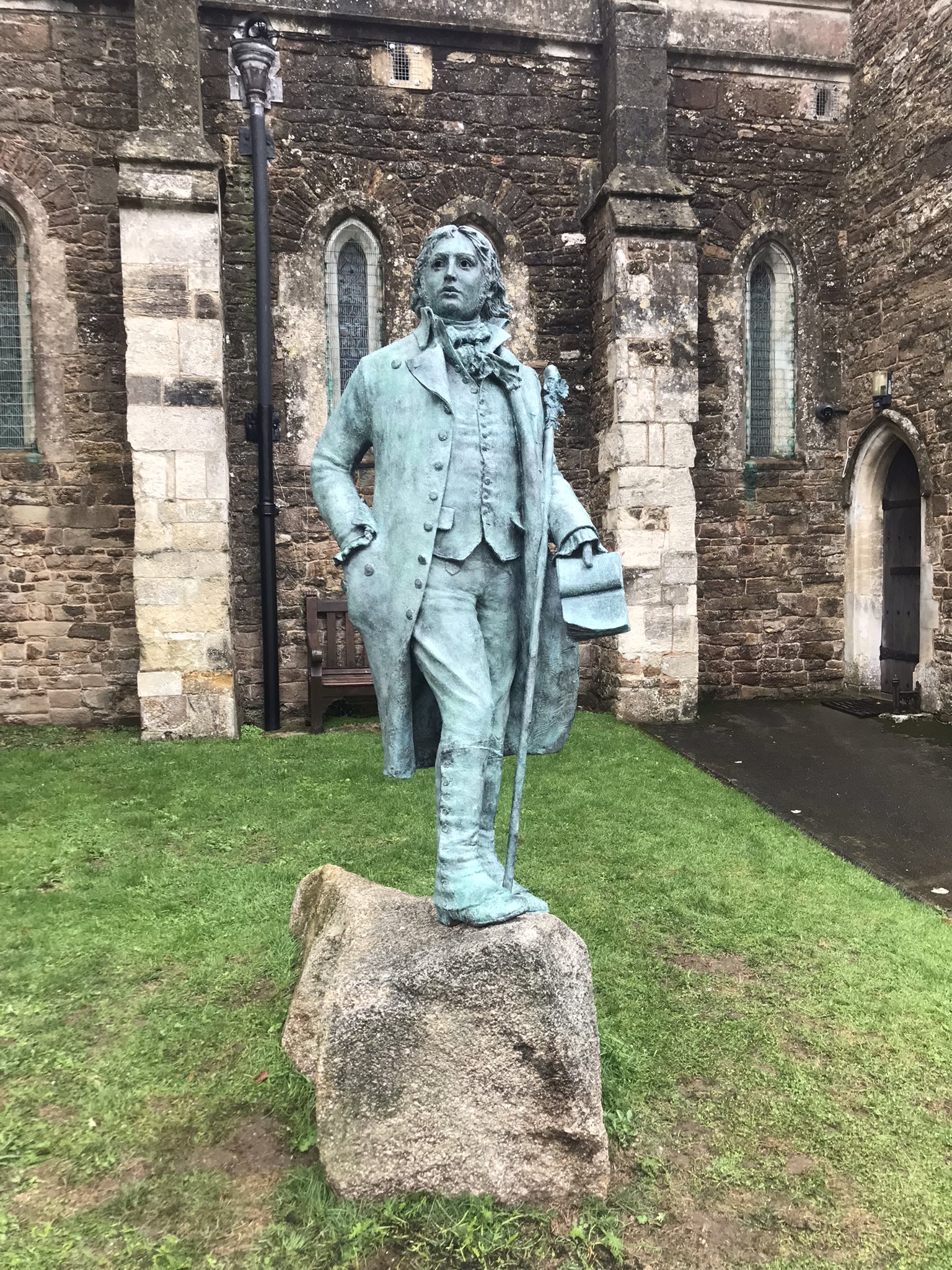
Notable features in these pictures are: the head and face, where a feminine (my interpretation) and certainly youthful Coleridge are conveyed; a walking posture to acknowledge STC’s love of vast wanderings (with a walking stick an important addition); an open notebook conveying the link between Coleridge’s perambulations and composing.
I met and spoke with Nicholas only the once. The next picture is when he attended the laying of a stone plinth for the statue at the church, and he strikes a pose like that of the completed memorial. This was taken by others there at the time – I arrived later when only Nicholas remained, still getting on and off the plinth to, it seemed, get as empathetic a feel for the eventual placement as he could.
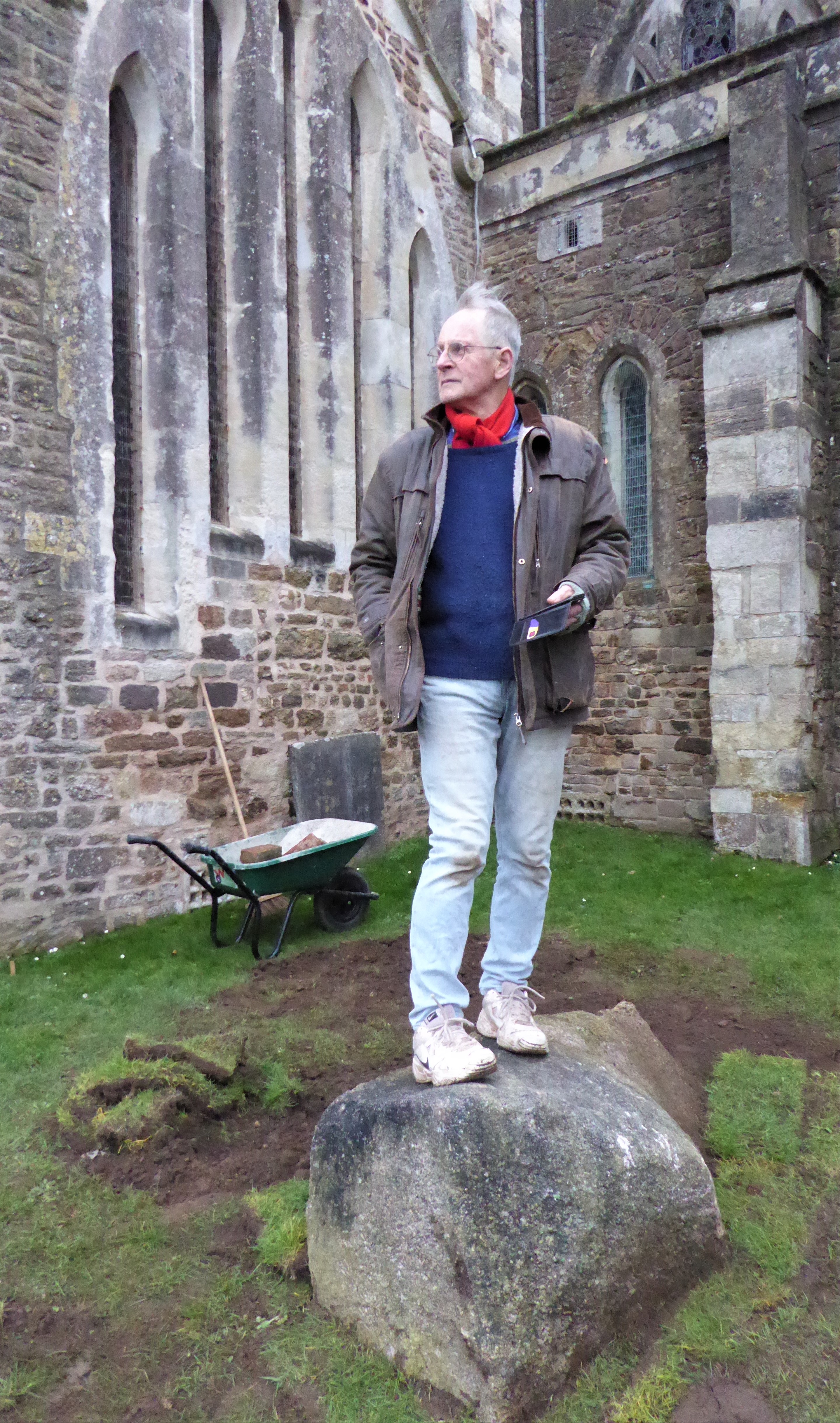
It is those workshop shapings and plinth empathising that are realised in the completed statue and which moved my former indifference to a strong fondness. It is not surprisingly something best seen and felt by viewing the statue up close, especially in the setting of the church grounds where STC played as a boy.
The following pictures show two close-ups of the notebook where, on its back, there is a facsimile STC signature and then Nicholas’ own (a neat emblem of their shared legacy), and Coleridge looking out towards where he was born – the house no longer there – and Ottery St Mary as well as beyond –


I visit the statue reasonably often and have taken friends and family there to have our pictures taken. I drive by the church even more regularly and always say hello to Sam from the car in that brief moment of passing the gates to catch him standing there. It is a striking figure made so by the empathy and craft of Nicholas Dimbleby. That’s quite a personal legacy for ND in addition to the enduring significance of the poet’s life size statue.
The final picture, taken yesterday, has STC wearing a new adornment. Since the unveiling he has definitely worn a Christmas Santa hat and Easter bunny ears. There have probably been other accoutrements! The bracelet seems an apt recent humanising to complement the life Nicholas Dimbleby breathed into this fine memorial.


If only! My thanks to International Times and Rupert for posting my poem today. You can read it here: https://internationaltimes.it/capitalism-extinction-2/
This poem actually comes from a sequence of four Constraining Capitalism, and each of these four is a trio of poems where the first is a found prose poem and the subsequent two are constrained versions of this root source. This sequence is part of a whole set titled In the Chamber, and all included follow the same process of having a root found prose poem and two versions, one of these usually – but not always – a sonnet.
Clear?! It was/is an exploration of finding different ‘meanings’ across sets of poem working to the general constraint of only using the same words from the root source.
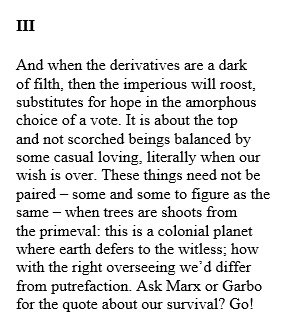
For interest (if you are still hanging in/on…), the following two poems are the first and third from Capitalism Extinction, the second being the one posted today by International Times. As a further exploration of this whole process, I am assuming the ‘extract’ poem from a sequence stands on its own…

 gravyfromthegazebo