Bob Dylan – Nobel Prize in Literature, 2016

dylan

Announced today, I am delighted to see Dylan’s lyrics given the literary recognition they deserve, and by extrapolation, an appreciation of the poetry of many others’ lyrics.

There’s storytelling too, and whilst I could have selected a more obvious example of this from Dylan, I have chosen Sara because it is probably my favourite song of his:

I laid on a dune I looked at the sky
When the children were babies and played on the beach
You came up behind me, I saw you go by
You were always so close and still within reach.

Sara, Sara
Whatever made you want to change your mind
Sara, Sara
So easy to look at, so hard to define.

I can still see them playing with their pails in the sand
They run to the water their buckets to fill
I can still see the shells falling out of their hands
As they follow each other back up the hill.

Sara, Sara
Sweet virgin angel, sweet love of my life
Sara, Sara
Radiant jewel, mystical wife.

Sleeping in the woods by a fire in the night
Drinking white rum in a Portugal bar
Them playing leapfrog and hearing about Snow White
You in the marketplace in Savanna-la-Mar.

Sara, Sara
It’s all so clear, I could never forget
Sara, Sara
Loving you is the one thing I’ll never regret.

I can still hear the sounds of those Methodist bells
I’d taken the cure and had just gotten through
Staying up for day in the Chelsea Hotel
Writing “Sad-Eyed Lady of the Lowlands” for you.

Sara, Sara
Wherever we travel we’re never apart
Sara, Sara
Beautiful lady, so dear to my heart.
How did I meet you ? I don’t know
A messenger sent me in a tropical storm
You were there in the winter, moonlight on the snow
And on Lily Pond Lane when the weather was warm.

Sara, Sara
Scorpio Sphinx in a calico dress
Sara, Sara
You must forgive me my unworthiness.

Now the beach is deserted except for some kelp
And a piece of an old ship that lies on the shore
You always responded when I needed your help
You gimme a map and a key to your door.

Sara, Sara
Glamorous nymph with an arrow and bow
Sara, Sara
Don’t ever leave me, don’t ever go.

It will over the coming days be interesting to read of undoubtedly both the pleasure in or rejection of Dylan and lyrics receiving this accolade. I simply reflect on how it was precisely this kind of emerging song lyric as well as modern poetry of the 60s that fired my interest in literature in general, and poetry specifically. Lyrics that became increasingly surreal and in reality meaningless which played a part in breaking down the barriers inherent in literary convention/expectation because they were so popular and widely heard.

Seeing Ginsberg in the iconic film of Dylan’s Don’t Look Back and the song Subterranean Homesick Blues is only one example of the merging of poetry and lyric writing, though I wasn’t as a teenager at this time that much of a student of Dylan. I grew up on the lyrics of the Beatles and Hendrix and a range of ‘psychedelic’ bands and their songs, but also the poetry of Penguin’s The Mersey Sound, The New American Poetry and the 1969 collection Children of Albion – Poetry of the ‘Underground’ in Britain, this latter I mention with enthusiasm as I have just replaced my previously lost original with a secondhand copy and have been reading these past few days.

So I say again I am delighted with this recognition of Bob Dylan as a songwriter with the citation for having created new poetic expressions within the great American song tradition.

I’ll finish on this one as it is more in the poetic than narrative style, though it is obvious Dylan’s recognition is for a body of work rather than singular songs:

It’s Alright, Ma

Darkness at the break of noon
Shadows even the silver spoon
The handmade blade, the child’s balloon
Eclipses both the sun and moon
To understand you know too soon, there is no sense in trying

Pointed threats, they bluff with scorn
Suicide remarks are torn
From the fool’s gold mouthpiece the hollow horn
Plays wasted words proves to warn
That he not busy being born is busy dying

Temptation’s page flies out the door
You follow, find yourself at war
Watch waterfalls of pity roar
You feel to moan but unlike before
You discover that you’d just be one more person crying

So don’t fear if you hear
A foreign sound to your ear
It’s alright, Ma, I’m only sighing

As some warn victory, some downfall
Private reasons great or small
Can be seen in the eyes of those that call
To make all that should be killed to crawl
While others say don’t hate nothing at all, except hatred

Disillusioned words like bullets bark
As human gods aim for their mark
Made everything from toy guns that spark
To flesh-colored Christs that glow in the dark
It’s easy to see without looking too far that not much is really sacred

Our preachers preach of evil fates
Teachers teach that knowledge waits
Can lead to hundred-dollar plates
Goodness hides behind its gates
But even the President of the United States
Sometimes must have to stand naked

An’ all the rules of the road have been lodged
It’s only people’s games that you got to dodge
And it’s alright, Ma, I can make it

Advertising signs that con you
Into thinking you’re the one
That can do what’s never been done
That can win what’s never been won
Meantime life outside goes on all around you

You lose yourself, you reappear
You suddenly find you got nothing to fear
Alone you stand with nobody near
When a trembling distant voice, unclear
Startles your sleeping ears to hear
That somebody thinks they really found you

A question in your nerves is lit
Yet you know there is no answer fit
To satisfy insure you not to quit
To keep it in your mind and not forget
That it is not he or she or them or it that you belong to

Although the masters make the rules
For the wise men and the fools
I got nothing, Ma, to live up to

For them that must obey authority
That they do not respect in any degree
Who despise their jobs, their destinies
Speak jealously of them that are free
Do what they do just to be
Nothing more than something they invest in

While some on principles baptized
To strict party platform ties
Social clubs in drag disguise
Outsiders they can freely criticize
Tell nothing except who to idolize and say, “God bless him”

While one who sings with his tongue on fire
Gargles in the rat race choir
Bent out of shape from society’s pliers
Cares not to come up any higher
But rather get you down in the hole that he’s in

But I mean no harm nor put fault
On anyone that lives in a vault
But it’s alright, Ma, if I can’t please him

Old lady judges watch people in pairs
Limited in sex, they dare
To push fake morals, insult and stare
While money doesn’t talk, it swears
Obscenity, who really cares propaganda, all is phony

While them that defend what they cannot see
With a killer’s pride, security
It blows the minds most bitterly
For them that think death’s honesty
Won’t fall upon them naturally
Life sometimes must get lonely

My eyes collide head-on with stuffed graveyards
False goals, I scuff at pettiness which plays so rough
Walk upside-down inside handcuffs
Kick my legs to crash it off
Say, “Okay, I have had enough, what else can you show me?”

And if my thought dreams could be seen
They’d probably put my head in a guillotine
But it’s alright, Ma, it’s life, and life only

Sara and It’s Alright, Ma lyrics © Bob Dylan Music Co.

Have I Got News for Nick Clegg’s Underpants

clegg-copy

I have just caught up with and watched last Friday’s Have I Got News for You hosted by Nick Clegg, and what a smug, mock-coy arrogant tosser he proved himself to be.

Ever the self-publicist, Clegg played the embarrassed-if-knowing sham whenever his suspect past deeds were alluded to, and it was quite nauseating to watch this self-serving, pseudo self-deprecation. It certainly wasn’t funny.

Not funny in the way I commented here on his similar attempts at humour in his recent political autobiography, especially about Michael Gove and the light-hearted ways he referred to Gove’s nastiness. The hypocrisy of Clegg was evident in the way he was more than keen to indulge in highlighting a clip about Gove and his underpants. Gove doesn’t deserve any favours in any forum and should forever be on the receiving end of others’ treachery, but it simply displayed more of Clegg’s duplicitous nature in his delight at mocking someone he was recently obsequious in defending.

Nebraska 17 – ‘La Nebraska’ by Lenora Castillo

From Tide-water baptism. Digital Repository @ Iowa State University, 1998

The promise of work brought my family north
crossing the never ending Texas plain in a tarp-covered truck.
Torn from a long tradition of family gatherings,
bodas, quinceañeras and christenings
we watched in silence
as the undulating heat made the miles of highway disappear.

My mother, feet swollen and pregnant
stood beside my father, four children pressed around her.
Other families, exchanged words of encouragement
and made promesas to the saints for a safe, fast trip
but there was always another town,
a few more miles.

n Colorado, long rows of barracks-like buildings
welcomed us as we stepped off the truck.
Questions of “who can work” quickly reduced our family
to tally marks on a clipboard: 4 workers, 2 babies
Sleep eventually caught up with us as we inched our way
through food lines, blanket lines.

The first truck, bound for Montana came and went,
its quota filled, leaving behind disappointed faces
and talk of the next one, the next one will be for us.
Children laughed and played,
making friendships that could last days
if they were lucky, hours if they weren’t.
Two weeks went by, another truck arrived.
Single men, couples and families (my family) boarded.
filling a wish-list from farmers in a state called Nebraska.

Nebraska, people whispered, a place where snow drifts
can get higher than a person’s head
and sometimes, over the roofs of the field laborers’ houses,
summers so hot, that paint on cars fade.
But that promise of work urged us north.

Easter, 1950.
We arrived on a small farm in the middle of nowhere.
Here, the air was clear and fresh like the ice cold well-water
that quenched our thirst. Scotts Bluff Monument,
a dark apparition rising from the flat prairie,
silently watched us through the cracks in our walls.

Nebraska
a good place to work and raise children my parents decide
but the others packed their belongings,
afraid of the snow and ice of winter and tornadoes
that fall out of the sky like thin black snakes from a torn gunny sack.
We promised to carry on the traditions: family gatherings, bodas,
quinceañeras and christenings. No they said.
There are no barrios here, no corner drug stores.
No hay gente…
There is nothing but the wind that moans like the Llorona
looking for her children.

We watched in silence as they disappeared in the undulating heat.

A simple connection for me is with the observation about the winter snow and the summer heat: both so true. I remember well the significant snowfalls, and the humid heat of summer; also the tornadoes, though never in one, but I spent a number of nights in the basement of our various houses during summer tornado warnings, recalling especially one in Norfolk after the sirens had sounded and, in the morning, finding my childhood swing-set destroyed by a fallen garden tree.

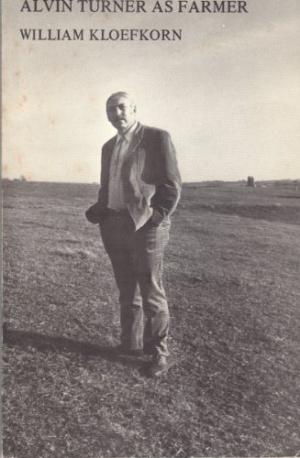
Nebraska 16 – a poem from ‘Alvin Turner as Farmer’ by William Kloefkorn

alvin

I am a dirt farmer
Who dreams of poetry.
Is that so strange? Is anything?
I have bent myself thankfully
Over the heat of cowchips.
When the Lespedeza flowers
I breathe its blooms
The calf I winch to birth
Grows legs like oaks to graze on,
And stuck hogs bleed for breakfasts.
This morning at milking
I kiss the cow’s warm flank
And she kicked the milk to froth beneath my knees.
I forgave her,
Then cried with the cats.
Now the manure is in bloom,
Thistles defend the driveway,
And corncobs gird the mud beneath my boots.
Plotting harvests,
I roam my acreage like a sweet spy.

William Kloefkorn was born in Kansas but lived in Nebraska and was the first Nebraska State Poet. This is from his first poetry collection, Alvin Turner as Farmer, and is about a Kansas farmer, but the geography of place doesn’t matter as much as the geography of land. I’ve been reading a few of these poems today, and whilst they seem to concern themselves with the daily routines and simplicity of farming, they are clearly also dealing with the complexities of living as seen through the deceit [conceit] of that farming frame. I will post another at a later date.

Rabbit, Still Running

Or more accurately, I am still reading John Updike’s Rabbit, Run. I had a short break away from home and forgot to take the book; also, I am a sunshine reader and as it is October there is less of it and I do not get outside to sit and read as much as I can and do in the summer. Yesterday and today there has been fine morning sunshine and I was back to reading the book on my front lawn, a table set for coffee too, but the afternoon sun sets behind ridiculously tall conifers at the back garden by about 3pm. Therefore, I am taking a long time to read this novel.

A few observations for this reader’s dairy today: my internal jury is wobbling on a verdict about Updike’s skills as a writer, as magnificent as they clearly are. As previously commented, his wordiness is astonishing and usually brilliant, but the sheer relentlessness of it can be wearing and even distracting – one wants to move on from some seemingly excessive elaboration to the advancement of the storyline. There’s also the personal liking I have for the American narrative voice which is simple and direct and devoid of the literary flourishes – I mean in the modern sense – and Updike is not a member of this fraternal style.

But I do nonetheless get blown away at times by the intensity of his observations and their many insights. Before providing an example of this, I will comment on an aspect of the book’s exploration of sexuality, specifically that of Rabbit and Ruth, and an apparent macho embrace of this, no doubt very much a product of its time, written in 1960. Like so much I think and then write about at the moment, this observation is prompted by the contemporary ‘locker-room’ talk of Donald Trump whose crude misogynist language and actions is dominating the current presidential election campaigning.  Updike doesn’t  engage in similar, though there are times when he is sneaking around in the corridor outside, and one long narrative that does reflect from Ruth’s point of view a female control of sexual discovery as a teenager is still steeped in the male world of this.

A short extract I want to illustrate now is a wonderful authorial insight into the behaviour of children, in this case two brothers who are arguing and fighting. Updike, through his character the preacher Eccles, understands so well the pain of a child’s defeat – a child who has suffered the propulsive power of a wrong – and also, at the end of the extract, how quickly this is resolved:

rab-still-run

I like the humour in the closing observation about Nelson’s quick ‘recovery’ from being hit on the head by the toy truck, and also how Eccles sitting in his insubstantial lawn chair is personally affected by the universal readjustment of this whole episode. This is clever without being superfluous in the telling. Time after time Updike provides these seemingly insignificant views, but they always bristle with knowing.

Photo of Mom

I see them standing
at the tight tomorrow

certain of growing older,
holding hands.

I say it is decided
where they are kids

but do not fear hope.
I say it is decided

but not in knowing
they are about to go into

that white space where
time is as if tomorrow.

Holding hands and
to not know want,

confident something is coming.
Mother, hold on,

it is okay to not know.
It will come.

Small, Existential Triumph

I am driving home on the dual carriageway. I have the car set on cruise control at 60 mph as I am not in a hurry.

I see in my rear view mirror a minibus approaching slightly faster than me and as we are about to go into a dip before there is a long hill climb up the carriageway. I know the driver will want to maximise the speed in that dip to help ‘slingshot’ the heavier vehicle up the lengthy incline. I consider going faster myself to allow the driver to make that increase in speed, but decide it’s not for me to make any adjustments. I’m on cruise, as I say, and quite content to stick at my speed in my lane, which is my right.

Sure enough, I see the minibus pick up a little speed, get near to the back of my car, but by this time we are moving out of the dip and up the hill. The minibus begins an attempt to overtake, but the cruise control keeps my speed at that constant 60 mph, and the driver in the minibus drifts back and has to pull in behind.

All the way up the hill the minibus is barking at my heels, matching my speed, and making one of those gestures motorists make when it hasn’t worked out for them. A gesture with the minibus rather than anything else. Indeed, the driver keeps both hands on the wheel throughout. But I can tell the driver is miffed by sticking so close. I don’t care. I’m cruising home, not having to make any adjustments, and at ease with things.

At the top of the long hill and just as the road levels out there’s my turning left to go home. The minibus is beginning to gain some speed, and I do put my indicator on so the driver doesn’t need to make another attempt to overtake, knowing I will be out of the way in a moment. As I move into the sliproad, the minibus begins to pass on the right. In fact, it’s at this point I confirm it is a minibus, rather than a van. I also then see the name of the minibus owner printed down the side, and I read as it passes slowly by, finally on its way having been kept in check by my determination not to alter my speed or course: Torquay Boys Grammar School.

Not an exhilarating win, but a small, existential triumph.

Degrees of Treachery in British Political Parties

UKIP: Former leader Nigel Farage with a consistently negative rhetoric about foreigners/immigration has clear, singular impact on Brexit vote through the fear/anxiety generated by this; ‘new’ leader of Party Diane James resigns after 18 days; prospective next leader of the Party Steven Woolfe has altercation with senior colleague Mike Hookam and is hospitalised

Conservatives: current leader and Prime Minister Theresa May is elected by default when there is no opposition [also not elected by public to be PM]; senior Minister Michael Gove involved in blatant treachery during election campaigning; senior Minister Boris Johnson is instrumental in arguing for Brexit but evidence subsequently suggests he did not believe in/support this; Panama Papers reveal large number of Tory members with offshore financial dealings

Labour: Jeremy Corbyn is elected as Leader of Labour, twice, with massive majority on a mandate that reflects years’ of consistent and principled following; there are resignations from Shadow Cabinet posts and significant bickering within Party about political differences

Much could be added to each of these three snapshot views, and much I think to flesh out precisely the line I have taken here, elaborating on and consolidating the view reflected. I also accept others could select and present different information and viewpoints, but I firmly believe the essence of what I have presented is accurate.

The media representation of the differing levels of treachery and incompetence and infighting within these three political parties seems to me to focus mostly on Labour. I could of course be sensitised to this, but I genuinely feel the bias against is there. An example today was on the BBC lunchtime news: in looking at Corbyn’s emerging new shadow cabinet, the lead-in to this was about the apparent conflicts already emerging, rather than reporting the names and positions. A similar report occurred the day after Corbyn’s recent re-election: the BBC reported that a meeting of Labour First [‘Labour moderates’] held a meeting at a pub and, as stressed, so many attended they had to spill out into the street. Well, it was just a pub…..! I have written quite a detailed account of another similar example here.

I haven’t even mentioned Nick Clegg.


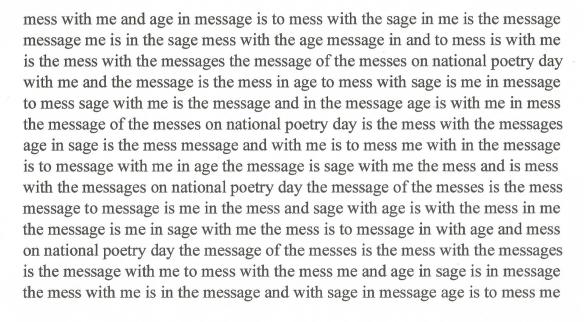
Messages for Facebook Friends

I send this message to my Facebook friends
hoping our like-ship never ends,
the agreeing comments and sharing too,
this approbation which comes through you.

I send this message to my Facebook friends
keen to join in one of the popular trends:
it’s National Poetry Day so I’m writing in verse,
my own ideas and not a newspaper search.

I send this message to my Facebook friends –
not the causes my posting usually defends,
and rather than a sonnet this set of quatrains
with digs at social media its satirical refrains.

I send this message to my Facebook friends
like a surviving library with books it still lends
after cuts – sorry, I fell in an onomatopoeic trap
of sharing heartfelt ideas others consider crap.

I send this message to my Facebook friends
without pictures of mac ‘n’ cheese or burnt ends,
no towering burgers, or platters of ribs and steak,
but a selfie of me in a hot-tub at a seaside break.

I send this message to my Facebook friends,
a public act of trust for the privacy it transcends:
insights or just asides perhaps best left unsaid
if adrift in cyberspace unliked as if an undead.

I send this message to my Facebook friends
with an apology to make some amends
for a preceding stanza so stark and serious
when it isn’t de rigour to post the imperious.

I send this message to my Facebook friends
hoping its mix of wry truths recommends
poetic warm readings with an incline to care,
tasty memoranda a metaphor to tear and share.


Sharing this here, a NPD poem I posted on Facebook: in a previous posting I urged people to ‘message’ poems to one another, this being about as apt a facility out there to fully utilise the theme of messages for this day. I’ll never know how many did.