Reading ‘Stoner’ by John Williams: the Empathy of Ennui and Endurance

stoner

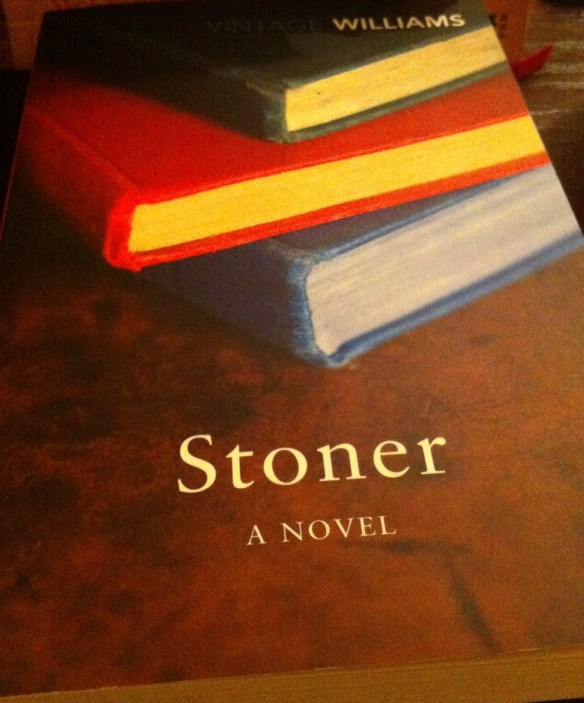
Reading John Williams’ Stoner has been an emotional experience. I initially struggled with the pervasive sadness and darkening tone, the latter a relentless characteristic of the narrative whilst the theme of a personal pathos was one that other writers have championed as its paradoxically ‘beautiful’ appeal, expressed as such on the back cover blurb of my Vintage Classics edition:

A terrific novel of echoing sadness – Julien Barnes

democratic in how it breaks the heart… – Colum McCann

A brilliant, beautiful, inexorably sad, wise and elegant novel – Nick Hornby

I have read and enjoyed novels of greater tragedy, thinking immediately of quite different examples like John Steinbeck’s The Grapes of Wrath and Somerset Maugham’s Of Human Bondage – sticking in my mind as being powerfully affecting, though both read in my youth – and there are many more that I have read then and obviously as an adult when I could increasingly relate to the human experience reflected. There are clearly thousands and thousands of other lasting examples.

I say ‘enjoyed’ as one does, but it is an ironic observation about texts like these and Stoner, and I have used the expression automatically but also because of this singular exchange from John Williams which was made in a 1985 interview with Brian Wooley who asked him

And literature is written to be entertaining?

to which Williams replied

 Absolutely. My God, to read without joy is stupid.

Terms like ‘entertaining’ and ‘joy’ do not readily equate with the emotional experience of reading Stoner. There are moments of minor triumph that do prompt the latter, though this is a relative response, and the utterly transient nature of any happiness or ‘joy’ is despairing, certainly at first. It is later in the story simply inevitable.

But this concern with upbeat tags is in many ways peripheral because we understand such paradoxes and ironies are the substance of engaging with great literature. My personal response echoes these uncertain considerations: the first is more noticeably marginal in explaining my overall experience; the second is deeper.

I came to reading Stoner after devouring four Jim Thompson noir novels – and before that a Larry Brown short story collection – so their exaggerated storylines of brutality, deception, gratuitous experiences [sexual and violent, often combined], revenge, and even surreal conclusions are worlds away from John Williams’ book set mainly in the University of Missouri and its immediate environs and spanning the two World Wars. It therefore took a while to incline myself both intuitively and through the power of William’s storytelling to the comparatively mundane if nonetheless profound experiences of William Stoner. Where the pulp noir provided an often vicarious thrill, Stoner transferred an empathy of ennui.

My deeper experience was one of growing identification. I know the immediate connection I am about to make is tenuous, but that is how great literature truly engages – when we see/understand something of ourselves in what we are reading. Accepting the superficiality: William Stoner moves from a farming background to education and teaching, the latter discovered through a growing appreciation of literature he learns when first attending university to study agriculture. I came from working on a farm that I thought would be a lifelong career to also study and become a teacher.

I said it would be tenuous and superficial. But I am not ashamed to say that I felt goose-bumps [a classic literary connection…] when I read the following, very early in the story. Having now changed from studying agriculture to literature, Stoner is having a discussion with Archer Sloan, an instructor at the university at the time, and a mentor as well as friend of sorts – not that Stoner really has many friendships – who tells him an important revelation:

“But don’t you know Mr Stoner?” Sloan asked. “Don’t you understand about yourself yet? You’re going to be a teacher.”

Suddenly Sloan seemed very distant, and the walls of the office receded. Stoner felt himself suspended in the wide air, and he heard his voice ask “Are you sure?”

“I’m sure,” Sloan said softly.

“How can you tell? How can you be sure?”

 “It’s love, Mr Stoner,” Sloan said cheerfully. “You are in love. It’s as simple as that.”

And of course he means in love with literature. Stoner does become and remains an English teacher, later assistant professor, throughout his whole life. He is industrious – a main theme in the story – and at times influential and even animated, but we are never given the impression that he is inspirational. This is not a story upon which Robin Williams as teacher John Keating in Dead Poets’ Society could be based.

There is of course much more with which I identify, especially as the older reader I am now and experiencing a life that has had its own demands for stoicism and acceptances – certainly no more than many have to accommodate in their lives, but enough.

Williams is fated to his enormous share of failures, most not of his making, and many caused by those who should be closest to and supportive of him. Even his marriage is doomed, and the following is an example of that relentless narrative describing inevitable problems and decline:

And so, like many others, their honeymoon was a failure, yet they would not admit this to themselves, and they did not realise the significance of the failure until long afterward.

They arrived in St Louis late Sunday night. On the train, surrounded by strangers who looked curiously and approvingly at them, Edith had been animated and almost gay…

Almost gay! This is the story of Stoner’s life, to only become occasionally and fleetingly happy, though this is not even about him. There is a tenderness in the way Williams does continue here and describe the inability to consummate their marriage that night, a portrait of a stereotypical anxiety and naivety from two virgins, and we as readers empathise as we will do on many more occasions. But Edith’s later evil treatment of William, especially the way she alienates their daughter from him as well as appropriating and altering anything originally belonging to William and having offered him some limited comfort and security, is one of the major and withering battles he has to fight and ultimately lose. He also loses because he simply acquiesces to the mistreatments. It is a manifestation of both his stoicism and his temerity.

The single sustained joy in Stoner’s life is his love for and affair with Katherine Driscoll, but this lasts no more than a year, if that. When we read of their shared passion it is such a genuine delight at that precise point, but we know it is doomed. From the very beginning. And it is ended mutually, but this has been brought about by the interference of another evil character in the story, Hollis Lomax. He, along with a student Charles Walker – and to some but lesser degree his daughter Grace – also conspire to ruin Stoner’s life, and we are naturally, painfully angered by this which is what engages so powerfully despite the inevitabilities of their victories. Maybe more so because we know the outcome and thus have our anger neutered by this.

It will be obvious from all I have written what an emotive experience reading Stoner is. To do so we have to acquire an emotional endurance which is the essence of Stoner himself, and this is our painful empathy. As I have said, and for slight but also deep reasons, it took me some time to make this acquisition. As with any literary tragedy, the qualities that make it bearable and indeed uplifting are in its expression, and whilst not particularly poetic, there is a consistent honesty in the narrative, and the measured way in which this is sustained becomes itself a calm, palpable tone and we are wrapped within it, suffering too but completely controlled by its sense of normalcy.

There is wisdom too. Stoner’s personal suffering is framed within the two World Wars and that universal suffering. Although never occupying much in the storyline, death and destruction become a backdrop, and Stoner loses one of his only two friends Dave Masters to the First World War, and he witnesses the further diminution and ultimate death of Archer Stone after the Second World War.

With Stoner’s epic endurance in life comes a personal wisdom and it is this which presents nobility transcending his stoic suffering. It is this nobility which we as readers take as the reward for our enduring the moments of strain in reading. Williams presents this throughout the novel but also in the following with a calm formality that belies its significance. I can’t quite see the expression or the knowing as ‘beautiful’. But I do accept it as hugely rewarding to have witnessed and lived with during reading:

In his extreme youth Stoner had thought of love as an absolute state of being which, if one were lucky, one might find access; in his maturity he had decided it was the heaven of a false religion, toward which one ought to gaze with an amused disbelief, a gently familiar contempt, and an embarrassed nostalgia. Now in his middle age he began to know that it was neither a state of grace nor an illusion; he saw it as a human act of becoming, a condition that was invented and modified moment by moment and day by day, by the will and the intelligence and the heart.

Measuring Inward Worth by Outward Standards

Further to my previous posting I have noted another salient quote by Edward Holmes from his book What Is and What Might Be, where he is writing a critique in 1911 of what is fundamentally wrong with our education system in this country:

In my attempt to account for the failure of elementary education in England to foster the growth of the educated child, I have travelled far. But I must travel farther yet. The Western belief in the efficacy of examinations is a symptom of a widespread and deep-seated tendency, – the tendency to judge according to the appearance of things, to attach supreme importance to visible “results”, to measure inward worth by outward standards, to estimate progress in terms of what the “world” reveres as “success”. It is the Western standard of values, the Western way of looking at things, which is in question, and which I must now attempt to determine.

As if to reassure but also add to the anger and annoyance that such criticism has existed without remedy for so many years, I have just read in the Introduction by John McGahern to John Williams’ wonderful novel Stoner the following where he writes about an interview Williams gave to Brian Wooley in 1985. This key reference to what was said in that interview reflects poignantly if fleetingly on these thoughts about education here in the UK both historically and, despairingly, in the present. It is the first and brief part of the extract that does this, and whilst Williams is referring to university education, it is still applicable as a general view of the detrimental ideological impact on all levels of education

Pressed towards the end of the interview he [Williams] complains about the change away from pure study towards a purely utilitarian, problem-solving way of doing things more efficiently, both in the arts and sciences, all of which can be predicted and measured.

The rest of the extract I am quoting here is more to do with the study of literature, but is making a similar point. I am quoting this too in advance of writing a review of the novel Stoner, especially the notion of it being ‘entertaining’ and a ‘joy to read’:

Then, more specifically, Williams complains about the changes in the teaching of literature and the attitude to the text ‘as if a novel or poem is something to be studied and understood rather than experienced.’ Wooley then suggests playfully, ‘It’s to be exegeted, in other words.’ ‘Yes. As if it were a kind of puzzle.’ ‘And literature is written to be entertaining?’ Wooley suggests again. ‘Absolutely. My God, to read without joy is stupid.’

Our Conception of the Meaning and Value of Life – Edmond Holmes

Another ‘Your Memories on Facebook’ prompting, from 2012, the following comment from me then demonstrates a few things: that I am consistent in my political sharing there, but more importantly, and sadly, that in 1990 yet even well before this in 1911 – so spanning over 100 years to now – the serious concern expressed about how education in this country is being destroyed by the obsession with academic measurements [think May’s current grammar-school ideology] has done little to halt the progress of that dangerous dogma:

Paddy Creber, former Senior Lecturer at Exeter University School of Education, writing critically back in 1990 of the then calls for ‘rigour’ in changes to teaching and examining, especially in English, cites in support of his despair at this the writing of Edmond Holmes who himself despaired of similar dangerous educational rhetoric further back in the 1862-98 period: ‘to show that the externalism of the West, the prevalent tendency to pay undue regard to outward and visible ‘results’ and to neglect what is inward and vital, is the source of most of the defects that vitiate Education in this country, and therefore that the only remedy for these defects is the drastic one of changing our standard of reality and our conception of the meaning and value of life’.

Grammar Schools and the Political Posturing of May, Gove and Osborne

I would never apologise for the honesty of my anger and despair when commenting immediately on this blog about Theresa May’s proposals to re-introduce grammar schools widely into the state education system. On reflection, my lengthy angst was probably unnecessary, though its expression was at the very least cathartic for me, and I would hope of interest in contributing to the argument against her proposals to anyone interested.

I say ‘unnecessary’ in as much as I increasingly feel she will not achieve her ambition, but also because the wider public backlash and arguments against, much from within her own Party, will have more impact in making sure she does not achieve that goal.

As the weeks have passed, it does seem that May has made a huge political mistake in laying so bare a highly personal idea [and as I said at the time, an ideological and dogmatic one] before the public, exposing poor judgement as a leader. At an immediate and pragmatic level, this meant she performed poorly against Jeremy Corbyn at the most recent Prime Minister’s Question Time, and in the longer run it has generated a widely publicised debate on education which has ironically for her exposed significant evidence against her claims that grammar schools can provide social mobility and justice, especially for students from ‘poor’ backgrounds.

Perhaps one of the more comically loathsome outcomes has been the backing for her views by Michael Gove, former Secretary of State for Education and now publicly notorious back-stabbing Machiavellian MP. It is the most naked demonstration of his desire to resurrect some political favour from the ignominy of his current Tory banishment, and it will, one hopes, cast an inevitable sickly shadow over May’s poor judgement when she can really only muster support from the likes of this has-been.

The fact that George Osborne has spoken out against May’s grammar school ambitions to establish, for him, a polar position for a future Tory Party leader election, adds more weight to the sense that all of it – her introduction of the proposal, Gove’s slimy support, and Osborne’s public disagreement – always were and will be simple acts of political posturing and ambition with little regard for the actual education of the majority of young people in this country.

Facebook Posting, 2012

This is one of the archival ‘Your Memories on Facebook’ prompts, but rather than re-share it there I am posting here: I’m simply proud of the restraint I demonstrated at the time, but also, with the hindsight we all now have, how incisive the observation was also at that time, and of course still is as The Gove apparently has come out in support of May’s grammar school nonsense, though I should perhaps regard such support as the kiss of death, almost literally:

Why oh why oh why did I just dip into watching Spiv Gove answering questions in Parliament – he is a brylcreem bastard in slickly saying so much to express so little. It is a rhetorical nothingness. He has no educational ideas other than an anachronistic ideology and even this is blatantly bereft of understanding. Can anyone imagine how hard it was to say just this so relatively politely?

To Say

Let’s break the conventions of

…to say…

I know you are more than
following;

more than following.

It is already
other ways

…miles…

and where you move beyond,
moving through the knowing,

there are layers like lines on to
understanding:

I think it would be fair to say.

The sound is there and I see you
watching,

then the rich vein from inside,
from years that have meaning

…just for you…

in a unison that is
gone by.

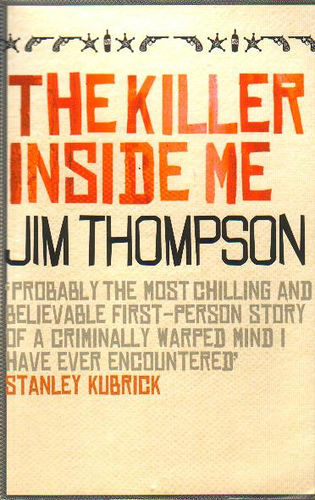
‘The Killer Inside Me’ by Jim Thompson: book review

killer

Written in 1952, this first person portrayal of the behaviour of a sociopath/psychopath in small-town America must have been then, and still is, both a frightening insight into the mind of a killer as well as a metaphor for the evil that can exist within an ostensibly ‘normal’ person and place, anywhere.

Cited by many as Thompson’s best work, I had to take a second run at reading in order to become wholly involved and to finish. I’m glad I did. I think my initial hesitancy was much to do with having seen the film version near that first reading. Even on the second successful one, the impact of seeing the film was destructive: [significant spoiler alert, so consider going to the fourth paragraph if…] because the critical narrative ruse is the fact that Deputy Sheriff Lou Ford thinks the first woman he brutally assaulted is dead, told so by his friend and the sheriff Bob Maples, and this is what gives him the confidence to carry on killing because he has not been linked to her death. Such foreknowledge from the film that she isn’t dead obviously destroys the twist at the book’s end: this is when we should find out Joyce is in fact alive, dramatically if deeply disturbing by her entry and what she says to Lou.

With Thompson’s penchant for peculiar/disturbing endings [Savage Night and The Getaway] it is fair to question the reality of the finale in this book. It could be that Joyce is dead – she should be after Lou’s ruthless beating of her – and he just imagines her return, especially as it is in his own home having been released from an insane asylum in an almost farcical legal scenario with the outrageous lawyer Billy Boy Walker. A house he has just primed to be torched and does. And all of this after he has spent a night watching images of his girlfriend Amy who he also viciously killed, these having been projected onto his sanatorium bedroom wall, though he is told later this never happened. But I think it did all happen, even though Ford is clearly insane.

Or is he? This is the wonderful dilemma for the reader, though ‘wonderful’ seems an oddly positive word to use for such a sinister suspense story. But that is its great appeal. We are drawn into Lou’s personal charm as both a person and lawman, a little dull but well-liked in his small-town community, and certainly highly intelligent: his reading of his deceased physician father’s medical, philosophy and other books is impressive. The possibility that he isn’t insane is more troubling than if he is, and this is the huge part of that attractive dilemma – which do we think, perhaps prefer, and probably need to prefer? Thompson toys with us brilliantly in the latter part of the book, and near the end he has Lou reference a book by Kraepelin which

…was written about a disease, or a condition, rather, called dementia praecox, Schizophrenia, paranoid type. Acute, recurrent, advanced.

    Incurable.

    It was written, you might say, about –

    But I reckon you know, don’t you?

And the fact Lou addresses us as readers like this, his own toying throughout the story, means we question whether this too is just an excuse, a manufacturing from his cleverness and ideas gleaned from his wide reading.

I did find the book dragged through much of the middle, though this might be a natural – maybe purposeful – bathos after the early graphic violence and revelations of Lou’s past. But Thompson does build the suspense cleverly in the final quarter, or maybe even third. There is a brilliant procrastinated narrative as Lou teases with his telling of what he has done to his girlfriend Amy Stanton. Chapter 25 is an artistic gem in the way it becomes a ‘list’ narrative, all thirteen of its paragraphs beginning with the apparent direct address of You or You’ve, speaking actually about himself in this generic third person, but also us, it seems, drawing us into his vision and explanation and justification, and the repetitions make it hypnotic and controlling. But of course the big tease here is what it predicts about the final chapter and story’s dramatic conclusion.

killer2