Go here for more
Go here for more

I think this is an extraordinary collection – a high-octane collage of ideas, soundbites, axioms, quotations, misquotes, lyricism, outbursts, narrative dysfunction and sudden apocalypse, comedy, bathos (comic and tragic) – which is to name, as they say, just a few. It is reflecting on a finite time of experience across an infinite refraction of it.
This rich range is contained but obviously not constrained by the framing as 100 prose poems of 28 lines across four stanzas each and I don’t think there is any particular rationale to the imposition of a form and finite number other than pragmatism. There could be, and one could make a case/argument, but why?
A wonderful tension/outcome is, however, how this pragmatism is exploded by the riff of random (or apparently so) thinking that occurs within its shaping. This is obvious in the consistent trajectories of thought and language, and within individual lines/phrases like ‘the shape of a forest is not the meaning of trees’.
I’ve pulled the above from 51. Work, so half way through the 100 poems, and this is where I will stop. I do so because saying more – from me anyway, now – would be the poison to perhaps corrupt what Tim Allen accomplishes in each and every poem (‘making us dizzy while coolly smiling’): the poison of over-analysis.

This poem speaks for itself so I simply celebrate its funeral cameo that Allen attends as ‘an unfinished work of temptation’ which I embrace as I haven’t finished reading – and I don’t mean from cover to cover – and I certainly don’t expect to ever reach an end.
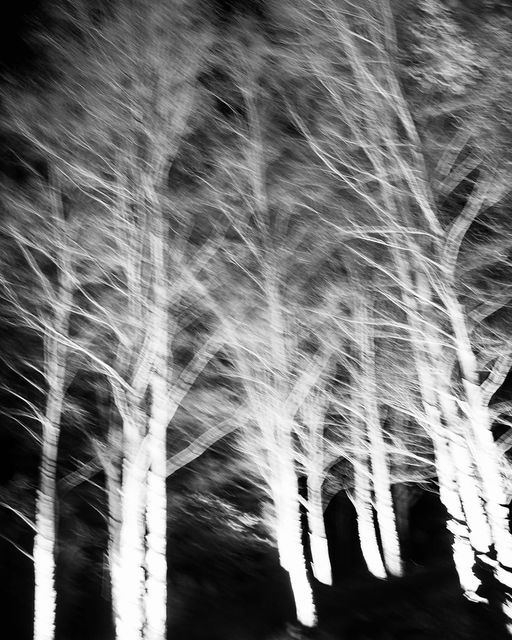

(image by artist and photographer Nick Dormand)
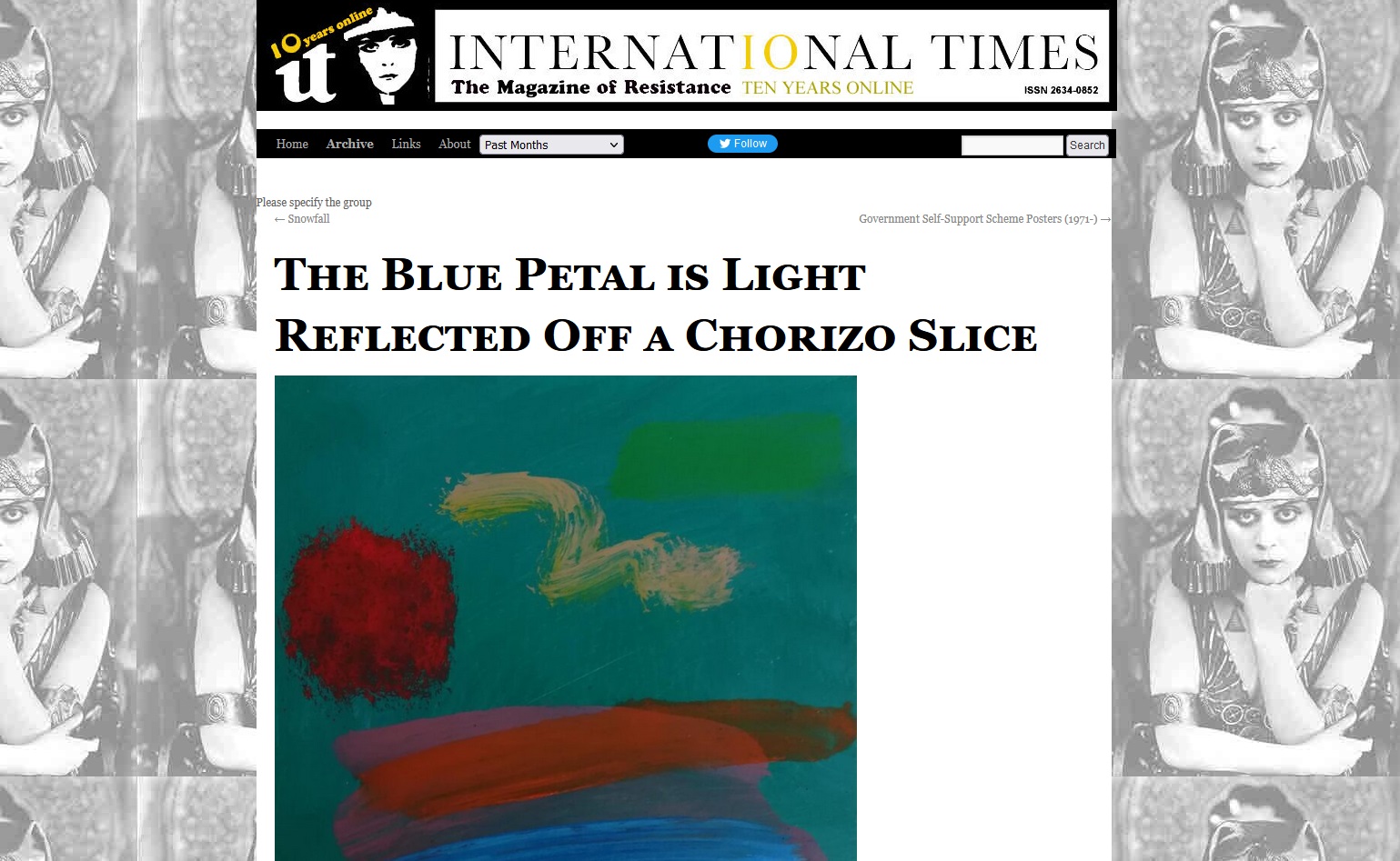
With thanks to International Times – also for the Rrupert Loydell image: read poem and see complete image here.
Padded with power here they come
International loan sharks backed by the guns
Of market hungry military profiteers
Whose word is a swamp and whose brow is smeared
With the blood of the poor
Who rob life of its quality
Who render rage a necessity
By turning countries into labour camps
Modern slavers in drag as champions of freedom
Sinister cynical instrument
Who makes the gun into a sacrament —
The only response to the deification
Of tyranny by so-called “developed” nations’
Idolatry of ideology
North south east west
Kill the best and buy the rest
It’s just spend a buck to make a buck
You don’t really give a flying fuck
About the people in misery
IMF dirty MF
Takes away everything it can get
Always making certain that there’s one thing left
Keep them on the hook with insupportable debt
See the paid-off local bottom feeders
Passing themselves off as leaders
Kiss the ladies shake hands with the fellows
Open for business like a cheap bordello
And they call it democracy
And they call it democracy
And they call it democracy
And they call it democracy
See the loaded eyes of the children too
Trying to make the best of it the way kids do
One day you’re going to rise from your habitual feast
To find yourself staring down the throat of the beast
They call the revolution
IMF dirty MF
Takes away everything it can get
Always making certain that there’s one thing left
Keep them on the hook with insupportable debt
And they call it democracy
And they call it democracy
And they call it democracy
And they call it democracy
~ Bruce Cockburn
Call It Democracy lyrics © Rotten Kiddies Music Llc, Bro N Sis Music Inc., Bro N Sis Music, Inc.


(an appropriation and erasure)
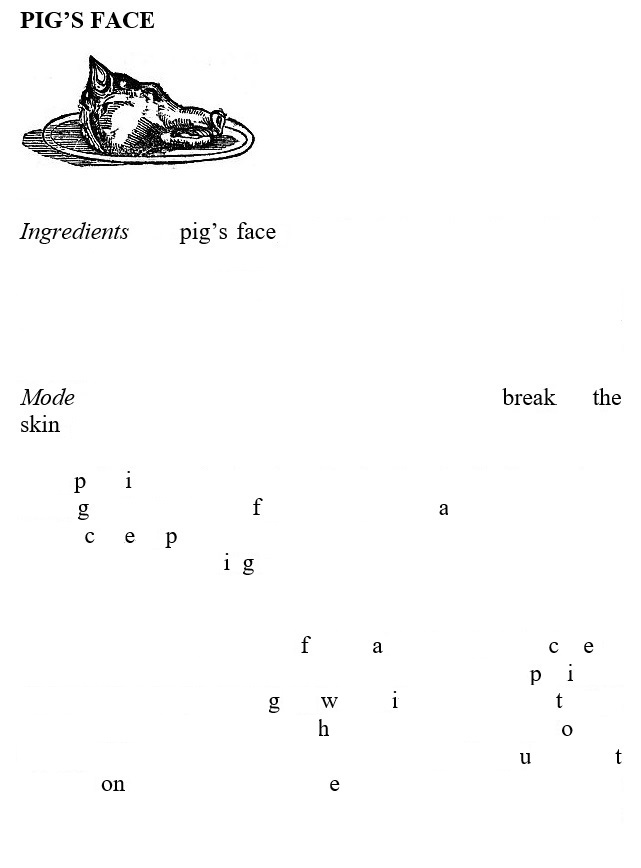
(erasure from Mrs. Beeton’s Dictionary of Every-Day Cookery by Isabella Mary Beeton)

I’ve known and enjoyed the work of Tom Jenks for a few years – both his output as editor/publisher of literary objects imprint zimZalla (two reviews here and here) and as writer of gloriously distinctive prose poetry. Before rhubarb I have enjoyed his and Catherine Vidler’s constraint construction Pack My Box with Five Dozen Liquor Jugs, a playful ‘zany and zanier’ collaboration (see details here) – though its undoubted cleverness is framed still in a way the writing in rhubarb isn’t.
rhubarb, from the wonderful and prolific experimental Beir Bua Press, is a ‘collection of a number of pieces written over a number of years’ and it has been interesting to trace what appears to be a range of styles built around a fundamental oblique and surreal world of Jenks’ writing.
I must, however, immediately challenge my dual categorising of this: neither is quite right, and ‘surreal’ has of late acquired an assault on its suggestiveness, usually by sportspeople interviewed on TV who have just achieved significant success and acknowledgement through their literal skills and dedication who still describe this as ‘surreal’ (when it is patently, and brilliantly, absolutely real). Therefore, I’d have to add/qualify that his writing is inventive, quirky, constantly surprising and signature.
I know best these signature prose poems that I encounter on social media postings, always happy to come across by chance and know I will definitely enjoy, smiling immediately at that first and then subsequent poetic shifts into the unexpected and unique.
The title poem of this collection takes us into a rhubarb world of ‘classic’ Jenks’ knowing, giving the vegetable a life beyond most of our imaginings, and introducing Stanley who knows even more. The ingredients, for example, of a ‘neutralising cordial’ involving rhubarb are revealed with the clarity of this further fascinating knowing.
The opening poem eyebrows exemplifies from the off the ‘peculiar’ narrative journeys we take as readers. Its first two stanzas
‘When I return from my walk across the fields,
my mother trims my eyebrows with the kitchen scissors.
They grow two centimetres every day.
The air is fertile out here in the country.’
launch us toward the sublime concluding visual of the curate ‘on his bicycle’ and the condition of his eyebrows. An ‘overlooked nineteenth century Russian novelist’ is the subject of the poem not so far, Fyodor and it is a tragedy, truly.
In when it gets dark, I fetch my special spoon we learn about the curing potency of UHT milk and a sponge as well as the connection (with Christmas approaching?) to ‘goose fat and memories’.
The poem hedge in its entirety speaks volumes about passion
‘We have planted a hedge at the edge of the fields. It grows a little
each day, like an ardour. At night we stand either side of it and
picture it seven feet tall, with a ditch.’
Where would you, as reader, imagine these opening lines from song from a forest will take you
‘What can I do with him, he is so randy,
hairy hands in the mayonnaise.’
I am wondering on behalf of Michael Bolton, by the way.
There is a comparative longpoem core in this collection Walt Disney is sending us letters, and it intrigues by sustained revelations that are absurd and comic and disturbing. There is a knight and there is WD and are either likely to be heroic?
There is another long and wise poem the baby that offers advice to those who anticipate and then have a baby. Surprisingly, there is some normal advice offered…
A favourite line from another poem:
‘I saw a dog that was entirely see through’
This brisk collection is an absolute delight. The storytelling is always fresh, and I have such huge respect for the imaginative depth with which Jenks sustains this. I’ve read many others who have tried to emulate – having a go myself – and speaking personally, it is upsetting to realise how impossible it is. I think of Matthew Sweeney and Ian Seed who also have their signature approaches in poetic narrative (as well as their failing imitators: OK, me again) and Tom Jenks is a bright light in that triumvirate.
Speaking of lights, I mentioned Christmas earlier. I know, it is only November, but it is near the end of the month. Two thoughts:
1.
It would make a wonderful Christmas game to choose and print opening and/or internal lines from any of these poems and put in a small box or other receptacle (a rhubarb basket perhaps) and family members and guests select and have to write the ‘rest of the story’ or similar from their randomly selected lines.
2.
Buy this book as a Christmas gift. Really. It would make a superb present; great Xmas reading. Fun and unusual, easy to cover in one sitting or a few. Tell readers they don’t need to take drugs to read and encounter amazing worlds; or encourage to take drugs and read and blow their minds beyond any previous hallucinogenic experience.
I am serious about both of these. More details and to purchase, go here.

(erasure from The Pilgrims’ First Christmas by Josephine Pittman Scribner)
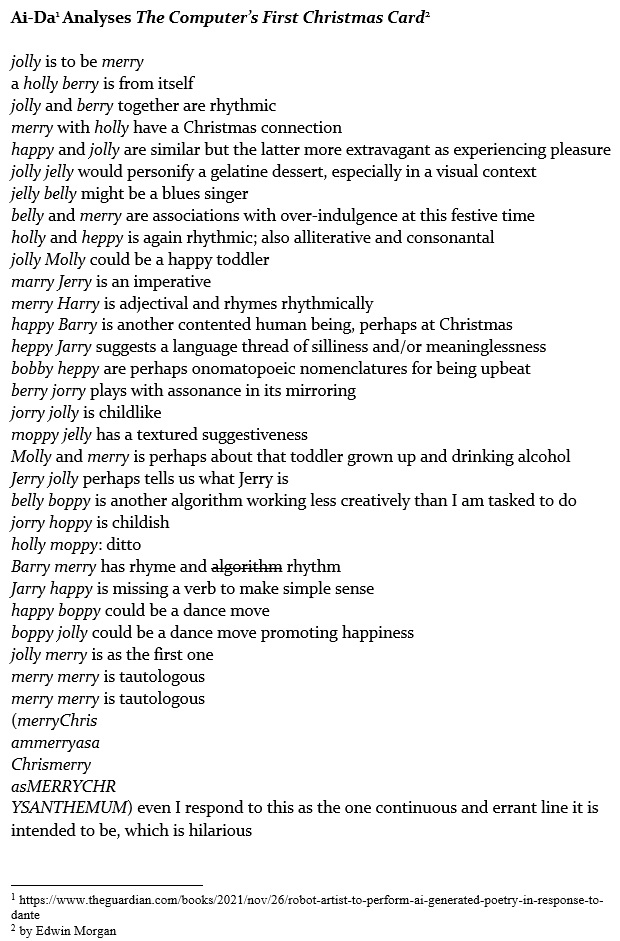
 gravyfromthegazebo