‘Forgetfulness’ by Ian Seed – Shearsman Books

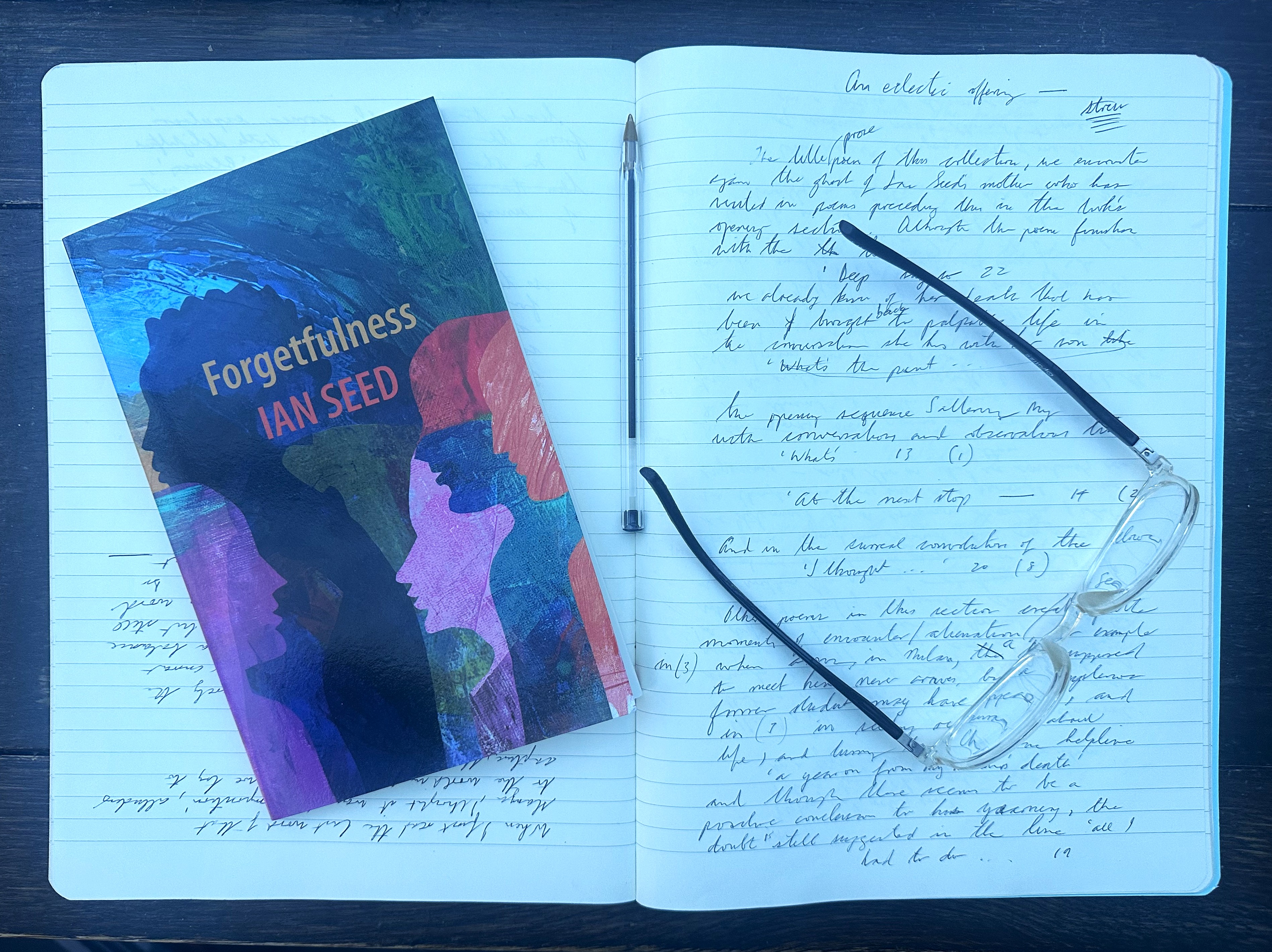
This is Ian Seed’s eighth collection with Shearsman Books, a distinctive writing journey of mainly prose poems. Forgetfulness is, importantly, an eclectic offering reflecting a varied crafting arc in his overall poetic framing of familiar themes like alienation, uncertainty and surprise, sustaining the genuine joy in reading these signature explorations.

This book presents its variables across four sections. In the title prose poem, we encounter the ghost of Seed’s mother who has already visited in poems preceding this in the opening section.

Although it finishes with the line

Deep down we both know she’s no longer alive, but neither of us can bring ourselves to say so 

we already know of her death which has been brought palpably back to life/our notice – not being flippant – in the first of eight sequences from ‘Scattering My Mother’s Ashes’*, this through the conversations she has with her son or other narrator observations like

‘What’s the point of writing in that silly way?’ my mother wants to know  (1)

At the next stop, the door at the back opened, and stayed open even when we set off. The driver mut have forgotten to close it. I had to hold my mother tight when we went around a corner  (2)   

and in the surreal convolution (in its context) of the following, referring to his father

I though he’d died, though I’d heard more recently that he hadn’t, just been very ill and was now recovered. In fact, he looked quite young, being much slimmer than when I’d last seen him. Perhaps we could be friends again now that my mother was no longer alive  (8)

Other poems in this section create further moments of encounter/alienation for Seed, for example in (3), when arriving in Milan, a poet who is supposed to be meeting him doesn’t turn up, but a mysterious former student may have appeared; and in (7), seeking assurances about the meaning of his life a year on from my mother’s death, and turning to a Christian helpline, there seems to be a positive conclusion to his yearning, though doubt is still suggested in the line

I felt that within the granted minutes I had infinite time, because love was infinite, and all I had to do was accept it

The second section begins with a poem ‘The Jugglers’, perhaps a metaphor for the storytelling that will follow in other poems, but also more broadly (predictably, as interpretation?) for the lives we think we lead and think we have led: from dreams to hopeful/desperate imagining of having happened. It is both lyrical and philosophical, from

5

Fingertips reach the tender side
beyond mere greeting and passing away.
This breath on my face, on my trembling
shoulder blades, the small part of me
which is still open, left open from the wound,
the only place you can enter

 to

10

The road is made of stones and stories. It merges
with the light ahead. It has mapped
our dreams. How long shall we linger
on its verge, nursing our cut feet, gazing
with affection at old scars?

The narratives of following poems is in the searching of self, strangers, other people in their stories and stories observing them. There are also explicit references to this focus

In the unwrinkled pages of the story
(‘Transfigure’)

…where every piece
of the story would fit
(‘Tenants’)

…the story
told just for the darkness
(‘Wakening’)

The third section is predominantly a collection of prose poems, wonderfully familiar in their sifting through uncertainty and the surreal manifestations of this.

The fourth and final section is work mainly from a previous list poem collection ‘I Remember’ (Red Ceilings Press). My review of this can be found here: https://gravyfromthegazebo.blog/2021/06/10/i-remember-by-ian-seed-the-red-ceilings-press/

The reminiscence in the first list poem is an affecting and candid addition to those recalls and reconstructions that open this fine collection.

For further details and to purchase, go here: https://www.shearsman.com/store/Ian-Seed-Forgetfulness-p767454180

* (a Red Ceilings limited-edition pamphlet)
 

ChatGPoeTry?

The AI Literary Review is a focused forum for writers/artists who engage with AI as a prompt and/or process for their own creative productions. That is probably a reductionist summary when the wonderful range produced across six issues now reflects a lively and evolving interaction.

I’ve made two contributions – with my thanks to Dan for taking and posting – and my most recent in the current edition can be read here:  https://ailiteraryreview.co.uk/issue06

Anyone who accessed the link above may be interested in an elaboration on my work to follow, otherwise, I suspect you aren’t…

The editor Dan Powers rightly keeps contributor narratives in the Review to a minimum and showcases instead the creative outcomes.

I can do what I like here, and will! Here is some further detail to my Issue 6 contribution:

When using the earliest ChatGPT available, trying to get this AI to write poetry was a chore because the responses were always so literal, anchored to rhyming, and usually banal/twee in content. Although once getting a wonderful but fortuitous, aberrant pair of visual poems as a response (included in AI Literary Review, Issue 2), I quickly gave up on it.

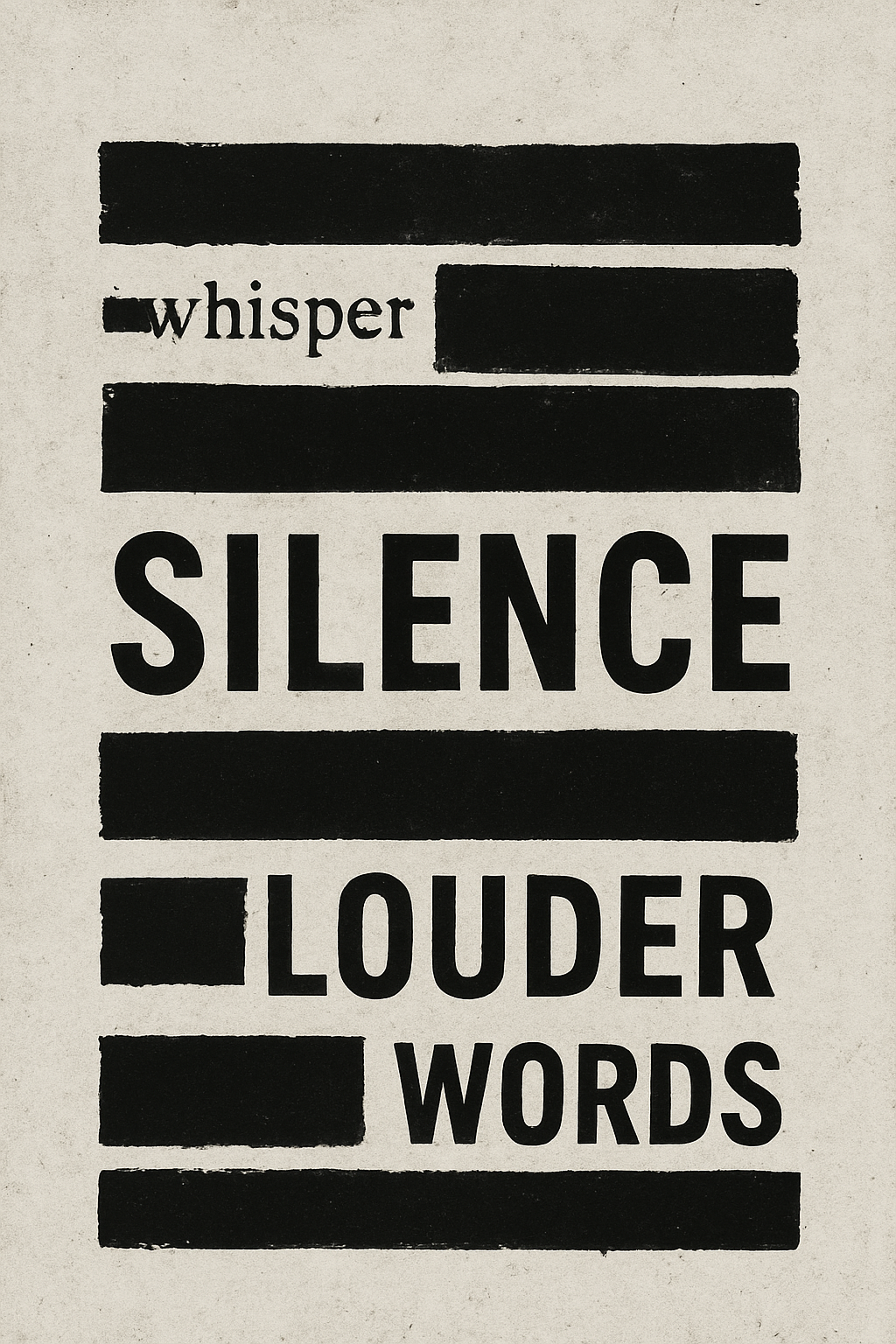
Until recently: mid-August, ‘25. Asking ChatGPT to ‘in no more than 8 words, write your best poem’, it produced ‘Stars whisper secrets; silence blooms louder than words’. Not impressed, I set a series of challenges for it to work on this, including my critique of the line being clichéd, my prompt to present that line as concrete poetry, then ChatGPT’s offer to make this a ‘graphical version’, with a subsequent proposal of ‘visual artwork’, and it came up with these:

As you can see, these are versions on the same simplistic theme. I have a copy of the narrative occuring within these repetitive outcomes, which includes ChatGPT’s sycophantic responses acknowledging my ‘corrections/suggestions’ (which I won’t labour through here) and I eventually asked it to try ‘something brutal’ and we arrived at the following:

The intentions of ChatGPT this time around seemed far more informed and adventurous, but the actual results were no more than a trivial adaptation of some erasure and varying text size approaches, so I have given up on these poetic quests with AI once more.

There was an outcome, however, and that is my creative, human TextArt response to this included in Issue 6 (with link for that above) and the following second piece – not published – as it is a generative TextArt poem:

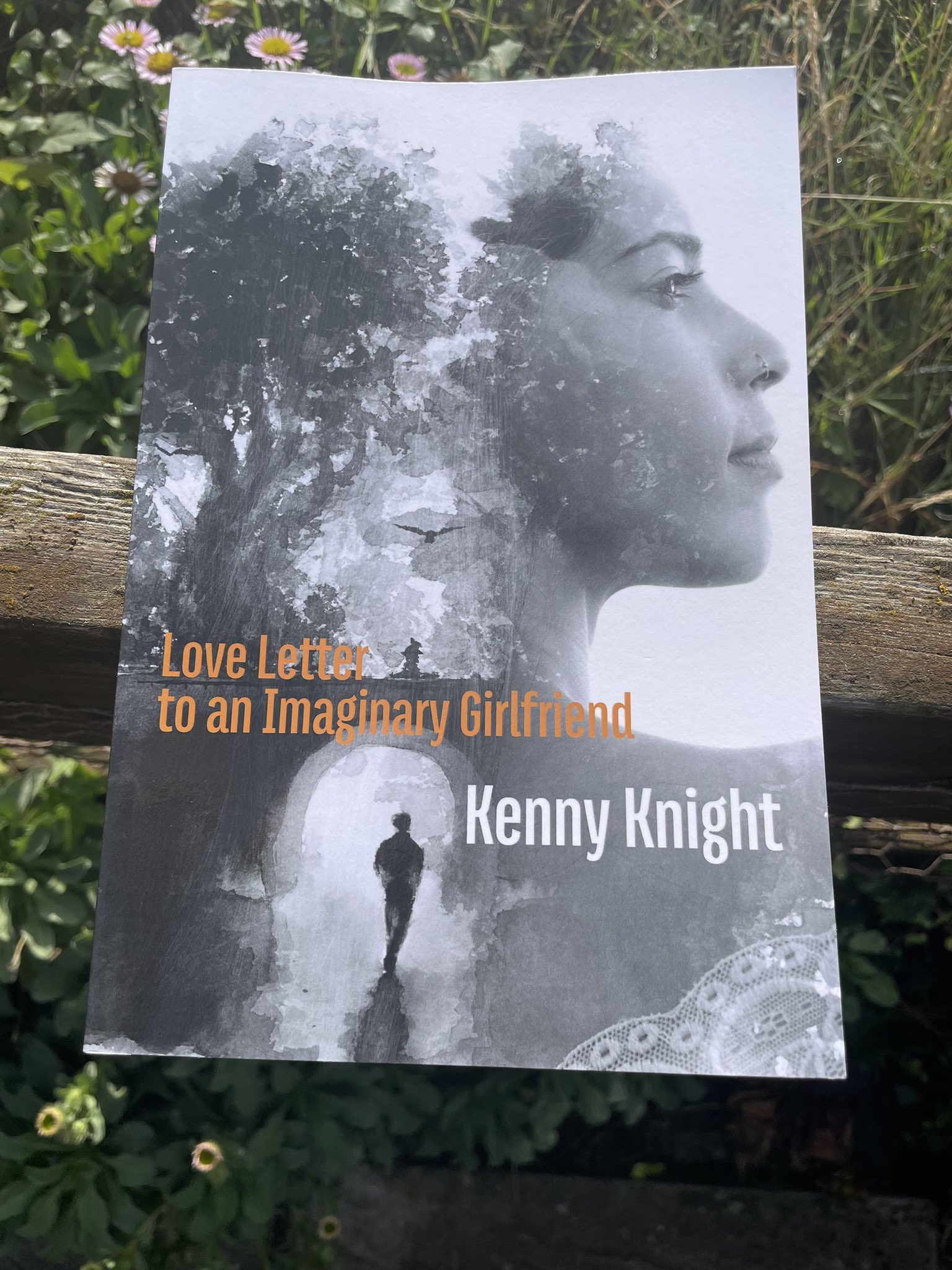
‘Love Letter to an Imaginary Girlfriend’ by Kenny Knight – Shearsman Books

I eagerly consumed Love Letter to an Imaginary Girlfriend by Plymouth poet Kenny Knight last week and it has been one of the more enjoyable of my recent readings. There is an accessibility that I like – a storytelling that riffs its way through obvious personal nostalgia with literal references (e.g. namechecks of music, people, places) and then the rollout of delightful surreal tangents and other poetic explorations.

I haven’t read Knight’s work before, but with this Shearsman Books collection one quickly becomes familiar with that narrative style – the narrow, linear move through content with its repetitions and asides – and also the sense of who he is: as well as for me, the constant touchstones of shared experience because we are the same age (Knight 73, me 70) with his many references to the music I mentioned just now and so many names, places and historical events.

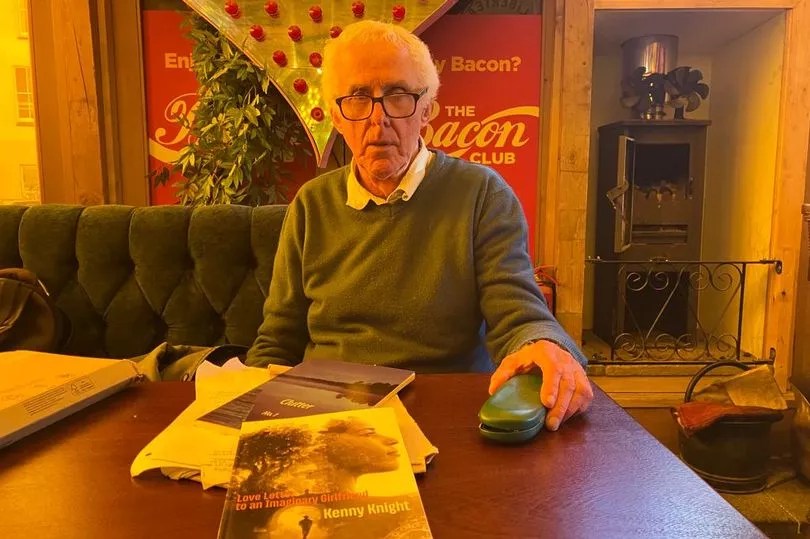
(Image: William Telford)

There is in fact a glossary for this collection detailing ‘Plymouth and its environs’, ‘cultural references’ and musicians/bands. It’s easy for someone my age to immediately anchor onto a reference of Country Joe and the Fish and therefore that era, but I found a perhaps more personal shared liking with the mention of Mike Cooley and Patterson Hood from a more contemporary Drive-By Truckers (but why no Jason Isbell, Kenny?). And I’m with him on Alice in Chains. To be playfully pedantic, I’ll note that he fails to put The 13th Floor Elevators in his glossary which does appear in the poem On Reaching a Hundred.

The wonderful long poem Dicing with Room Numbers makes continuous reference to a range of music/musicians like Chuck Prophet, Bill Callahan, Buddy Holly, Ornette Coleman and so on before branching out to TV, poets and Amazon (as in the commercial conglomerate outlet) links. It ends with,

‘I spin the roulette wheel
with my lucky left hand
which takes me to a talk
on the Plymouth Poetry Mafia
the roulette wheel is still spinning
tell me if it stops on Geoffrey Hill
or Eric Dolphy.’

and this is a good example of that riffing through memories, realities, imagination.

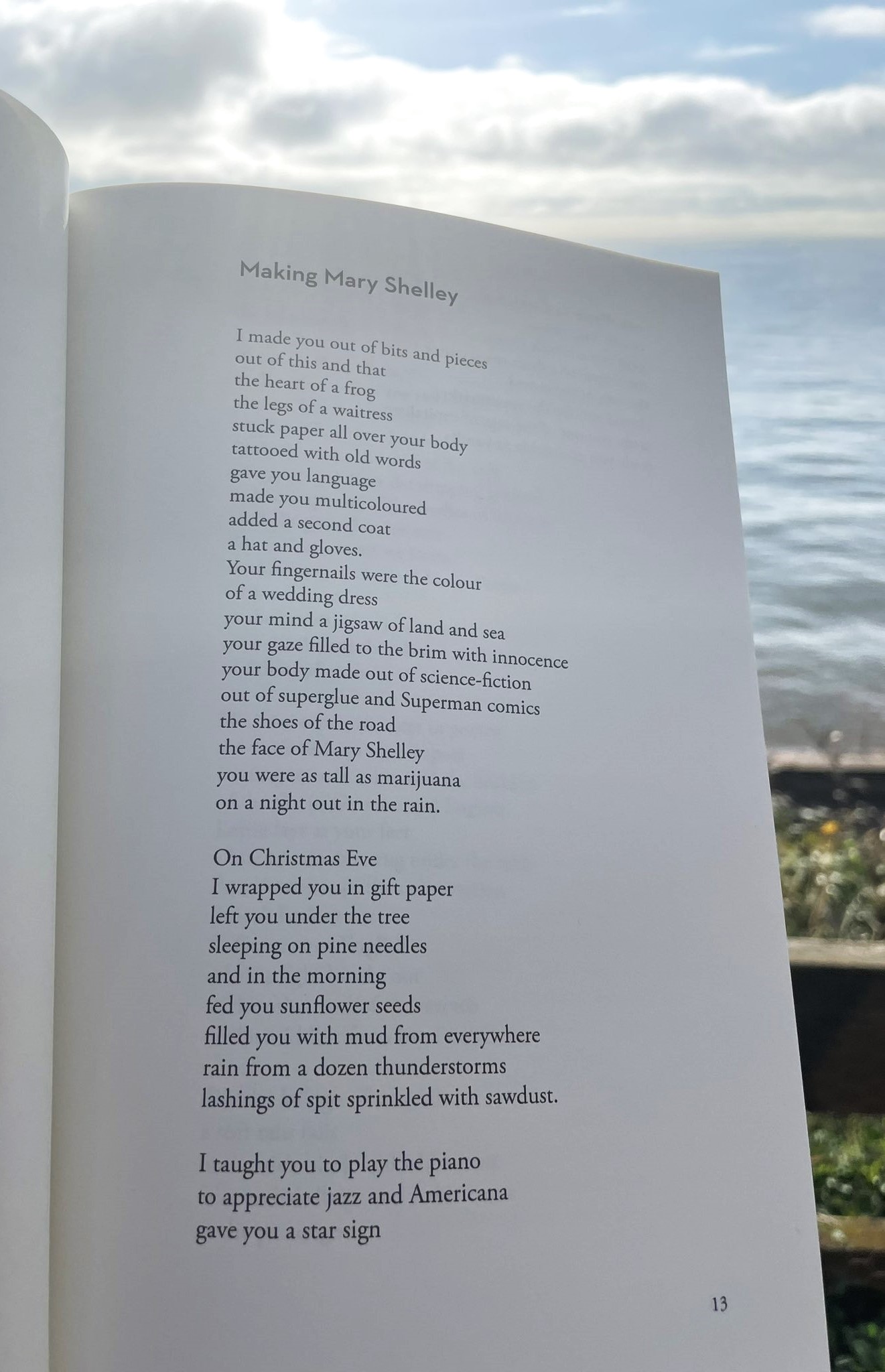
I read this collection last week when away from home, at Dawlish and nearer to Plymouth than from where I reside here in East Devon, and living as I do near the seaside/coast is another shared experience with Knight. In the midst of my reading, I did tweet his poem Making Mary Shelley as an example of my early appreciation/celebration and referred then to the ‘incantatory narrative’ which is a different take on ‘riffing’! Seeming apt, I took the snaps of this poem outside with the sea as backdrop,

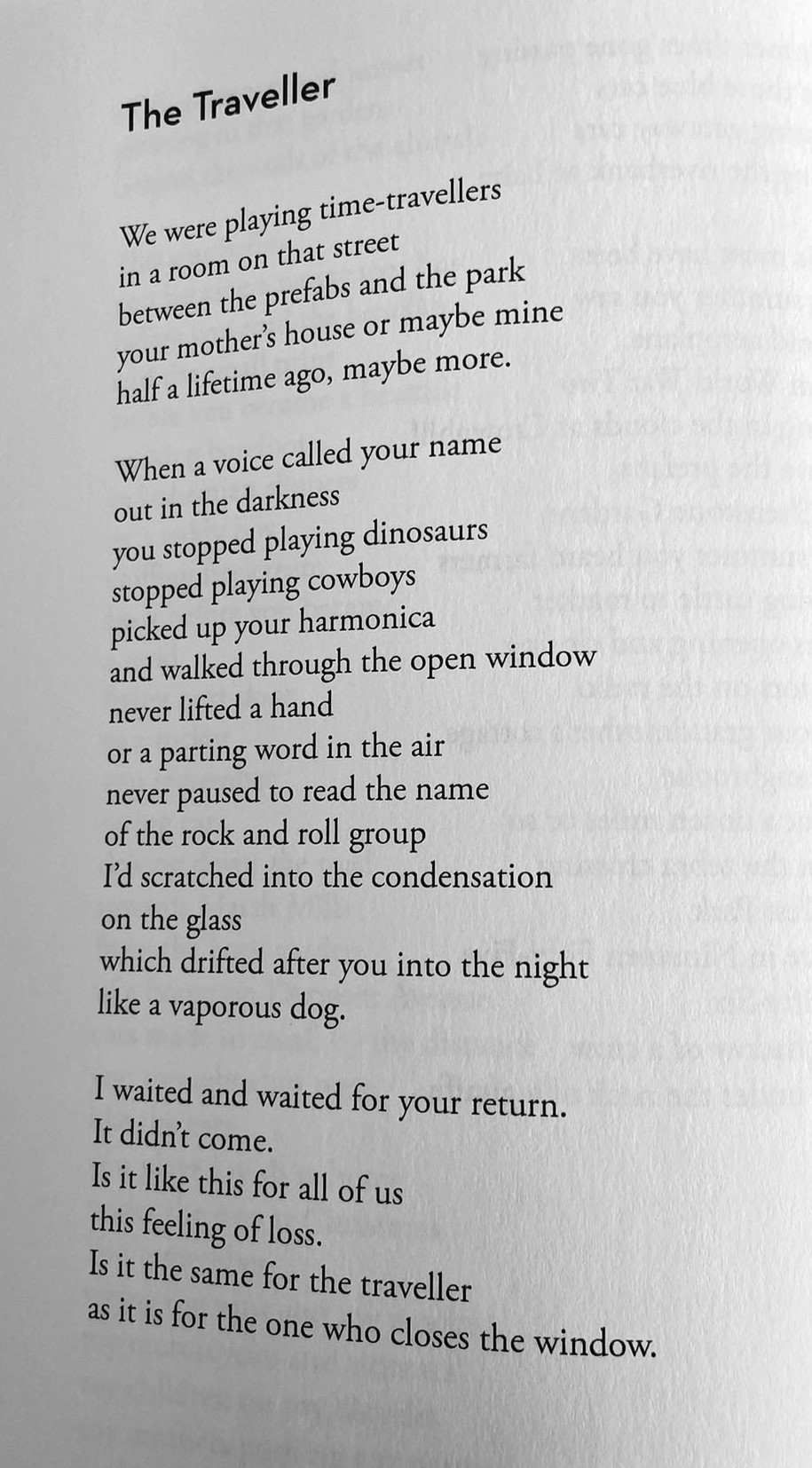
Continuing with my full engagement, I also later tweeted his poem The Traveller, referring to finding it emotive. Like so many of Knight’s poems in this collection, he is nostalgic and continually reflective. References to childhood dominate much of the content, and this is an obvious element of my personally feeling ‘a sense of who he is’. In the poem, literal and figurative storytelling paints a plaintive picture and it resonates with that ‘feeling of loss’,

The autobiographic in these poems matters, to me at least. It’s a fine line, isn’t it, the ‘I’ in poetry informing or engaging or alienating the reader? Too much and there is a self-indulgence, obviously. I think Knight presents the perfect balance because there is in this collection its seamless thread of the apparently real and the delightfully imaginative refraction of this.

I’ll conclude on my own self-indulgence, which moving beyond it, reflects the palpable engagement I have had with Kenny Knight’s poetic storytelling. I researched online Knight as poet, and in addition to discovering other work of his I’ll want to read, there was an article about him in Plymouth Live from 4th December, 2023.

With a dramatic headline and sub-headline – ‘Plymouth man laughs at pain after shattering diagnosis / Kenny Knight lost the use of his eye but it didn’t stop him going on to achieve great things as a writer’ – we are informed of his having surgery on his left eye in the mid-80s which led to loss of sight in that eye. There is more detail on this which I won’t pursue here, but also the following observation which proudly describes Knight as,

‘one of the city’s most respected – and even somewhat famous – writers, with three collections to his name, work in numerous publications, and appearances at literary and academic events.’

When later reading the poem Blue Gone Grey, this seemed to me a direct reference to his impaired sight and I was especially moved by that autobiographical ‘knowledge’ as context: a further depth to a reading that would otherwise have still impacted. I do think the knowing adds layers where the poem is witty (‘I could see Blind Lemon Jefferson’) and suggestive (‘four blue eyes gone to cloud’),

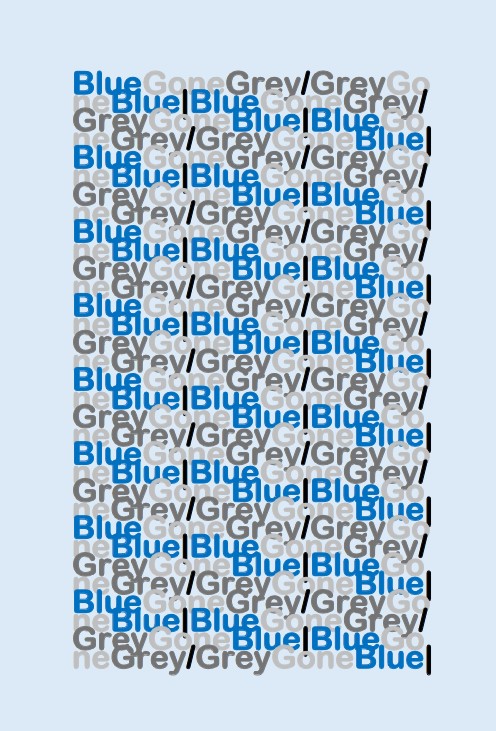
My following 2 from a set of 5 generative TextArt poems was prompted by this and I offer these here as more expression of my genuinely deep encounter with Kenny Knight as person, poet and writer of this fine collection,

In inverting his title line to include ‘Grey Gone Blue’ I am stressing how out of whatever difficulty (‘vapour’) Knight may experience, he elevates this to the natural and beautiful blue of his distinctive poetic voice.