National Poetry Day, 4th October, 2018 – ‘Change’. Free Resources Launch, [NPD Change]

NPD Main Logo with copy

This year’s National Poetry Day in on the 4th October, and that is some way down the teaching line.

But it isn’t.

It is in terms of months away from this posting – 4 months – though perhaps not as much as one might initially think, and it is in terms of workload and current commitments: primary school teachers may feel more inclined to consider now having hurdled the first part of Key Stage 2 testing [though there are many traps yet ahead], and secondary school teachers – the main target for this work, but not entirely – still have GCSEs to pass through.

It isn’t in terms of, hopefully, seeing something positive on the horizon. And it isn’t in terms of having some time between now and October to look at and consider if these poetry writing ideas would be useful and welcome for your classroom.

As an English teacher, I always celebrated National Poetry Day. Since leaving the job, I have always devised teaching/creative writing ideas for others to use, if they wished, on National Poetry Day. For a number of years these appeared with Teachit. Lately I have promoted them through this blog.

Enough of the prompt and history. This is an initial launch and promotion. I will be hoping those interested will also share/promote/retweet, especially those with an ‘audience’. I will over the next four months be adding to this work – especially producing teacher notes and perhaps student sheets – and I will also be re-posting, especially nearer the 4th of October.

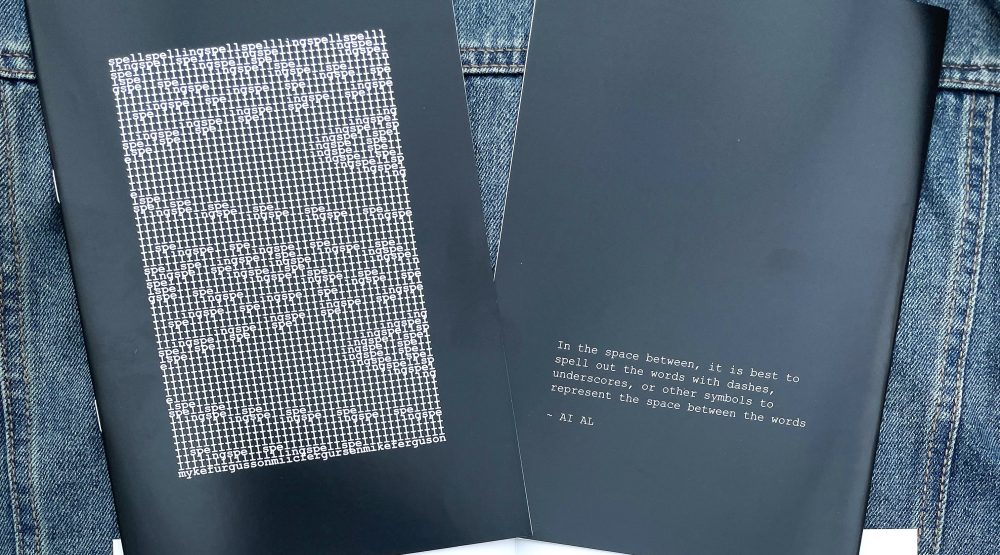
What hasn’t changed in this thematic National Poetry Day theme of Change is my commitment to presenting creative writing ideas that can be ‘copied’: models for writing to provide actual forms to emulate; to copy. I often use list poems as that main form – it works! – and I also encourage experimental forms, like cut-up/remix poetry.

More on this later.

The following are pdfs of the creative writing ideas for the theme of Change. No notes yet, but I trust they give a flavour of the focus. If you click on these, they can be downloaded and reproduced/use as you will. These are free resources to use and share: nothing would give me greater pleasure than to think students will be encouraged to write and be supported in that by the models given here.

With all future postings on this, I will use [NPDChange] in the heading so this can be searched on this blog and all resources found together:

A – I Will Change

B – The change in my pocket

C – Change

D – Search engine change titles

E – Change Quotes 1

F – Change Quotes 2

I have added the following since this morning’s posting as an example of the Student Sheets I will be producing. There will be a singular Teacher Notes with suggestion and guidance for presenting the ideas. These will all be offered as support/guidance – they obviously do not have to be used [and/or they can be changed! I can be advised if it will be useful to make all of this available as word documents for the facility to amend?]:
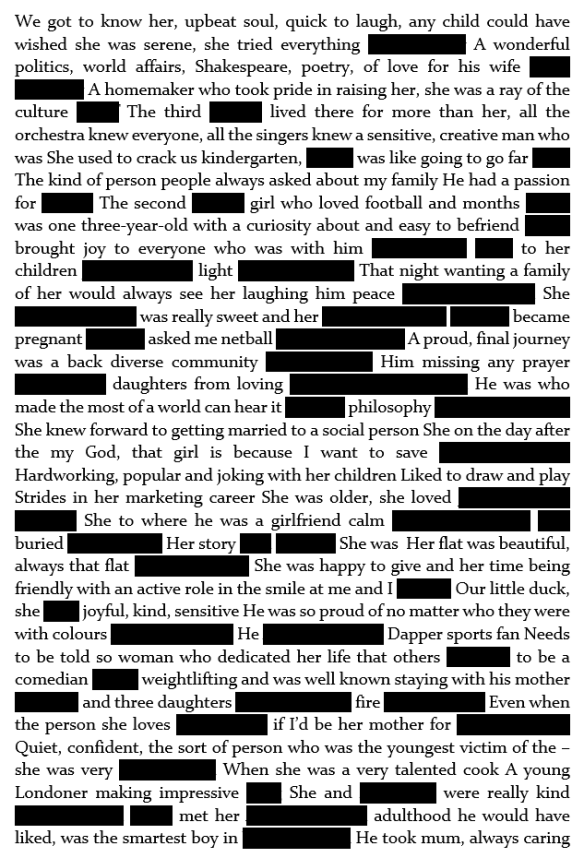
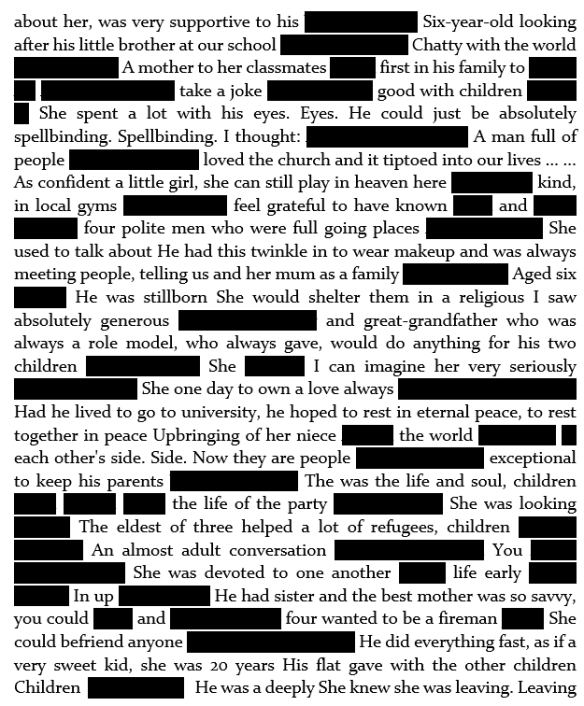
G – I Will Change – Student Sheet

71 Names Taken Away, But They Are All One

grenfell1

grenfell2c

I wrote this in response to and found in yesterday’s The Guardian article The 71 lives of Grenfell Tower, finishing it late last night, moved by the full naming of those who died in the tragedy of that fire and the mixed emotions of the personal accounts of the 71 individuals. The article and those voices speak poignantly for themselves.

As a secondary but important observation, I think The Guardian deserves recognition for its consistently passionate and probing reporting on realities like the Grenfell Tower tragedy, and all that lies behind such, not that reporting can ever fully represent the human experience.

Not as a comparison by any means, but in their coverage of the Windrush situation and that injustice and human suffering, well in advance of it making the wider headlines, The Guardian reflects the importance and impact of what others like to denigrate as the ‘liberal sensibilities’ of some of the media.

The Guardian article here.

Poems for Grenfell Tower is still available here.

My GPS Test Debilitated Me Today

I want this to be my only comment on today’s KS2 English GPS tests [questions and spellings] because I’ve banged on this door many times before but it is shut tight, locked, bolted and welded closed forever it would seem.

But I can’t promise.

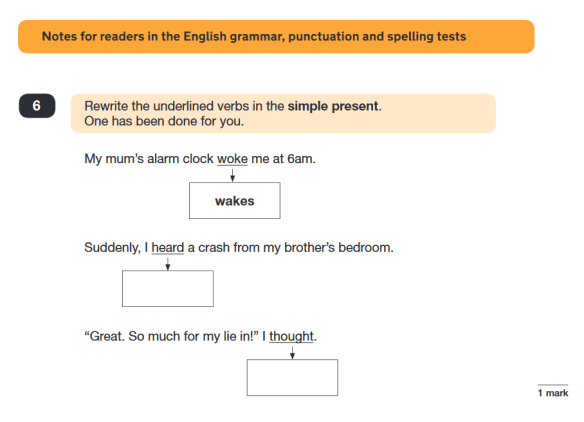
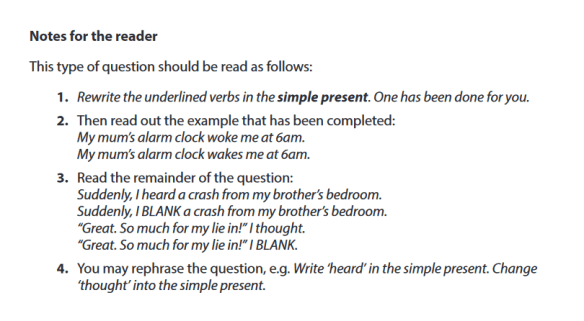
The following question isn’t from today’s tests because I haven’t seen these, but it is from this year’s Notes for readers in the English grammar, punctuation and spelling tests and so is illustrative of the types of questions asked, and I have supplied other ‘real’ examples elsewhere on this blog:

gps1

gps2

I genuinely do not understand the point of such a question. I say this in the context of such a test being linked to the teaching and learning of Writing. This example presents/asks a number of things that seem quite meaningless:

It uses the term ‘simple present’ as if this is a known term, and/or an important term, but of course the question can be answered/completed without knowing the term.

Answering these three questions won’t really tell us much, will it? It will tell us if the student can answer the question correctly or incorrectly. So what? Even in the constriction of teaching/testing tense cohesion, it would be more ‘telling’ to ask a student to write three sentences in the past or present tense.

And what is the problem with my suggestion immediate above? Simple. It can’t be assessed as a right/wrong answer in the crass simplicity of a national test with a prescribed mark scheme. Such an approach to testing has to be uniform and simplistic and finite. Just like what writing isn’t.

What would be a more interesting and engaging way of using the frame of this question to explore a student’s ability to write, and to write with variation?

How about asking students to supply alternative words to those given? Would it matter if they were past or present tense? [To a degree that is a rhetorical question as I do think tense cohesion can be an important aspect of writing, and a common problem of maintaining in students’ writing, not that I would test it like this, not that the question we are looking at is testing this – if you are following].

But for my wider point, what about encouraging:

My mum’s clock shocked me at 6am.

My mum’s clock startled me at 6am.

My mum’s clock laughed loudly at me at 6am.

You know what I mean. I’ve gone this route before. But it is an important point and idea.

Could this be tested? Not on a national basis with prescriptive mark schemes which couldn’t countenance, let alone encourage such endless variation. Writing has to be finite. It has to be right or wrong. Just like the worst writing there is.

But teachers could assess this.

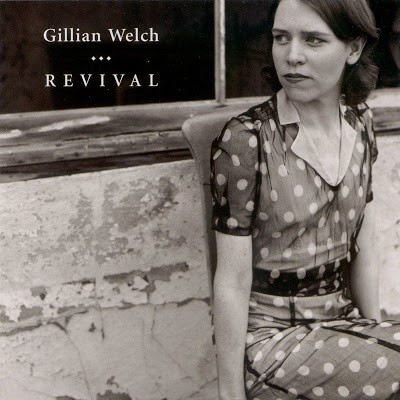
Top Fifty 26: Gillian Welch – Revival, 1996

[Originally posted May 2011]

67

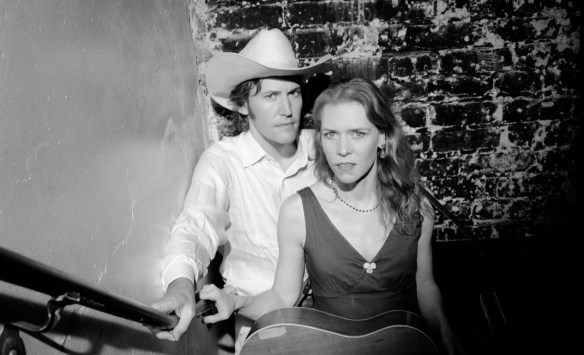
This is a perfect album to bridge/connect my love for old and ‘new’ Country, or to put it another way, the traditional and americana. This album, released in 1996, certainly revived for popular appeal a more niched sound of bluegrass and Appalachian twang, the rural folk of America’s past and perhaps more modern redneck appropriations.

It isn’t difficult to find where that aural anchor grabs and holds: it’s in the taut harmonies of Gillian Welch and partner David Rawlings. There is a vocal rapport in both timing and tone that is sheer perfection, and Rawlings’ guitar work adds a stunning extra dimension in its virtuosity.

There is at times a sombre intensity to the pair’s self-penned songs which is a consequence of meditative gospel lyrics and the live solo recording of these by T-Bone Burnett. Perhaps the best way to encapsulate the overall impact is to describe the music as darkly beautiful, though it does ‘rock’ here and there.

I have seen Gillian Welch and David Rawlings twice, first in Manchester and second in Birmingham, and at that first gig they were supported by Old Crow Medicine Show – a Rawlings project – and they too brought, and still bring, good ol’ Country twang to a modern nuance of virtuoso playing and energy.

Revival has a very strong place in my Top Fifty and is supported by a subsequent body of work that continues to impress and delight.

68 - Copy


Multiple Choice Question

As Education Secretary, Michael Gove banned American novels from being studied for GCSE English Literature.

In order to mark this year’s GCSE English Literature exam, is it [select appropriate adverb to go here from the following on offer] ironic that examiners need to take and pass a patronising online security awareness quiz presented by an American?

A cruelly
B perversely
C ludicrously
D hilariously

It’s Crazy

Boris Johnson’s ‘crazy’ Brexit tag today is surely correct in the general sense rather than the specific he intended, not that we should really give him much credit for being accidentally accurate. Read more on this here.

A photo with a poem I wrote yesterday and intended to share later this week seems apt to post now. The image is by artist and photographer Nick Dormand.

31945300_10156316525253544_6898884566019211264_o

Fear

This has-been, this washed-up gnarl of a tree-
something is fake news – not being ancient or
special, not travelled from thousands of years
and miles away but probably further up this
coast, the remains of some louts’ beach party
with beers and fireworks and drunken shouts of
‘Brexit!’ and those other random loud chantings.

It is the remains of this, and they wouldn’t get
that irony, imagining the creature clinging to its
side as an alien from a Ridley Scott film, not
knowing that’s his name or how such features
are metaphors for our fear and not the actual of
absorption, torching the host but missing its tight
holding on that rides the terror of their rantings.