The Fugs – the fugs final cd [part 1] – 2003

[Originally posted April 2012: not a Top Fifty, but linked to the previous here which is]

45

Poignant Yodel

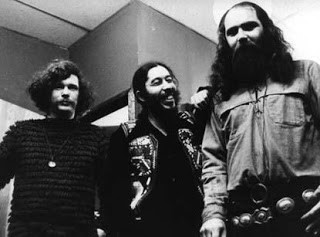
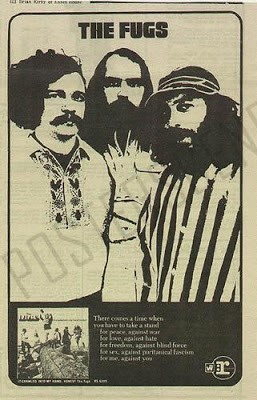
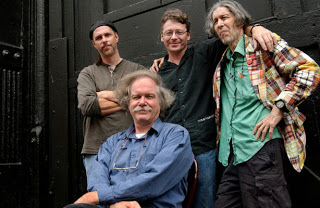
Arrived today and now plays, more of the political [Government Surveillance Yodel] and puerile [Septuagenarian in Love], set to country-tinged harmonies or rock’n’roll parodies, there is ironic wisdom in the humour, for example this sage advice from a band whose core members Ed Sanders and Tuli Kupferberg will have obliterated so many personal bridges in their irreverent lifetime,

Don’t burn a bridge that you’re standing on
Never try to sleep down a burning bank
Don’t try to cling upon a burning plank.

Context is everything, and when you know these lines actually follow

Oh isn’t it true that sometimes
the river is more beautiful
when the bridge is gone

you realise the satire is tinged with real regret as well as silliness. As these hippies rage in their old age the compromise is embraced in the song’s chorus

Mix prudence with my ashes;
Write caution on my urn,
While life foams and flashes,
Burn, bridges, burn.

It’s not an abnegation of the past but an awareness of the present where death is the biggest joke of all, and it is the banal and mundane that drives us to the grave as well as the bigger issues,

Please can I have my job back?
Burn, bridges, burn
I don’t want a divorce, after all
Burn, bridges, burn
I’d like a security clearance, please forget my past
Burn, bridges, burn
I’d like to rent the same apartment, I know I trashed it last year, but
Burn, bridges, burn

[Burn, Bridges, Burn]

And just when you might think The Fugs really have regressed to a primary concern for the domestic, they come up with an absolutely gorgeous song that reminds us of those bigger issues, and the ultimate purpose and power of the yodel,

It’s time to think
of ultimate things
– yodel
what will happen to the soul?

[Ultimate Things]

Another beautiful song is A Western Ballad – For Allen Ginsberg [by band member Steve Taylor with echoes of both Arlo Guthrie and Roy Harper], its potent and political poetry set to a gorgeous tune, and this is what The Fugs can merge so well: meaning with melody.

There’s the wonderfully witty too: getting there with A Short History Of The Human Race and its three core lines,

World War 1: The human race stinks
World War 2: The human race shrinks
World War 3: The human race extincts

and is fully realised with IS, where Bill Clinton’s ‘apothegm’ is captured as a soundgrab to be sampled within the song playfully, set up for its first ridiculing by the lines,

Get ready, Mr. Nietzsche Get Ready, Kierkegaard
Stand down, Mr. Hegel, and Bertrand Russell too
‘cause someone has come up with a homily
that’s sharper than Plato and Wiittgenstein
& shivering with truth

It depends on what the meaning of the word IS is

It’s all good fun [in the album booklet’s introduction and description of the songs, it is acknowledged that Clinton was ‘unfairly hounded by an interlocking geek-pack of right wing nuts throughout his presidency’] so the attacking is assuaged by understanding and explanation rather than any outright contempt – the kind of contempt allowed for rebelling youth and revolutionaries, not senior citizens even with attitude.

It’s not therefore the caustic comedy of early Fugs nor the polished pillorying of it crawled into my hand….., but it is still the brilliance of social and political commentary coupled with clever songcraft, now tempered by the maturity of age and perhaps knowing that raging against it all doesn’t stop it coming.
46


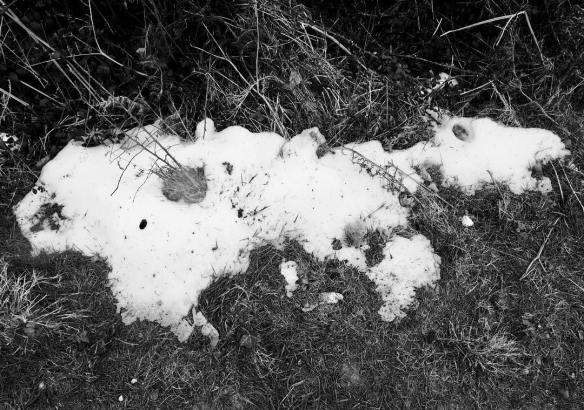
Snow Carcass

28514947_10156150511493544_4551532097241846966_o

Lost, fallen and alone – this snow died.
Thinking no one would care, it became
a carcass, desiring the innate sympathies
people have for the death of an animal
even if their own kind can matter so much
less. Here is its shape of living, an outline
where the hollow look will elicit concern.

There is the other question of its last gasp –
was it running when it fell, exhausted and
somehow scared? This does not register in
the dead grass shooting through its side or
blood of the soil. Yet it is an animal, too big
for petting, but still clean and white and soft
and tugging at whatever strings will melt.

[picture by artist and photographer Nick Dormand]

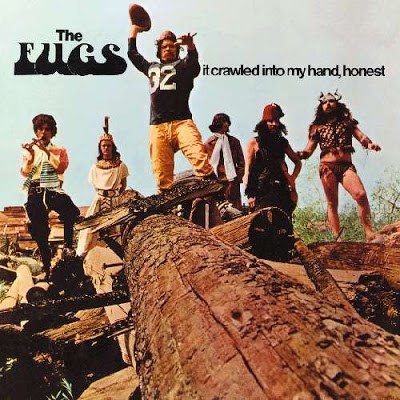
Top Fifty 16: The Fugs – it crawled into my hand, honest, 1968

[Originally posted April 2012]

39

Apocalyptic Intro

This album was my apocalyptic, first introduction to The Fugs and it was only afterwards, some years in fact, that I heard their earlier, rawer material. This record still contains their incipient, trademark preoccupations, essentially from the puerile to poetry and the surreal, but it is overall a much more polished affair, the ‘band’ [with core members Ed Sanders, Ken Weaver and Tuli Kupferberg] having succumbed to and/or exploited a larger budget and the production values going with this.

40

It was a supply English teacher who introduced my 5th year class to The Fugs, using a study of poetry as an excuse to play Ah Sunflower, Weary of Time taken from their first album. He must have shown pictures of them as well and I was hooked immediately with the obvious appeal of hippies and poetry and music and, though not with this track, irreverence and rebellion. I won’t write in detail about him now, but this lanky, informal, eccentric, seemingly worldly-wise and charismatic teacher had a colossal impact on me at the time and opened up new and exciting horizons, musical and poetic, for which I will always be grateful.

The album has two distinct sides. Side 1 is very ‘musical’ – surprising and maybe even unwelcome for those preferring their earlier iconoclastic style – and Side 2 which is a whole side amalgam of songs, chants, poetry recitals, subliminal oddities, and spoken extracts. Crystal Liaison is the beautiful opener on side 1, written by Sanders and Weaver, and it echoes the psychedelic sound-swathes of The Electric Prunes’ Kyrie Eleison, no doubt intentionally, adding blaring horns, pumping bass and a rock lead guitar. It delivers both pastiche and poignancy. Ramses II Is Dead, My Love follows immediately with yodelling and an expansive choral accompaniment. Burial Waltz is even more mocking in its sweeping strings and light operatic additions, but for all this jesting with genres there is an underlying beauty to The Fugs’ production and performance on this album. The humour one would more readily expect comes with fourth track Wide Wide River, beginning River of Shit, River of Shit, Roll On, River of Shit, Right from my toes right up to my nose….I’ve been swimming in this river of shit more than twenty years and I’m getting tired of it which then moves on to the spoken narrative Who dealt this mess anyway – that’s an old card player’s term… and the song mixes its scatology and straight comedy with possible elements of political satire – it isn’t wholly easy to work out. Side 1 finishes with the plaintive Life Is Strange, by Tuli Kupferberg, with its eclectic mix of oriental tones, folk harmonies and jazz piano. The whole side is a rich concoction of musical motifs and lyrical adventure.

Side 2 is so much more wild and wicked. Opener Johnny Pissoff Meets The Red Angel begins with the redneck tirade of Johnny, his racist and homophobic rant as manic and real as it still is today: it is a dangerous parody because of this realism and I won’t actually repeat the words here. But it isn’t left unanswered. In another musically beautiful twist, Johnny’s angry persona is answered by the graceful Country Rock harmonies of the Red Angel who seeks to change Johnny’s ways with its wisdom and urgings for peace,

When The Red Angel comes and the TV is cold,
Will you pray in the dawn for the rest of your soul?
When you lie in the dour death coma,
Do you think you’re gonna go to heaven, oh Johnny,
With a violent heart? With a violent heart?
Are you ready Johnny? I’m the Red Angel.

Ahimsa, oh Johnny, ahimsa!
In the spinning confusion, ahimsa!
In the blood of life, death, and torture,
Ahimsa! Ahimsa! Ahimsa!
Ahimsa, is the seashell of Buddha.
Ahimsa, is the rose and the lamb.

When The Red Angel comes and the TV is cold
Will you pray in the dawn for the rest of your soul?
When you lie in the dour death coma,
Do you think you’re gonna go to heaven, oh Johnny,
With a violent heart? With a violent heart?

Ahimsa is a Sanskrit term meaning ‘peace’ and literally translates as ‘no violence’, or ‘no himsa’. For a teenager full of fear about this redneck mentality and also full of idealism for achieving world peace and love, this song’s double narrative spoke volumes. So much of the album’s themes and my attraction to these are wrapped up in the cultural concerns we shared – theirs real and mine at this time vicarious – and whilst this is in many ways obviously dated, it still resounds. Another example of this cultural context is the gorgeous and surely satirical second track, a Gregorian chant of synonyms for Marijuana, its title. As satire and protest it is beautiful. There are sixteen snippets and fuller songs on this side, and one of the more multi-faceted numbers is When The Mode of the Music Changes, again by Kupferberg, which is complex in its array of musical styles, ranging from beautifully sung balladry to militaristic beats, and back again to lush harmonies and orchestration, then into a funked-up groove, back to a military anthem, and finishing on the peace and calm of its pretty central melody. The songcraft is superb. The snippets and oddities that follow are primarily vaudeville and circus acts, performed as puerile titillations, what Frank Zappa labelled ‘smut rock’, and again as a teenager I thought it was hilarious – and still do. I learnt most of these by heart and sang them when drunk. It seemed cool at the time. Lines like whenever I see the moon on the shore….or see a piano leg touching the floor…..I get horny! [then sung as a rousing chorus]: horny horny horny horny! It is a recurring theme. Another favourite learnt ditty is the song Life Is Funny, sung in the most morose of tones, life is funny, life is free, got all of them goodies coming to me, it’s so funny I could cry, it’s so funny you could die,  it’s so funny….. and I felt then and still do today that the elliptical existentialism of that ending has great meaning……

41

There are other jokes, for example The National Haiku Contest, the winning entry coming from a William Chain, a senior at South West High School in Kansas City, Missouri,

do not tell me I am source of you knock-up
the mud elephant wading through the sea
leaves no tracks

and it is juvenile certainly, but it is this mix of the absurd and silly and at times musically sublime that teases and delights and fulfils. It made the late 60s/early 70s cultural revolution seem like a lot of fun. The album finishes on a simple ‘peace’ chant with crashing cymbals, and we are reminded that within the smut and comedy there has been social observation and commentary. And above all there has been the unbridled joy of The Fugs’ creativity.

42


Sonnet Dancing

28337877_10156141609213544_3774419710853527264_o

Levitating? Come on – strictly, it’s dancing,
not necessarily well, without much energy,
yet it takes two to get anywhere these days,
nail it as they say, and there is a sharing
with that delicate apilado which will possibly
please judges who are simply standing around

and do not object to oxymoron in a style.
Should this pair lose, there is an escape route
through the archway at the back, a corridor to
other tangos in the snow where whiteouts will
be complete as a natural part of the scenery.

Like here, these three steps out of the expected
sync, self-aware, but gliding to the bitter end
in a flourish of another kind of arch and bend.

[picture by artist and photographer Nick Dormand]

Egret at February’s End

Today
the egret is standing in a
flood plain of the Otter’s riverbank
flattened by rushing water from recent
rain, and browned dead by
cold.

Tomorrow
it will be invisible
if it is still and still standing there,
lost in the white of a promised
Siberian Arctic snow,
but we shall see.

Egret irony.

White or buff
and at dusk
just as visible.

This egret is over two hundred years old,
the same Coleridge observed as a boy
walking in this town of his birth,
archiving for later,
dreaming already of an albatross
he’ll never actually see.

Recently,
a great white migrated to Somerset, its
belated chase of Samuel to write his
Rime and Kubla there, opium moving
to nether regions,
deep in
fantasy.

#egret:
taking off
spreading wings
reflection
with snow
with other birds
elegant landing
awkward landing
catching food
female against egret wallpaper

Nuptial plumes
breeding demise,
but xeno-cano
will share
their calls,
little snowies of
sound –
those who haven’t survived
two centuries to sing now.


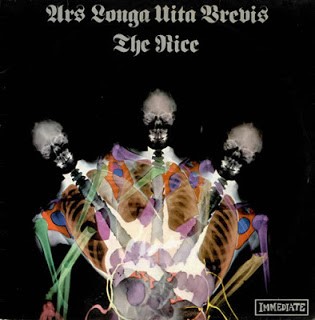
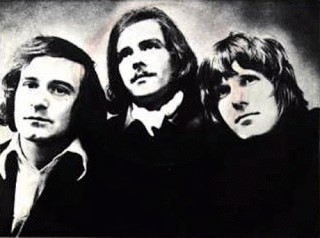
Top Fifty 15: The Nice – Ars Longa Vita Brevis, 1968

[Originally posted January 2013]

37

Lucky Latin

This is one of the earliest albums I owned, and one of the earliest truly psychedelic ones. Released in 1968, I will have certainly had a copy in 1969 for reasons I will explain shortly.

Its psychedelia is a perfect mirror of the genre at this time: there are childlike, playful songs mixed with progressive interpretations of classical music. Indeed, that latter penchant for such acts pilfering from the classical catalogue was the catalyst for me and many others my age to take a serious interest in classical music at a time when we had little reason to do so otherwise, and I certainly had no nurturing from family for this.

A typical playful song is second track Little Arabella with its lounge-organ sound, Beatlesesque horn arrangement, and silly lyrics to a bubbly silly tune. But what wonderful fun. Even opening track Daddy, Where Did I Come From taps into a youthful sense of rebellion [though hardly revolutionary: instead, a conventional birds and bees query] but the question asked is mocked by its melodramatic tone and the naff parental response to which the asker seems to be dying in agonised rejection of that naffness. There is the requisite use of the child’s voice too; with more to come. Third track Happy Feuds is equally pop-central with Keith Emerson’s Hammond organ as the pervading hint that something musically more dynamic is about to happen. Again, childlike vocals sing the essential nonsense of the lyrics, but within that nonsense about ‘knowing themselves’, it actually hooks into the adolescent questioning of personal identity, so I think it really did appeal at the time more deeply than it can – platitude alert – listening now.

It’s fourth track Intermezzo from the Karelia Suite, from Sibelius, where the ‘seriousness’ kicks in. It is a rousing tune in its own right, but the organ with pounding drums and bass of respectively Brian Davison and Ian Hague leading into the jazz organ solo announces its prog credentials with virtuoso skill and volume. It ends too on a psychedelic noise-jam leading back to the romp of its main melody which was genuinely adventurous for its time. Emerson’s L-100 huffs and puffs and swirls are stonking.

That’s side 1 on the LP, and side 2 is the prog rock suite Ars Longa Vita Brevis which translates to ‘Art is long, life is short’, a suitably grand maxim for a band of the time and inclination, and again adolescent aspirations to being creative. Its five movements contain another requisite of the time – the drum solo – and there is also a full orchestra used for some parts. Emerson indulges himself in some piano virtuosity as well in 2nd Movement – Realisation before returning to full orchestra and Hammond for the 3rd Movement – Acceptance ‘Brandenburger’ where the jazzy appropriation of J S Bach’s Brandenburg Concerto No 3 is brilliant, and quite beautiful. The classics made cool for this 15/16 year old at least.

The Latin maxim of the album’s title and the side 2 suite formed the basis for my English ‘O’ Level creative writing exam in 1969. I don’t now recall how I was able to use this and its named movements – Awakening, Realisation, Acceptance, Denial – but I did, relishing the conscious manipulation to sound knowledgeable and informed. I do vaguely remember really enjoying what I wrote and how I incorporated the gist of the aphorism in some youthful declaration of creative intent. Pretentious? Hell yes. And of course I did well, but as an eventual English teacher I never lost sight of the fortuity of the examination process this had presented me and thus its many flaws, though in this case I was able to make positive use of the opportunity.

So for many reasons this album is important both musically and as significant memory and deserves its place in my Top Fifty.

38

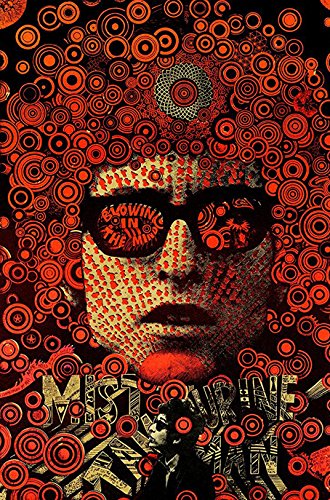
Oz Mag and Me, October 1967

ozdylan

It’s a long time ago thus I can’t remember precisely, but school had already started, so it will have been late September but quite likely October of 1967 that I first came to England, living in Ipswich and going to Chantry Secondary Modern School for the cultural shock of my life.

It was either ’68 or ’69 when I had the poster above hanging on my bedroom wall with many others, my Dylan the full red/orange colour, as I recall, and a shiny gloss surface.

bob red - Copy

I mention because you can – as I currently am – download the entire Oz Magazine collection here.