A Mother

I forget
how my friends

will still have
their mothers.

They visit
or even talk

from a distance
still here.

There is so
much technology

too.
I imagine

catching the train
or airplane

or even driving –
though I am not sure

why there
must be a

journey: it
just seems

there is somewhere
to travel to meet.

Rant Recall

fbook

Facebook Memories are a clever way of trying to convince users that they say useful/important things once and it is worth sharing that again 1, 2, 3 or more years down the line. Of course, it is just to encourage users to use – there is no deep-rooted altruism and/or client support!

I was reminded today through Facebook Memories of a former rant of mine, and my main inclination for printing it here [I am not sharing on Facebook] is that I have tried to stop Facebook rants but am rather proud of this one so will share instead on this blog.

It also links to a previous post on this blog here about school uniform, so there is a direct connection. More importantly, as I say in the original rant, this is all a false avenue diverting attention from the real issues and nothing in this respect has changed.

For example, last week’s Association of School and College Leaders’ conference was informed by political and other non-professional interference with nothing other than deflection and diminution on offer: there was Theresa May’s continued fatuous infatuation with promoting grammar schools [supported in the Spring budget at the very time new funding arrangements are decimating school finances across the country]; Justine Greening’s appearance at the conference to ape this promotion to the universal dismissal of professionals, and new Ofsted Head Amanda Spielman also there to attack schools/Heads that remove students from certain examinations [and similar tactics] to improve attainment/meet targets.

That latter factor is of course a reality, but the reasons for it are ironically – and appallingly so – because of decades of irrelevant target setting and consequent school bashing for failures to meet the merely measurable. The point is that these interlopers – all with investment, accounting, banking and similar backgrounds and precious little experience in and of Education – dominate and destroy the educational landscape and any attempt it has to define itself through professional narratives.

Therefore, it is hardly surprising that Heads and others even in education, desperate for something to control – but also and obviously those outside of it – fall back on the trivia of the impact of school and teacher uniform/dress.

I entered teaching in 1980 and there was much then that was about teaching by teachers, either specifically about my subject English or more generally. There was Bullock Revisited which ignited thinking about and practice of oracy [Speaking and Listening], and even the Cox Report and its programmes of study had some professional sense to its prescriptions.

I entered the profession at a time when John Dixon, David Holbrook and Peter Abbs – among others – had much to say that was inspirational about teaching English. There was the Resources for Learning Development Unit work that introduced new approaches supported by materials for English teachers – and I would spend weekends producing my own similar ones, enthused by the ideas and positive responses from my students.

Where is that same professionally focused work today, either general or subject-specific? And even if it does exist, who has the time to pursue and engage when the targets and all the attendant pressures of that dominate – dominate school leaders and teachers?

There is, I know, some – I have reviewed it here: Making Poetry Happen by Sue Dymoke, Myra Barrs, Andrew Lambirth and Anthony Wilson, and I noticed recently that Sue Dymoke has been pursuing further research into meaningful aspects of teaching writing. But I have only been able to follow this in retirement.

And that is what I have wanted to write recently, and now I have, prompted by a former Facebook rant, reminded about today [and the original Guardian article here], and here it finally is, still relevant:

This isn’t really a complex issue, but I will simplify it to an extreme to make the point: a good, effective, compassionate, humane, funny, informed and innately talented teacher could teach in a onesie and after the initial novelty had worn off, the students would be engaged and learning; an indifferent, charismatic-bypassed, authoritarian or weak [doesn’t matter which pole], humourless, soulless, ill-informed, and quite likely a member of Senior Management teacher in the most pristine suit and tie [the image tends to be of a male] couldn’t teach worth old dog’s poo because there is nothing/zilch/nought in the sartorial facade that can make-up for crapness, and the students – who probably don’t really know who this asshole is anyway because he/she is so consumed by nothingness – won’t be fooled for one nanosecond and will not be engaged nor learn.

See, not complex at all.

Ok, so you pressed ‘read more’ and got this far: thank you. Yes, I’m off on one, again. So you must like this. I don’t mean you have to ‘like’ this but I always like that. Now here’s the real deal – at 60 and into my 4th year out of the classroom, I do reflect back on what could have made me a better teacher, especially in those last too many years when I wasn’t what I was. And I never think about the clothes I wore! I do sometimes think I could have used less naughty language in the classroom [I see someone was recently brought before the Teaching Council – or whatever it is – for saying ‘crap’ in the classroom! Fucking hell, just the word ‘crap’!!]. I know why I did it, and sometimes I genuinely couldn’t help myself, and I think I got away with it, but I might have changed that. But not my casual attire!

This is all a false avenue diverting attention from the real issues that affect learning and I have allowed myself to be detoured. No doubt the Ofted Inspector/s who made the observations about teacher dress wore formulaic grey suits and thus encapsulate exactly what is wrong with the whole pathetic premise of their observation: as Inspectors they weren’t good enough for the classroom. And they probably wore their suits when they were those nominal teachers.

And of course this article more or less dismisses the nonsense of it all as well! I just wanted to join in the rejection.


Alternative Peace

How is it there is
less to reassure

when we regard the
history of our world?

Perhaps it is the
wishful thinking

from all that music,
poetry and other

peace paraphernalia
in a recent past

that urged us to this
former expectation.

Perhaps it is our
children, teaching,

relative wealth too,
and imagining

language would
matter more widely.

Now there are too
many words framed

in quotation marks –
to name one modern

mystery that scares.
So what is ‘peace’

when there are so
many alternatives?

Clip-Ons

A school not so very far away, a very successful comprehensive by any measurement, has a new Head who has felt the need to stamp his personal stamp and ‘improve’ it further, so like many new Heads desperate to – no, let’s just say desperate – he is introducing a new school uniform which will include a coloured blazer and clip-on ties. That will do the trick, I am sure.

It reminded me of my former school introducing the same a few years ago. I wrote about it then. I’m sharing now as my distaste for such hasn’t waned.

It’s not high art, by the way.

Clip-Ons

‘Clip-ons. Geeettttt yourrrrrrr cliiiiiiip-ooonnnnnns. Two fer two paunds; four fer three paunds. Clip-ons. Geeettt yourrrrr cliiiiiiip-ooonnnnnnns ‘ere!’

Two men stand at the entrance of the locked school gates next to a trestle table festooned with a row of school clip-on ties like an elongated spread of psychedelic piano keys. On its own, an individual tie is quite ordinary in its conventional stripes, but when laid out like this, the colours become an optical illusion that is surprisingly attractive.

One of the two men stands quite still, indifferent to the early morning gathering around him; the other is obviously energised by the sing-song elasticity of his salesman’s spiel. Apart from the incongruity of this surprise enterprise outside the school, the man enunciating his best early Eastenders’ Ian Beale patter is wearing one of the recently instituted new school clip-on ties and also appearing somewhat absurd in his jeans and denim shirt.

‘Good morning gentlemen. Can I interest both of you in our very special deal on these clip-on school ties?’ the chirpier of the two salesmen regales teachers Paul and Robert as they arrive together for work. ‘Ask your good selves, why should the boys be the only ones to benefit from these beautifully hand-crafted clip-ons now that male members of staff have been instructed to wear ties too? Just think of those extra essays you can mark or charts you can fill in before leaving home for work  rather than wasting time having to knot your own?’ he adds with a smarmy alacrity.

Paul is the first to speak as he walks straight past,

‘Go fuck yourself. Toodlepip.’

Robert stops and smiles politely. Years of being a genuinely amiable and kind person prevent him from behaving like his much more grizzled and caustic colleague. He walks over to the table and touches one or two ties as if to corroborate their existence, and in this tactile gesture of recognition he also feels compelled to engage in the proposed purchasing discourse.

‘I used to be a professional footballer,’ he begins tentatively – not because he hasn’t told the story he is about to tell before, because he has many, many times, but because of his pleasant inclination – ‘and I once met Brian Clough who always insisted that any players on one of his football teams wore a club tie.’

‘You are so right my good Sir,’ the chirpy one responds obsequiously, sensing his capture. ‘We sell a lot of these up and down the country as Academies recognise…’ he stalls whilst seeming to trance into a mental search-mode for an internalised recording of a more complex pitch ‘…the link between professional dress codes and target achievement acceleration…’ when just as stutteringly as he had switched to this prepared premise he reverts to his previous fruit’n’vegesque appeal ‘…and they are only two fer two paunds or four fer three paunds, and that’s a bargain mate!’

Robert pauses before replying, but then does so with considerable emotion,

‘I’m not your bloody mate,’ he swears surprisingly – not because he is swearing but because he isn’t playing five-a-side whilst doing so – ‘and I’m fed up with all of this nonsense. My actual mate Cloughie would never consider wearing a tie as such a shallow device, and wore his own green jumper with genuine pride…’

But before Robert can collect his thoughts to a more cohesive rebuff, Paul suddenly reappears and interrupts. His face is contorted in its usual contempt for the paucity of thought and creativity in those around him – and especially those notionally above him – and he is wearing a full length clipless school tie wrapped around his forehead and looking like John McEnroe playing Macbeth as he approaches the slaying of Duncan.

‘You tell these rascals!’ Paul acknowledges Robert’s outburst approvingly. It is at this point Robert notices Paul is carrying a wooden sword, the kind he used to thrust about histrionically on Shakespeare Days organised years ago in better times by his dear friend Ken who now spends his time organising whole school clip-on tie demonstrations where local employers come into school and advise students on the guarantees for academic success and jobs for life if they learn to wear their clip-ons with sartorial superiority, or a well-tutored approximation of this.

‘To clip on or not to clip on,’ Paul shouts as he approaches the trestle table, ‘and that is not a rhetorical question!’ he shouts even louder as he sends the neat row of offensive merchandise flying, flailing his sword up and down the display whilst also hitting with a wayward parry the quiet salesman who has continued lounging disinterested at one end throughout this brief encounter and whose newly smashed nose starts to bleed immediately. Paul turns to strike with intent the other noisy one, but he has already exited this impromptu early morning stage and is disappearing in unseemly haste towards the English block.

‘What have you done!’ Robert asks shocked but oddly smiling.

‘I’ve made a statement for two teachers who are soon to retire and shuffle off from this educational coil and toil,’ Paul responds pompously and theatrically, his robustly righteous yin to Robert’s equally honourable but calmer yang. ‘What can they do, sack us?’ he adds with a riotous guffaw, ripping the tie from his head and trodding it into the ground as he and Robert enter the school’s front door arm in mutual arm, both heads held as supremely and serenely high as only years of truly tieless professionalism can achieve.

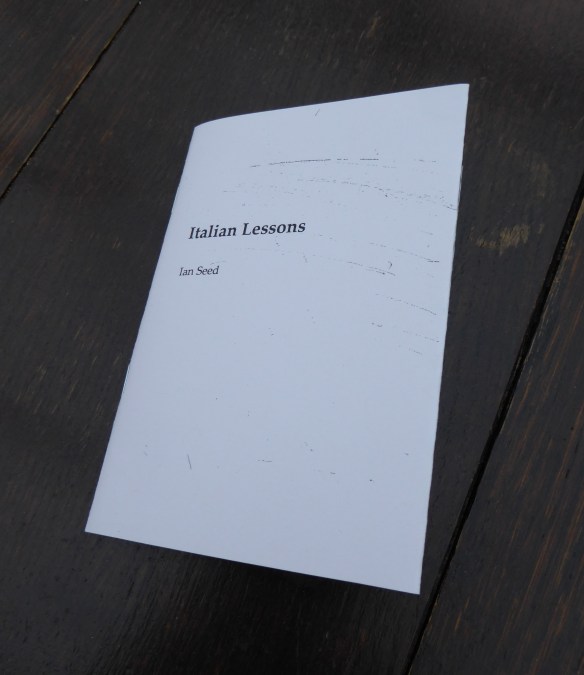
Italian Lessons – Ian Seed

p1000833

If you have read Ian Seed’s poetic narratives/vignettes before [and you can read two reviews and reflections of his previous work here] you will know what to expect. And if you have read his work before you will know that you should not expect.

Italian Lessons fulfils such certainty and uncertainty. This is a short but complete story, and diverges from the randomness, surprises [absurd, comic or disturbing] and dislocations of place and experience that feature in the vignettes readers of his work will be used to. The setting in Italy is, however, familiar, as is the graceful simplicity of description and setting of tone. The mysterious, as thematic echo, is far less evident as this reflection on a ‘young Englishman’s first weeks of living, working and falling in love in a foreign country’ is quite conventional as storytelling.

But there are shifts in time and shifts in mood and shifts in what we as readers might expect and/or hope will happen. As with his other writing, that is for the reader to experience rather than reviewer to reveal.

As the blurb tells us, this is a ‘bittersweet’ tale and I think it is most apt as summation of mood. Characters are quickly sketched but real and worth caring about, especially their engagements with one another, as with Anna and our first person narrator Ian – so there is this personal anchoring. Elements of the spoken broken English, the teaching of English, and the spoken Italian with, thankfully, repeated English translations have a simple but affecting way of establishing a natural and authentic setting.

It is a warming read at one sitting of absorbed and gentle empathy for the experiences we have when younger and which define us.

Italian Lessons is published by Like This Press. It is worth mentioning because with this small private press there is and always has been a production ethic, and that is for ‘publishing high quality, beautifully designed, and largely handmade books that do things just a little bit differently’ which I fully endorse – earlier publications included boxed editions, for example Rupert Loydell’s Tower of Babel, still available, with postcard paintings inside the box with its poems. Italian Lessons is a ‘hand-bound paperback with French folds’ and recommended, obviously, to read and have both as pleasingly palpable experience and object.

For more details and to order, go here.

Predicated on Belief

I don’t want to come back to this. It’s late for one thing. I’m also trying to watch an episode of West Wing. I’m well through series 1 of a box set and it has been a fascinating contrast of its original rose-tinted and liberal romanticism, dramatically heightened with comparison to the now of Trump’s Presidency.

Did I simply say ‘dramatically’?!

But I did catch a snippet of a BBC post-Trump-Florida-speech discussion with an American journalist/pundit working in England. His observation was how Trump had delivered a ‘masterclass in communication’. He wasn’t endorsing the message at all, but [similar to aspects of the West Wing] he contrasted Obama’s consummate oration with Trump’s plain talking directly to the people and stated how effective the latter’s was.

I can see the point. However, I would have to believe that Trump believes in and understands fully what he is talking about to call it effective or anything remotely positive, and I simply don’t. He has said too many downright nasty and dumb things for this to be the case. I don’t believe his backers and puppet-masters, like Bannon, have the interests of the ‘ordinary joe’, as the journalist/pundit put it, at heart at all. Far from it.

Ok, back to Jed and a world that will and never has happened, even under Obama.