Letting Lose on the Lackey

The following letter is my response to the one I received and posted on this site yesterday from a representative of Nicky Morgan. He works as a civil servant in the Ministerial And [sic] Public Communication Division, which sounds like a euphemism for a Ministry of Misinformation. The letter certainly fulfilled that cynical purpose.

I recognise my response could be called naive and a rant. I would reject both claims. I know only too well my response is likely to be ignored completely: this will be the following stage on from the letter itself which ‘responded’ but studiously ignored specific points made – they will simply cease any more ‘communication’. I don’t believe it is a rant, though it is impassioned, but I would like to think there is a coherence to my argument, as well as truth. I have had 20+ years of such experience directly with Education Secretaries, their civil servant lapdogs, other politicians and other leaders of various government institutions: responses which deflected from any direct answering/dealing with queries, or just ignored.  But I can’t quite stop myself from fighting against the barbarians. At times I know there is a risk that can be a pedantic cause, but in this case it is challenging Gove’s original and significant untruth about the situation as well as the subsequent mere parroting of that deception.

As a final preamble, I watched last night’s episode of The Good Wife where Alicia Florrick is being tutored in the art of politicking as she runs for State’s Attorney. In one scene she is being rehearsed to deal with with probable tough questions from an imminent interview with a TV legal commentator Frank Prady. A sample question is put to her and she begins answering before being stopped immediately by her professional coach. I can’t remember his exact words, but he explains that she should never actually answer a question. All questions should instead be ignored and she should alternatively persist with whatever ‘party’ line she has been given. I know this is hardly apocalyptic, and we see similar blatant evasion every day from our real politicians, but it struck a chord with me last night in the way it completely characterised the letter I had received: not a single specific query of mine addressed, but instead the total disconnection in the unfolding of and persistence with the ‘party’ line.

My letter:

Thank you for your letter of the 10th March in reply to mine to Nicky Morgan of the 7th February. Whilst I have to accept your explanation that the Secretary of State was too busy to reply herself, I do wonder if she would actually fully support the ignorance and affront of your response sent on her behalf.

My first point is to state how astonished I am by your complete regurgitation of the narrative that ‘no authors, books or genres have been banned’ which I had taken such care to unpick and challenge. You ignored completely my analysis of the effective banning of – let me be precise again – American authors from being studied and examined at GCSE, hardly a nuance of interpretation and one I think deserved a direct addressing. In every other respect your letter simply repeats all those previous dodges and defenses that Michael Gove had presented himself, and which I was querying.

I will re-present my precise query to Nicky Morgan in the hope she will respond herself. In support of this I will be drawing to her attention, and to others more widely, your personal assertion ‘Parents will rightly expect their children to read more than four pieces of literature over two years of studying for their GCSEs’. This is a preposterous observation. It exemplifies the most staggering lack of understanding of facts, let alone the realities of at least the last two decades of such similar study. This daft obfuscation is compounded – though it would seem impossible – by the comment ‘as they will in future be tested on unseen texts which can be by authors outside the exam board specification’ which does not in any way relate to the study and examination of American prose and drama authors which is, of course, the specific detail of my query.

I need to unpick things again for you, though I am really doing so for Nicky Morgan and those others. Firstly, from which deep pocket of not-knowing do you pull the comment on perceived parent expectations? As an English teacher of 30 years and a GCSE English Literature senior examiner of 28 years I know of no clamor from parents about a need for students to study more than four texts for their GCSE examination [one of these including a significant number of poems]. In addition I am unaware of any similar clamor about this number from Government sources over that time, from HMI, from Ofsted, from Ofqual, from school governors, from business, from professional education bodies and so on. As these four texts/areas of study have been the status quo for such a long time, from where have you extrapolated your assertion to use as such a key plank of defense [a defense which is again NOT addressing my key query about the effective banning of American authors]?

To put this in a wider context, that throwaway comment of yours that ‘Parents will rightly expect….GCSEs’ is absurd. In their study of both GCSE English Language and Literature, students will encounter, engage with and study a significantly wider range of texts, and not just literary as that range will necessarily embrace a huge spectrum of non-literary texts. The even wider context is that the two years of GCSE study will include all of the students’ other subjects and content, including countless texts! This is such an obvious point it seems silly to mention, but your assertion has mischievously ignored that context. Or you really are hopelessly unaware.

Secondly, and quickly, the study of four texts/areas for the purpose of being examined on these requires far more than reading, and yet that is the word you use: ‘…read more than’. The teaching of a text for study and examination is a detailed and highly structured preparation that includes far more than reading: there is analysis, exploration, revisiting, stepped written work on themes, characters, meanings and much more, plus the actual exam practice of writing for an examination, all of which is, quite rightly, time-consuming. Failing to acknowledge that significantly wider context – just for English Literature – is, as I have said, mischievous. And I am being polite.

Thirdly, you make another meaningless observation. You refer to ‘…as they will in future be tested on unseen texts which can be by authors outside of the exam board specification’. This is meaningless because it has no bearing on my precise argument that American authors have effectively been banned. The unseen texts refers to the unseen poetry text/s [one for AQA and OCR; two for Pearson] that will be set in the examination for the response to the study of poetry. The phrase ‘in the future’ is a further irrelevance because that is the situation now and has been the status quo for some time, so yet again your not-knowing is staggering and also therefore insulting when presented as an explanation.

It then becomes an absolute certainty that you are utterly out of your depth when you suggest that books such as To Kill a Mockingbird and Of Mice and Men can be studied by 11-14 year olds as the ‘seminal world literature’ they should be accessing at this age. Would this, by following the logic of your previous judgments, also include The Crucible? I ask because these long-standing, traditional GCSE texts have been chosen precisely for that age range considering their themes, language, content and other factors and I am intrigued as to how you would suddenly judge them as now equally appropriate for a significantly younger age and level of maturity.

In conclusion, it is shamefully evident that you have ignored my precise query to Nicky Morgan and instead read through the English Literature subject content and assessment objectives document for teaching from 2015 and simply and sheepishly lifted in chronological order statements from that to offer as a formulaic, ‘hymn-book’ response. This is exactly the same cut-and-paste regurgitation my MP Hugo Swire undertook when he too could not find an actual answer to my specific query. The final insult in your letter was to refer me to that very document. I trust it is clear that I know it thoroughly. It is as clear as your complete lack of knowing and understanding what it actually means.

Nicky Morgan’s Minion

The letter below is what I received today in response to my letter to Nicky Morgan – posted on this site a few weeks ago – about the effective banning of American authors from GCSE English Literature being taught from September 2015.

I am not surprised it isn’t from Nicky Morgan but is instead sent by one of her lackeys. I am also not in the least surprised – though obviously both disappointed and incensed – to receive this complete regurgitation of the entire narrative I had so carefully unpicked and challenged. This isn’t disagreement with my argument: it is completely ignoring that argument. It is thus – and I think this is beyond a simple matter of opinion – risible, insulting, patronising and despicable. My more trenchant argument and response will be in the letter I write in return, probably not today for obvious reasons, and posted here when finished.

nm minion again

Challenging Lemov

1. Less is more: government initiatives should be limited to one side of A4
2. Targets are for archers, not teachers: adorn your classroom with who you are
3. League tables struggle to measure the sensitive inside leg
4. You can lead a horse to a test but that won’t make it think for itself
5. Teaching is like riding a bike: when you fall off it hurts
6. Ofsted is awful: sound and symmetry and sense
7. If they’re laughing they’re learning
8. Don’t wear a tie just to look like a teacher
9. A full house beats a flush and metaphor beats the literal, hands down
10. Praise everything said that is serious and genuine
11. The best objective is that which discovers itself by accident
12. Only one of the Gospels reports seeing a four-part lesson plan
13. The ‘wrong’ answer often reveals how learning works wonderfully
14. If a sonnet has 14 lines, is this a poem? Discuss, but there is no answer

Writing Workshops – Interviews [digital resources]

I had the great pleasure of being involved in a few of the interviews that make up a huge digital resource underpinning the whole English ‘package’ being offered by Cambridge University Press [see previous posting]. This ranges across interviews with authors, performers, and academics (for A-level) to dramatic presentations of play excerpts, with exploration, and poems.

10443237_10155002852388125_1230493295414555266_oOne of those interviews was with Lemn Sissay, MBE, the brilliant poet, performer, writer, broadcaster, and social commentator. Lemn made a writer’s visit to my school many years ago and I have always regarded him as someone who lives to write and be creative as well as enthusing others to do so. Lemn contributed excellent poems to my previous book Poems in Your Pocket by Longman, and he makes a number of short commentaries for the Writing Workshops units where I believe his honesty and enthusiasm, as brief as digital clips need to be, will provide genuine stimulus, as well as grounding in real experience,  for students.

10708643_10155077414908125_5554473487124241176_o

Another was with the American author and musician Willy Vlautin whose debut novel The Motel Life was recently made into a film, and whose band The Delines produced, for me, the album of 2014: Colfax, his spoken narratives getting further expression through music.

There is a Writing Workshop about dialogue – Pete Can’t Speak. But You Can – which uses an extract from Vlautin’s award-winning and third novel Lean on Pete. As a huge fan of American writers John Steinbeck and Raymond Carver, the tradition of presenting the simplicity and yet potency of realistic dialogue is continued in his own work, with Lean on Pete providing memorable examples. Willy’s interview about this and other aspects of his life and writing is brilliant and I thank him for his honest enthusiasm in giving it.

My WW writing partner Martin Phillips has been at the forefront of producing all of the digital material used across the entire ‘package’ I have been referring to and it is a treasure trove of insight, examination, exploration and engagement covering all aspects of the study of English at both GCSE and A level.

Writing Workshops – Cambridge University Press

DSCN1865 (2)

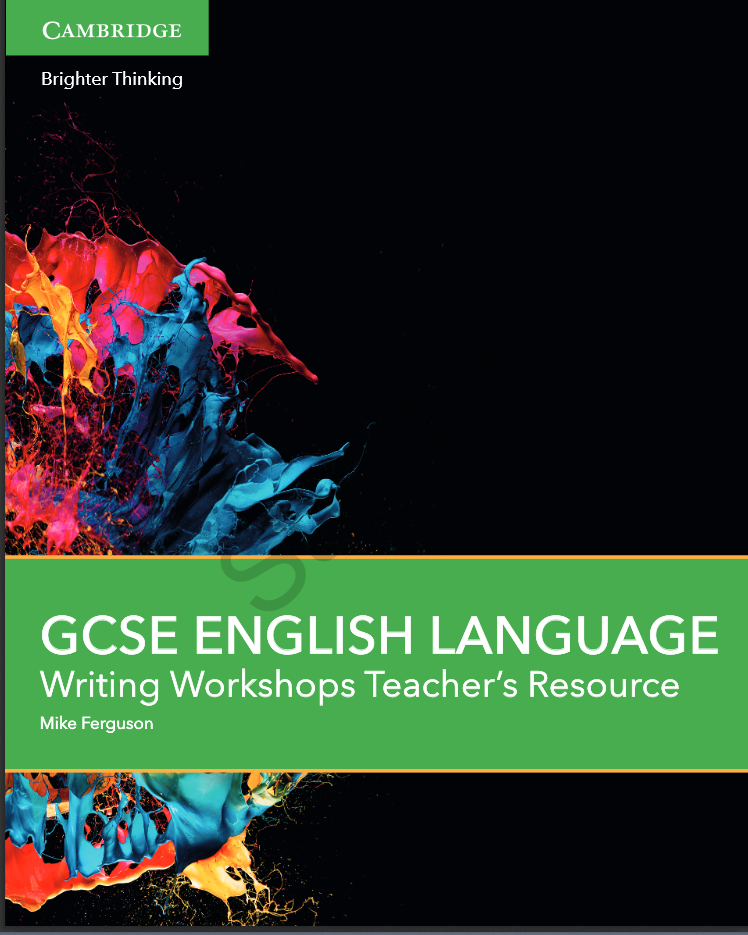
Just published, this is a stand-alone book or it can be purchased/used within the expansive GCSE English ‘package’ being offered by CUP for the AQA syllabus to be taught from September 2015.

This book, however, written by myself and Martin Phillips, is not tied to any particular examination board and focuses exclusively on Writing, treating students as writers and underpinned by the ethos that a priority regard for writing skills and experience above assessment objectives is the best preparation for the inevitable requirement that students will have two writing tasks in their final GCSE examination – whichever awarding body sets this.

The workshops aren’t intended to appear particularly innovative in such a text book – apart from excluding the clutter of constant references to AOs and similar – but instead offer straightfoward, tried and tested classroom activities that engage and encourage students as much as is possible in the writing process. That said, we think the stimulus and ideas provided also offer new and appealing material at this level.

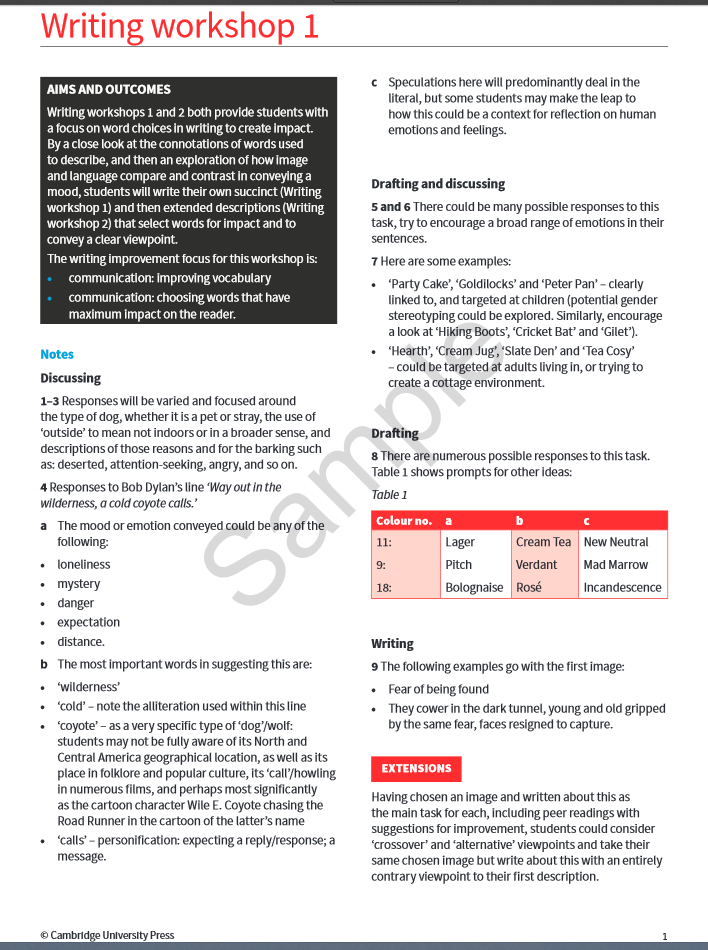
Whether bought as a stand-alone or part of the larger ‘package’, there is considerable online digital and other supporting materials specifically for this text, as well as a dedicated, and detailed, teacher’s resource which I have written and will be available free online from, hopefully, April.

DSCN1867 (2)

Those ‘specific GCSE skills’ are actually writing skills, but of course the latter informs the former: our ethos. Each workshop begins with – and the language is chosen purposefully – a ‘writing improvement focus’.

Not a Parallel Universe

RBS announces today a loss of £3.5bn [that’s BILLION] for 2014 which is a failure, and yet it will be paying out bonuses to staff from a pool of £421m [that’s MILLION].

A school doesn’t meet its targets [that’s OBTUSE NUMERICAL BENCHMARKS] so is put in special measures which is deemed a failure, and staff, mostly teachers, get blamed and undermined and upset and depressed and maybe leave the job or get sacked in forward-thinking Academies [that’s JUST HOW IT IS].

Apparently you have to pay bonuses to bankers to keep them in the job, however poorly they do.

Apparently you can crap all over teachers and they will come back for more [if they  survive] because they care.

Gove and ‘The Crucible’

gove letter 2

This is the neighing from the horse’s mouth. My local MP had represented my ‘banning American authors query’ in the first instance – thus this response from Gove to him – but I should point out that when I naturally challenged such explanations from this letter again through my MP, he personally responded with more of the above to state he wouldn’t further my questioning because he agreed with Gove, but did so by simply, and blatantly, cut-and-pasting from the DfE/Gove’s justifications – so I stopped that route, and then Gove was gone.

I have made the point about this deceit well enough I think in previous postings, but I thought it useful, for those still interested, to read this if you haven’t already challenged and received similar in the past.

I’ve considered this a ‘clever’ response and argument, and in the negative use of this word I think it is apt enough. There is much that obfuscates in this letter by suggesting there is a grand design across Key Stages 3 and 4 to instill a ‘solid grounding in English Literature’ and for pupils to read ‘widely and freely’. This is completely undermined by his risible notion of the GCSE Orders representing a ‘minimum’ requirement, and not the ‘maximum that we consider them [students] to be capable of studying’. This is so utterly naive [being generous] and deceitful [being candid] in suggesting (a) exam boards/awarding bodies could countenance setting other texts to that minimum, with all the implications for mark schemes and actual awarding grades to accommodate a potentially infinite move beyond that core, and (b) perhaps the most depressingly pragmatic obstacle that there just wouldn’t be time in a full whole-school curriculum for anyone to pack in yet more.

But of course, English students will instead be absorbing a ‘seminal world literature’, and thus those effectively banned American authors within this mix, in their Key Stage 3 curriculum where there would be loads of time for such.

The Crucible as a year 7 starter text perhaps: exploring lust, sin and death as metaphors for the abuse of political power?

Hauntings

I have been searching for a piece I wrote some time ago about my  own secondary school education to post here. I recall writing this about my secondary modern – just a damn good ordinary institution on a council estate in Suffolk – a model from the late 60s to contrast with the target setting and management driven culture model of schools today [or even back then when I wrote it – that culture has been here for some time now!].  However, I can’t find it.

In searching today, but also when I habitually return to such past writing, I come across articles, documents and HOD minutes I have written over the years whilst still in the job. For some reason, I have this masochistic urge to revisit these – they aren’t all dark, but so much of what I had to write was reactive, and usually reacting despairingly, and almost always angrily, to some nonsense from within or outside the school.

I came across the following which was the ending to a memo I was writing to my wonderful team about an impending review from someone in our local authority, someone with whom I had little respect or regard and who lived up to those feelings. As was my wont, I framed the memo by, at the beginning, referring to my recent reading of some excellent Raymond Chandler-esque narratives my year 12 students had written for publishing within the school, and commenting on how their writing expertise was a clear reflection of the superb teaching from the entire English team as those students had worked through the school to year 12. I ended with this:

I thought long and hard about the impending review. I’d worked with shysters before and this had all the hallmarks of some sham run by a gang of people in high places with low morals. It could rain all day on this parade but nothing could wash the stench of an unnecessary intrusion away. You can’t play chess with a dog that just wants to gnaw at a bone, I thought. You could kick its teeth out and even chain it somewhere dark and dirty but dogs were a dime a dozen in these kinds of streets. There were always more to hound you. I’ve been doing this job for years and I’ve managed to surround myself with a few good people who know the difference between a naked dame and a girl without any clothes. I didn’t want no one telling me which one I could sleep with. Neither did they. I took another drink and wondered how many more I’d need before a new day promised me something it would take too long to deliver.