
Here, with thanks.
Here, with thanks.

[Image by artist and photographer Nick Dormand]
Here’s my two pence worth on The Royal Wedding. I’d decided I wouldn’t watch any of it on TV [the obvious lefty-leaning reasons: the privilege, the pomp, the profligacy at a time of years of austerity for most, the cost to the State, the PR rebranding of the Royals as an institution of relevance] and I was therefore outside mowing the grass noisily in a protest only my neighbours would hear.
When I came indoors having manicured the lawn in my dissent, it was later than I thought and the TV was on, my wife V viewing the spectacle already well on course in an understandably watchable moment. I headed as intended straight for my computer, but when I sat down, I heard the strident but also musical voice of Bishop Michael Curry who was already in full flow. It was irresistibly intriguing. I went in to watch, and was captured. Not being religious nor, as already stated, keen on that kind of ceremonial event, I was nonetheless drawn to Curry’s powerful invocation of the power of love, and to his civil rights’ touchstones. It was also hilarious, in many ways, to immediately sense but also witness the incongruity of that delivery in the Royal context and all of its otherwise conventional, sedate, reverential, boringly predictable and clichéd expectations.
And to see the look on so many bemused, shocked faces! It was wonderful. You either watched it or you didn’t: if was joyous to observe – the injection of soul into an otherwise traditionally staid event. My personal favourite moment – more comic than moving – was in this line from Curry’s speech [read the whole here], Anybody get here in a car today? An automobile? But you had to hear it live for the comedy to make sense. Curry asked the question and then paused – that pregnant pause waiting for the expected assent, the yeahs or nods or hands up, but when there was no response and just the still air of indifference/uncertainty/unknowing, he clarified to this largely British/UK attendance with that American word automobiles! Brilliant.
And then this was followed by the black gospel Kingdom Choir performing the glorious Stand by Me, resonating with its inherent civil rights meaning and the deep beauty of its melody. With these two moments I was hooked – but at the point of H and M’s vows being taken, I did immediately go to the kitchen to prepare the pizza for V I had concocted the night before: a colourful range of vegetables, yet my inspirational crumbling of sweet potato pakora with its fiery red pepper was, in the end, perhaps accidental/incidental homage to Curry’s reference to fire from the writings of Pierre Teilhard de Chardin.
Continuing with my proclivities, I read this morning’s Observer with special interest in its reflections. I enjoyed, as I always do, television correspondent Euan Ferguson on the banalities of much of the TV coverage, as well as that which took a lighter perspective. I was initially convinced by Nosheen Iqbal – and don’t challenge her optimism for its purposefulness – in an article titled Astonishment in the pews as dose of civil rights puts seal on a radical wedding – but I was then more swayed by the sense and questioning of such reverie by Kenan Malik in his piece Meghan Markle can’t make feudal privilege acceptable.
For my part, I found the following in the listing section of Curry’s powerful sermon, able to relate to his calling for love in the world though not seeing it in any Christian or other religious sense. It seems to me we do not need the ceremony and privilege and institutionalised programming of such a call to be better:
the way
imagine like we love
is the way
imagine when love is the
imagining
imagine when neighbourhoods and communities
become the way
imagine unselfish, sacrificial, redemptive
governments and nations
imagine there’s plenty
of good room
imagine a mighty stream and righteousness is
imagining
imagine business and commerce
become history
imagine when we lay down our swords
is love
imagine when to study war is
imagining
imagine our homes and families
shield us all
imagine we actually treat each other
like love
imagine the earth
is the way
imagine this tired old world
is the way
[Originally posted May 2011]
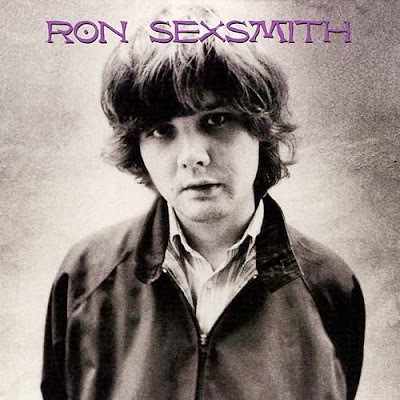
It doesn’t matter at all, but I wanted to make sure I had contemporary as well as 60s/70s albums in my notional top fifty – though I don’t know why I should feel so compelled – and Pearl Jam’s Ten is there, and now this by Ron Sexsmith. However, Ron Sexsmith was released in 1995, technically his second but in reality the first album that made him known as the brilliant singer-songwriter he is, and along with PJ’s 1991 effort I don’t seem to be all that recent in the end. Not that this is the end, but you know what I mean.
Ron Sexsmith is simply beautiful. When I first heard this eponymous album I knew instantly there was genius at work, for me at least, and that is one of those phenomenal aural experiences you have every now and then and never forget. This blog was created to articulate musical awe and has, but it has also been sidetracked here and there, so writing about Sexsmith returns me to address that initial purpose.
Ron Sexsmith has an angelic voice and all of the songs on this album are sublime. If it is appropriate to make a football analogy then this album is Barcelona and I will leave the reference there to avoid an extended metaphor that could ultimately detract from the music. But this album is in the back of the net.
As I read the song-list for his album I can hear each one instantly. That says something about the excellence of the songcraft. Whilst every single one is a Messi goal, extra-special free-kicks are Secret Heart; There’s A Rhythm; Lebanon, Tennessee; Speaking With The Angel [and just writing that title I hear its plaintive, yearning and gorgeous vocal]; Waistin’ Time; Galbraith Street, and There’s A Rhythm.
In the Stadium of Singer-Songwriters this album is a true champion. Aural crowds chant Sexsmith’s name.
Ron Sexsmith now has a body of work that firmly establishes him as one of Canada’s greatest musicians and a singer-songwriter to compete with the best from any nationality. I don’t think any of his other albums can compete with this one – and that is so often the case when such brilliance is crystallised in one remarkable musical moment – but throughout these there are echos of that incipient excellence as well as maturing depths both in musical variety and lyrics which plot a life and career [for example, Long Player Late Bloomer].
I wanted Manchester United to win the Champions League Cup but the majestic football of Barcelona made them the rightful victors and it was a joy and privilege to watch. There is a connection to Ron Sexsmith over and above this playful if unoriginal football analogy: it was soon after the release of his second but significant album that I saw Sexsmith play live in the great city of Manchester. That too was a memorable experience.

Very pleased to have my poem The Imaginary Orchard here today.
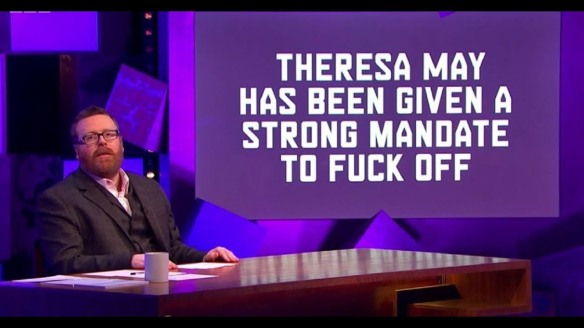
From the previous series, though still applicable!
For my personal catharsis, I recently tore a larger hole in the anus pastitis that is Have I Got News for You here, focusing on the first of its current series hosted by a bloated Jeremy Paxman with Ian Hislop as boorishly smug as ever. I haven’t changed that view. I have, however, and am more than content to admit, watched further episodes, and I can say they have been largely tolerable, at best. This naturally depends on the various hosts and guests, these usually supplying the brighter lights within its dimming continuance. I can’t remember actual good jokes, but there have been a few. One of the funniest moments was seeing host Alexander Armstrong buff up his remaining hair like Ian Hislop.
I mention now in the context of watching Frankie Boyle last night with his current series of New World Order. It was, as I expected, hilarious, but it was also satirically sharp as sharks’ teeth, with the kind of insight and knowing HIGNFY can only dream of these days. Yes, Boyle brings to the open discussion his scripted monologues – those that follow the two themed segments and his closing rouser – but Hislop, for example, will bring his prepared and tired ‘jokes’ to slot into a programme focusing on current affairs and thus having easy expectations of those predictable slots – these preparations yawned into his head previously and made more soporific by the waiting for recording.
Is that last bit too strong and personal? Well, it is the nature of the satire upon which both programmes are built. One sturdy, one collapsing…
Moving on. The two themed foci for Boyle’s programme last night were the demise of the Labour Party, and The Royal Wedding. The first is wonderfully illustrative. Where HIGNFY increasingly snipes and carps and takes cheap pot-shots at Labour and Corbyn [and there is a consistency that seems like childish bias], Boyle and his guests Sara Pascoe, Katherine Ryan and Mona Chalabi, including for this segment David Baddiel, dismantled Labour quite ruthlessly – but again hilariously – and this was interesting as those five people [incl. FB] are all left-leaning in their political sensibilities. The strongest and most incisive criticism was of the anti-Semitism perceived to be in the Labour Party and how Corbyn constantly links this to ‘other’ racisms, rather than seeing and dealing with it distinctively, and perhaps clarifying the position more defiantly, Baddiel having a personal view that carried great weight, not that one needs to be Jewish to have this. But it did. And Boyle was as near-the-knuckle in his humour here as is his signature, pulling from the white-knuckle hat of playing with words, jokes on ‘solution’ and ‘Holocaust’.
The other segment on The Royal Wedding was as acerbic and funny and convincing. Here are two of the jokes, the first lightweight but nonetheless amusing, ‘Meghan Markle will become the Duchess of Sussex, that’s got to hurt. You grow up wanting to be a princess and you end up sounding like a pub in Eastbourne’, and the second packing a surer punch, ‘It’s going to be a traditional wedding. Something old, Prince Philip, something new, the royal baby, something borrowed, the wealth of India.’
I freely admit I haven’t watched last night’s HIGNFY with which to make a comparison, especially in a mirroring of the two themes I have focused on here. I will watch at some stage. Whenever. There just isn’t any great urge – but I can’t wait for next Friday and Frankie Boyle.
I liked this place,
large and quiet
and light,
with proper chairs
at a round table
and no music.
We could talk.
The food was
wholesome,
too much to eat
for him, and I
couldn’t drink my
second beer.
We talked of
his travelling:
spreading her ashes
where they had
been together –
so much for a
petite person –
how to dig a
hole in sand
at beaches, not
throw to the wind.
I said I loved
listening to her still
answering the phone,
her recorded message,
but he didn’t know.
I never ring home
he told me,
which made sense,
like later our hearing
nightingales sing.

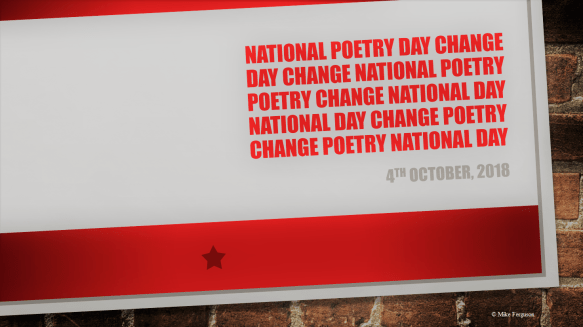
This year’s National Poetry Day in on the 4th October, and that is some way down the teaching line.
But it isn’t.
It is in terms of months away from this posting – 4 months – though perhaps not as much as one might initially think, and it is in terms of workload and current commitments: primary school teachers may feel more inclined to consider now having hurdled the first part of Key Stage 2 testing [though there are many traps yet ahead], and secondary school teachers – the main target for this work, but not entirely – still have GCSEs to pass through.
It isn’t in terms of, hopefully, seeing something positive on the horizon. And it isn’t in terms of having some time between now and October to look at and consider if these poetry writing ideas would be useful and welcome for your classroom.
As an English teacher, I always celebrated National Poetry Day. Since leaving the job, I have always devised teaching/creative writing ideas for others to use, if they wished, on National Poetry Day. For a number of years these appeared with Teachit. Lately I have promoted them through this blog.
Enough of the prompt and history. This is an initial launch and promotion. I will be hoping those interested will also share/promote/retweet, especially those with an ‘audience’. I will over the next four months be adding to this work – especially producing teacher notes and perhaps student sheets – and I will also be re-posting, especially nearer the 4th of October.
What hasn’t changed in this thematic National Poetry Day theme of Change is my commitment to presenting creative writing ideas that can be ‘copied’: models for writing to provide actual forms to emulate; to copy. I often use list poems as that main form – it works! – and I also encourage experimental forms, like cut-up/remix poetry.
The following are pdfs of the creative writing ideas for the theme of Change. No notes yet, but I trust they give a flavour of the focus. If you click on these, they can be downloaded and reproduced/use as you will. These are free resources to use and share: nothing would give me greater pleasure than to think students will be encouraged to write and be supported in that by the models given here.
With all future postings on this, I will use [NPDChange] in the heading so this can be searched on this blog and all resources found together:
D – Search engine change titles
I have added the following since this morning’s posting as an example of the Student Sheets I will be producing. There will be a singular Teacher Notes with suggestion and guidance for presenting the ideas. These will all be offered as support/guidance – they obviously do not have to be used [and/or they can be changed! I can be advised if it will be useful to make all of this available as word documents for the facility to amend?]:
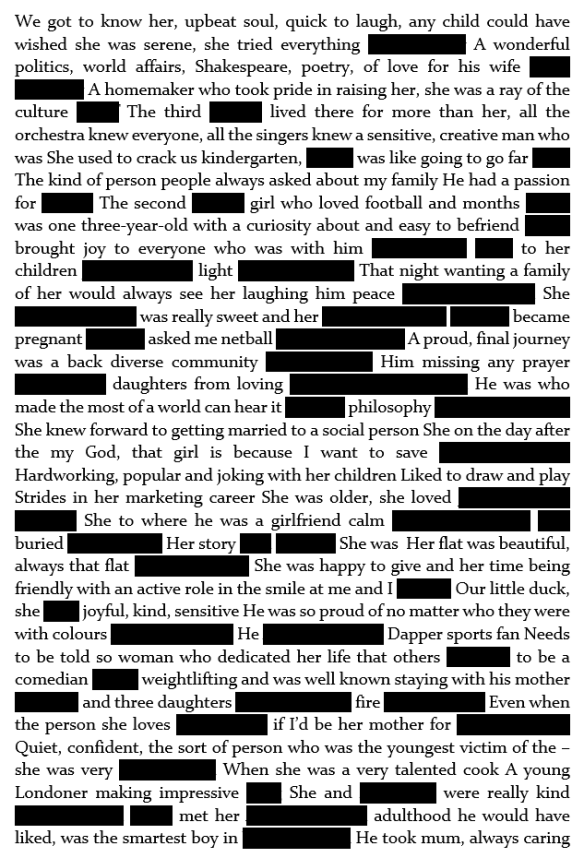
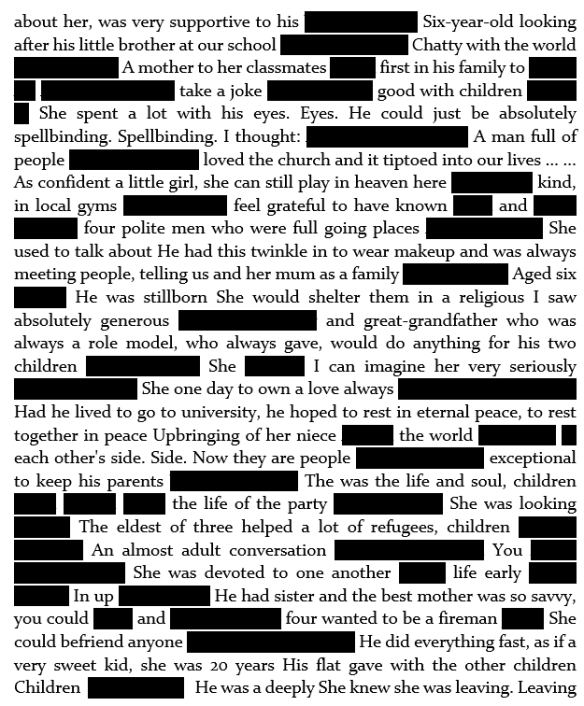
I wrote this in response to and found in yesterday’s The Guardian article The 71 lives of Grenfell Tower, finishing it late last night, moved by the full naming of those who died in the tragedy of that fire and the mixed emotions of the personal accounts of the 71 individuals. The article and those voices speak poignantly for themselves.
As a secondary but important observation, I think The Guardian deserves recognition for its consistently passionate and probing reporting on realities like the Grenfell Tower tragedy, and all that lies behind such, not that reporting can ever fully represent the human experience.
Not as a comparison by any means, but in their coverage of the Windrush situation and that injustice and human suffering, well in advance of it making the wider headlines, The Guardian reflects the importance and impact of what others like to denigrate as the ‘liberal sensibilities’ of some of the media.
The Guardian article here.
Poems for Grenfell Tower is still available here.
 gravyfromthegazebo