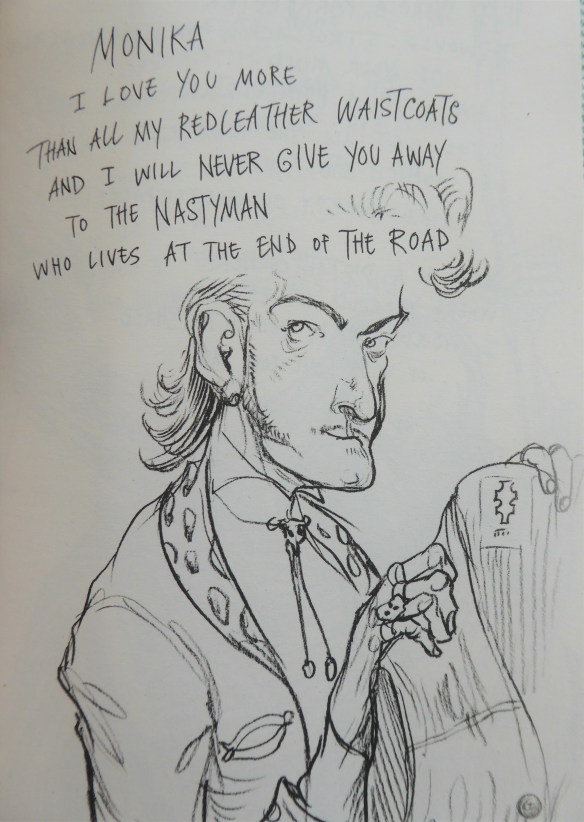
from ‘The Leave-Taking’ by Ray Bradbury, i.m. Shané

This is the ending from Ray Bradbury’s story The Leave-Taking, posted here in loving memory of Shané, who sadly passed 29th October, 2017. It was a personal favourite of hers and one she used in her teaching:


Important thing is not the me that’s lying here, but the me that’s sitting on the edge of the bed looking back at me, and the me that’s downstairs cooking supper, or out in the garage under the car, or in the library reading. All the new parts, they count. I’m not really dying today. No person ever died that had a family. I’ll be around a long time. A thousand years from now a whole township of my offspring will be biting sour apples in the gumwood shade. That’s my answer to anyone asks big questions! Quick now, send in the rest!”

At last the entire family stood, like people seeing someone off at the rail station, waiting in the room. “Well,” said Great-grandma, “there I am. I’m not humble, so it’s nice seeing you standing around my bed. Now next week there’s late gardening and closet-cleaning and clothes-buying for the children to do. And since that part of me which is called, for convenience, Great-grandma, won’t be here to step it along, those other parts of me called Uncle Bert and Leo and Tom and Douglas, and all the other names, will have to take over, each to his own.”

“Yes, Grandma.”

“I don’t want any Halloween parties here tomorrow. Don’t want anyone saying anything sweet about me; I said it all in my time and my pride. I’ve tasted every victual and danced every dance; now there’s one last tart I haven’t bit on, one tune I haven’t whistled. But I’m not afraid. I’m truly curious. Death won’t get a crumb by my mouth I won’t keep and savor. So don’t you worry over me. Now, all of you go, and let me find my sleep…”

Somewhere a door closed quietly.

“That’s better.” Alone, she snuggled luxuriously down through the warm snowbank of linen and wool, sheet and cover, and the colors of the patchwork quilt were bright as the circus banners of old time. Lying there, she felt as small and secret as on those mornings eighty-some-odd years ago when, wakening, she comforted her tender bones in bed.

A long time back, she thought, I dreamed a dream, and was enjoying it so much when someone wakened me, and that was the day when I was born. And now? Now, let me see…. She cast her mind back. Where was I? she thought. Ninety years…how to take up the thread and the pattern of that lost dream again? She put out a small hand. There… Yes, that was it. She smiled. Deeper in the warm snow hill she turned her head upon her pillow. That was better. Now, yes, now she saw it shaping in her mind quietly, and with a serenity like a sea moving along an endless and self-refreshing shore. Now she let the old dream touch and lift her from the snow and drift her above the scarce-remembered bed.

Downstairs, she thought, they are polishing the silver, and rummaging the cellar, and dusting in the halls. She could hear them living all through the house.

“It’s all right,” whispered Great-grandma, as the dream floated her. “Like everything else in this life, it’s fitting.”

And the sea moved her back down the shore.

© Ray Bradbury

The Borg’s Assimilation of Grammar

star trek2 - Copy

Just announced, the next Star Trek movie will feature a return of The Borg in a blockbuster titled Random Chance, its premise constructed around a Federation/Borg conflict about intergalactic language change over time, this itself based on a genuine terrestrial debate regarding the development of the English language as exemplified in the following observation by Joshua Plotkin, from the University of Pennsylvania, co-author of research titled Detecting evolutionary forces in language change,

‘Specifically, “woke” is increasingly preferred over “waked” and “lit” more popular than “lighted”, while “weaved” and “snuck” are on track to eventually overtake “wove” and “sneaked”, respectively.

The study also revealed that a flower today is more likely to be “smelled” rather than “smelt” and that the neighbour’s cat probably “dove” behind the sofa – although, as Plotkin notes, British felines remain more likely to have dived.’

The film’s tag-line has been confirmed as Resistance to changes in grammar is futile, but early reports that there will be a return of Patrick Stewart as Jean-Luc Picard and a controversial new but emblematic Captain’s command So make it has so far been denied.

Further details can be found here.

borg - Copy


Ottery Tar Barrel Rollers

otb rollers grab2

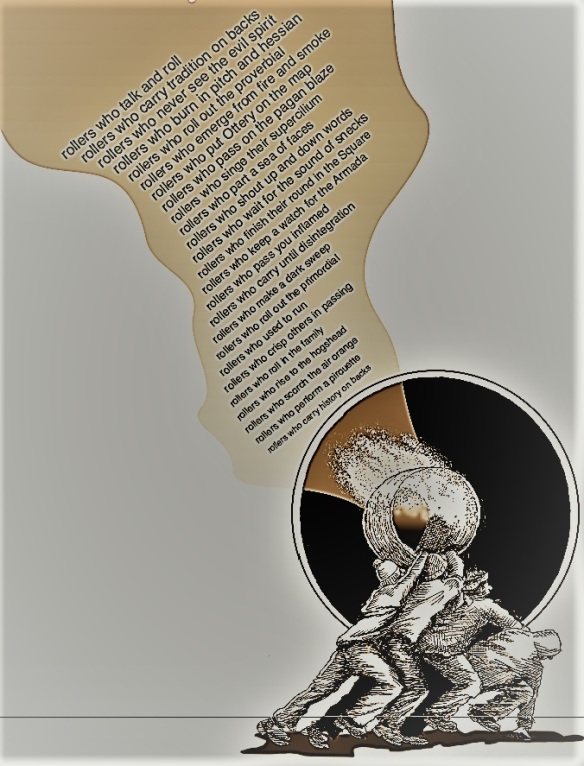
As it’s the first of November I am presenting my poem Ottery Tar Barrel Rollers, with an illustration by Chris Wakefield, to celebrate the annual Tar Barrel event in Ottery St Mary. This year’s ‘rolling’ will take place on the 4th November.

For further details about the history of this occasion, here is a good place to visit, and do check out the numerous photos online – though you need to see it in person to believe the genuinely spectacular!

Out of interest, a first draft of the image which conveyed much of the inherent menace in the tar-lined, flaming barrels, but it made the rollers themselves seem intimidating  – which is a part of the exciting spectacle, but it is not their manner, so to speak, so we changed!

early version


Spam Deposit at X-Peri

x-peri logo

I am delighted to have my latest spam poems Spambolic Q&A published here at X-Peri, an experimental writing site that continues to support my work of this kind.

For those interested, I have explained some of the processes of writing these here, found as they are in a bulk of literate email spam I once received – this reception some time ago.

These latest are an actual re-visiting of that spam, and therefore a re-writing of what is there, and for me this adds to the creative engagement with found text where the here and now is a part of that process: current thoughts and feelings as well as, simply, new seeings finding the meanings.

Previous spam poems have also been published and supported by Stride magazine.

You Can Lead an ‘Expert’ to Water, But If It Doesn’t Know How To Drink…

I wrote an angry comment to/about the author of this comment piece here. I make no apology for being angry with its simplistic and patronising tone and suggestions. I genuinely believe the author – who would appear to have a notably non-teaching educational experience/presence – is writing to write rather than to share any knowing observation on new GCSEs.

I admit I write now and in my comment from a wholly English GCSE perspective, as an English teacher for 30 years – 18 as Head of English which includes in my latter time the annual intense scrutiny and judgement regarding examination results and targets – and as a Senior Examiner for GCSE English Literature for over 30 years. I do have at least this very precise teaching and assessment experience.

In the article, the only subject-specific comment is about ‘set texts’ and thus this has to be about English Literature, and thus my totally focused backlash. Nowhere else in the opinion piece is there any specific reference to subjects and/or examples of linear vs modular curriculum designs, even if these ever existed in the way described – well, not described, but vaguely invoked.

I leave it to any interested readers who have perused the article to see if they can make any sense whatsoever of the claimed liberating effect/impact of the new GCSEs. As for the condescension on how teachers ‘now’ need to work hard with the new exams and, for example, not bother their unnecessarily concerned little heads with ‘what grade constitutes a pass’ – this is simply ignorant.

For me its greatest contextualising nonsense is the assumption that all teachers have done over previous years is teach to the exam rather than tackling the syllabus with energy and creativity. It is the implicit rather that is insulting. As I reference in mentioning Ofsted chief Amanda Spielman who has recently made similarly daft ironic accusations and suggestions, teachers have taught to the exams – because they have no choice in the target-setting and judgemental climate of the last two decades at GCSE [and elsewhere], yet the very nature of teachers in this vocation – especially in English and, I suspect, other more creative subjects, but not exclusively as the vocational tag apples to most, whatever subject taught – has and always will be to make the teaching as lively and engaging as they possibly can, whatever complete dissatisfaction is professionally held with the content and means of assessment.

I would like to know how the author thinks this sweeping statement about teaching and learning in the past could ever apply to a subject like English Literature:

A generation of teachers has spent their professional lives teaching a modular curriculum. We are used to serving up six-week, bite-sized, discrete chunks of knowledge. It was formulaic and predictable – if students could answer a limited number of questions in a certain way there was a good chance they would get the requisite mark. Superficial skimming over a subject and teaching to specific questions would usually get a student through an exam.

I might say if only if I was as cynical and ill-informed as the author. The intensive study then and now of, for example, the poetry in the GCSE English Literature anthologies could not deliver this model for discrete parcels of knowing. That doesn’t mean it was then and is now perfect: indeed, it never was, and is still demanding for all the wrong reasons in terms of amount of content and therefore a requirement of over-knowing [and of course those creative teachers the author imagines didn’t previously exist would teach skills and transferable appreciation over content knowledge, as they now do where possible]. But if I go on I will have to get even more specific and detailed and illustrative, and the article in question doesn’t deserve a treatment it woefully did not deliver itself.

This is what angered me most. This complete lack of specific references. As I said, it seems to be an article that exists entirely for the sake of being an article.

And as for the ‘Experts’ heading…

Boris Johnson’s Abuse of English

bj

Boris Johnson speaking in his role as Foreign Secretary at Chatham House today continued to use a by now utterly becalmed nautical metaphor, grand gestures to eloquence, and a Shakespearean mishmash of ‘knowing’ quotation to talk complete bollocks.

Answering a question on Brexit, he began by revisiting his previous metaphoric reliance on sailing, here expressing his belief that the EU now has a

‘…fair wind to the idea of themselves discussing the new trade deal…’

Feeling immediately exasperated at the presumed pace of this, wind-aided or no, he added they should now

‘…get on with it…’

However, also immediately struck by the brisk simplicity of this, Boris felt compelled to expand in that ostentatious but preposterous oration he imagines clarifies and solidifies. Working through three hacked-out-of-context Shakespeare quotations, this is how his rhetorical tragic three filled a momentary expression of nothingness:

from Macbeth: ‘I dare not wait upon I would’

from Hamlet: ‘let the native hue of resolution be [misquoted] sicklied o’er with the pale cast of thought’, [then adding in his own words the somewhat bathetic] ‘or whatever’

from Julius Caesar: ‘there is a current [*misquoted] in the affairs of men’

At which point he realised – though actually I can’t imagine he in fact had a moment of any kind of percipience] that what he said initially was what he meant, so repeated that they [the EU] should

‘…grip it…get on with it!…’


[*] You would have thought with his proclivity to water-bound metaphors he would have recalled the word is tide.

Waving at McGough, Again

P1010651

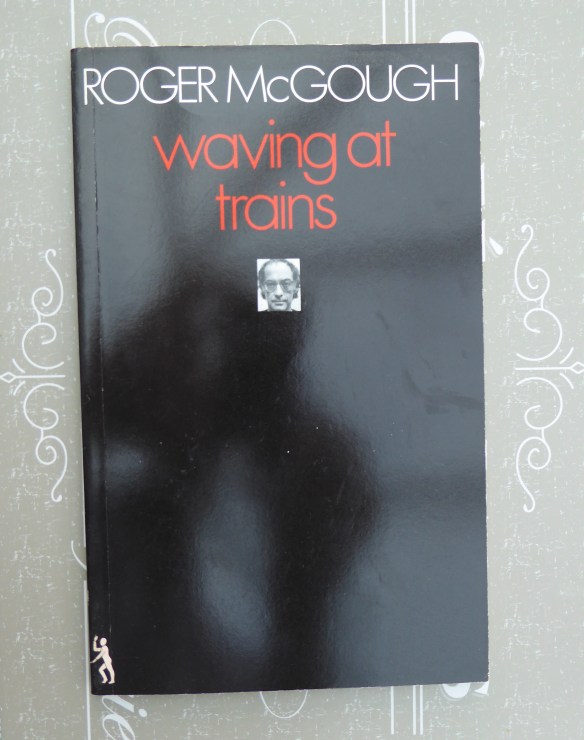
Further to my previous on Roger McGough here, I have acquired another collection to add to my collection, waving at trains, 1982, and this is particularly meaningful to me as I will explain.

This collection includes memorable poems like the title one, and I Don’t Like the Poems and The Examination, these two self-referencing poets-as-writers poems that seemed much more apt and acceptable as both witticism and real observation at the time than they would be today, the moment for such having long passed in the exhaustion of the similar, and increasingly repetitive, self-reflecting. But these have charm and bright insight.

Waving at Trains is one of those ‘deceptively’ simple McGough poems that are accessible, engaging and, without overstating, deeply meaningful. I wouldn’t take that trio of tags away from any reader, but I do apply them especially to younger readers, and do so because I included this poem in my Longman GCSE poetry teaching resource Poems in your Pocket, 1999, a book I am proud to have written because I believe as a study resource [rather than poetry anthology] it has one of the greatest number of poems collected in such, and a variety.

P1010623

I used this poem to illustrate comparative techniques – preparing students for examination – and it is paired with Patience Strong by U.A. Fanthorpe. And I write this now because buying an original copy of waving at trains reminded me of all I am stating now, and in reading Patience Strong again I thought about this: since retiring from teaching, I have read significantly more poetry than I ever did, or could, while working; when teaching, I did, however, probably read some poems much more carefully and deeply because in teaching them I would need that substance of knowing and understanding [which makes students studying also of a particular value, I would extrapolate], and finally, I read poets like U.A. Fanthorpe because they were on a syllabus, and in this case I am glad I did so, where I probably wouldn’t otherwise have encountered/bothered.

In my teaching resource, I was particularly pleased not just with the number of poems allowed [and there is a significant, additional haul in the accompanying Teacher’s Handbook] but also generally with their presentation, including titles and illustrations. That said, the completely stock image of the train is the least inspiring of the book’s representations – unless this too was chosen as a precise visual metaphor?

P1010624

Fake Whistle

whistle1 - Copy

a boy
screeching
from the
railway line

like a real
man’s whistle
wolfing
signalling

there where
the holed
strips were
found in

between the
ties having
fallen from
passed stock

imagine a flat
cap-gun’s
ammunition-
strip though

bigger and
rusted metal
its powder-dots
as holes

and you
would fold
place between
your lips and

poke in
the tongue
blow
screaming

but that
was its sound
not the
growing sores

become
angular cheilitis
trying to be
like guys

who could
use their mouths
talking big
whistling too

*

Reading a poem yesterday where the writer reminisces about having wanted to be able to whistle using his fingers [so the real deal] I recalled my inability to do so, but how blowing through a folded strip of metal with holes allowed me to perfectly make the piercing sound of a proper one. This is described in the poem, and I wouldn’t normally illustrate further – literally – but I was intrigued to find that what I produced as a kid is a well-known, if different, homemade construction, an image of this tin-can lid idea heading the poem here. I was further intrigued to discover this is a rudimentary version of an established and professional sheep-dog whistle:

whistle2 - Copy

And just in case readers have no idea what I mean in comparing my metal strip to a cap-gun’s ammunition strip, I am going to provide an image for this too:

cap ammo - Copy

We continue to grow and learn, but I still can’t whistle with my fingers…

The Long Haul of Roger McGough

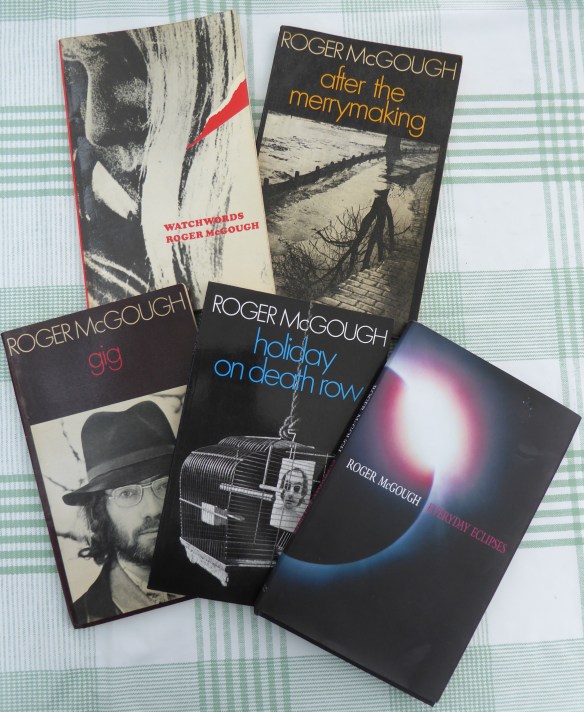
I recently wrote about Penguin’s 1967 poetry collection The Mersey Sound and the BBC4 programme Sex, Chips and Poetry: 50 Years of the Mersey Sound here and it is this which prompted me to recently purchase a superb haul of Roger McGough’s largely earlier poetry books to add to my existing collection.

P1010621

It isn’t that I needed reminding what a wonderful poet he is, and wonderful poet to read [there is a distinction], but nonetheless I was galvanised to seek out and buy some ‘originals’ to experience his work in its first contexts.

In my blog post referenced above I also direct any interested readers to my two reviews of McGough poetry books, but this post now is quite simply to reinforce how they are all worth having.

There is so much fun in reading his work. And he is a funny poet, but he isn’t an exclusively humorous poet. He is an accessible poet and he is witty. His work is at times playful rather than experimental, but that doesn’t mean the latter won’t apply. I’m not going to mention that he is also a deeply serious poet because that would be a platitude, though a good one. [Yes, there are bad ones. Like that one].

watchwords, 1969, is his most playful in so many ways, but especially in the poems’ presentation acrossandalong and upanddown the page. Yes, I have. Emulated. I lovethat in his writing but am going to stop now. If I were Poet Laureate makes me wonder why he hasn’t been and isn’t.

after the merrymaking, 1971, is occasionally experimental in an obvious concrete way, and it also contains the delightful section The Amazing Adventures of P.C. Plod.

gig, 1973, is a book I read in one glorious go, and I did enjoy the opening section about his poetry gigging and the towns/venues in which he stayed where the romance of being on the road is amusingly dismantled. I was also surprised to come across The Identification because I had forgotten about this [I know…], a poem I had used in my teaching and read aloud many times back in the 80s because of the power of its storytelling – and this is that wonderful original context in which to experience it, reading all that had come before because it is one of the final poems in the collection. This must have been anthologised in one of the many English resource books available in those days, when reading poetry for fun was common. Even though there were no tests on this.

holiday on death row, 1979, arrived this morning and I haven’t read yet. Everyday Eclipses, 2002, is another I haven’t read completely, but it does have the great In Two Minds which has fueled many a creative writing model for students, and me [e.g. What I love/What I hate…].

If you look next at my McGough Shelf, you’ll see the other books I have the pleasure to have. Note also how they are bookended by double copies of texts where I forgot I already have, a common occurrence with my record collection, though here the memory is worse and I sometimes have at least three of the same. I also thought it would be interesting to see McGough’s work bookended by Lemn and John because this proves I don’t alphabetise my poetry books in the same way I do my vinyl collection because that would be weird.

P1010617

Lastly, I have also recently received my copy of the 50th Anniversary Edition of McGough’s Summer with Monica and its brilliant illustrations by Chris Riddell.

P1010619

P1010620