
King Poetry

1. Saxon Rhyming Kings

Egbert was the first Saxon King,
ahead [wait for it] of four Aethels – that’s
wulf
bald
bert
and red
up until the first Great,
who was Alf-
red,

and each King had to wait
for the preceding to be pronounced led
off from their mortal bed.

Next was Ed, or Edward
as his name’s
longer word,

then it’s the fifth Athel-,
this time stan,
yet another man,
and then the symmetry of five more Eds,
or Eads – that’s
mund
red
wig
gar
and ward;

when not quite ready as he hadn’t
read the script,
back comes a sixth Aethel-
red II,

then one more, though second time around
to make six,
Edmund II Ironside
who would divide
his kingdom with

Canute

who cleverly ordered the tide to stay away
knowing it would roll back later that day
and make him a man [rather than a god],
his crafty nod
to normality.

Harold I was the next king for a bit
[a nasty joke if you look into it]
then Harthacanute until he made toast,
or a toast to be precise,

then Edward the Confessor
is the next kingly dresser
until Harold II was the last
Saxon successor.


2. Norman Kings Haiku

Four Kings are your lot:
Williams 1 and 2, Henry
1, Stephen the Nought.


Examiner Accuracy

Not all have
a valuable role
in assessment:

there are levels
of granularity;

there is
derivation of
component level
rather than
script level;

there is
quality of marking
as
marked items;

there is
ideal quality of
at the least
granular marking.

Where metrics is
non-trivial

this is
derivation of
component level metrics.

In such instances
ex
ternally
assessed examinations

present the idea of
marking consistency

as variable.

Visual Narrative

Love it! Just been looking through some old discs, and found a selection of visual narratives my GCSE students from around 2002 created in preparation for their Media/English coursework assignment. I can post this because there are no faces revealed [privacy, naturally]. Not quite the days of 1980’s summer 8mm filming at the top of the field when we had the time and independence to write scripts and film, for example, Wild West narratives [yes, we called them Cowboy narratives back then….]. But I still found time later when exam commitments and target-setting became paramount to indulge in an element of creative preparation.

The boys’ narratives almost always had an element of violence in them, though these were meant to be dramatic.

Group four 001

Group four 002

Group four 003

Group four 004

Group four 005

Group four 006

Group four 007

Group four 008

Group four 009

Group four 010

And This Seed Did Sprout

You know how it is: you are in the middle of something for which you have a strong instinct, an informed gut-knowing, a professional goose-bump apocalyptic grasparoonies.

And then you do some research:

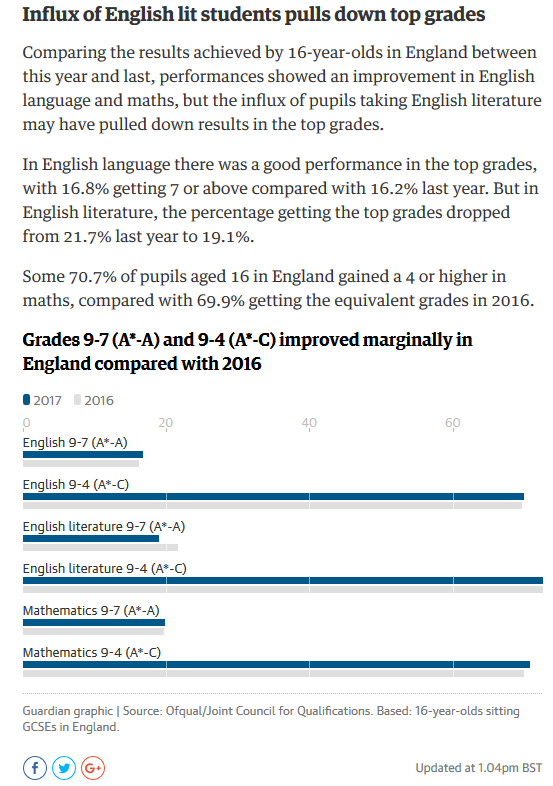
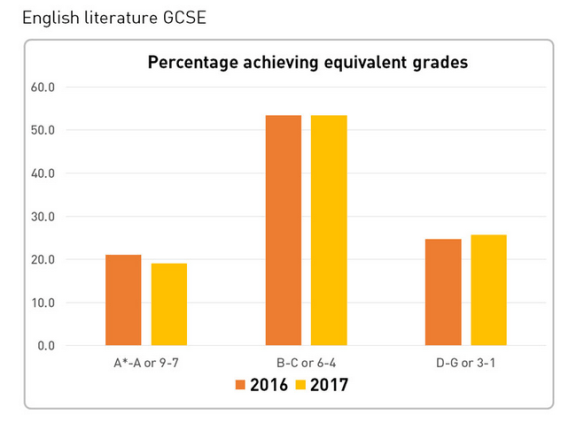
equation3

I wouldn’t say I’m proud of this statistical revelation and knowing already – for all kinds of obvious reasons – but I can confirm there is no definitive grade on this evidence and in my own experience, though some are I believe more definite than others…..

Oscar Wilde – An Ideal Husband by Dr Jackie Moore, Oxford Student Texts

ideal hus

Context is everything.

I have said this before, and elements of what will follow: this latter in more ways than one.

I have wanted for some time to expand on thoughts and feelings about social inequalities here in the UK and everywhere else, really, but it is that everywhere else, really that smacks of such hopeless naivety – without a contextualising – and therefore I avoid launching myself into a general and inevitable black hole of personal observation.

One specific and relevant context was explored on this site recently when I made observations about examining student responses to the GCSE text An Inspector Calls and their insights into and anger at the social inequalities and gross injustices portrayed there, these augmented horribly by the Grenfell Tower disaster at the time of my marking. You can read this here.

I also recently wrote here about acquiring Adrian Mitchell’s 1971 collection of poems Ride the Nightmare where I reminisced about reading again the poem Old Age Report which I used to teach. The poem, however, that made the first nostalgic impact and impression on reading was this one,

 Flag Day – But Not for the Revolution

Hunger scrapes the inside out of the human belly.
Your charity small change clanks into the tin
And makes no real change.
They are not slot machines for your spare pennies
Although you can read your own gross weight
Scrawled across their faces.
The razors of hunger slash and slash and slash their skin
And all your fat pity helps no one but yourself.

This quite simply – and yes, naively – reminded me that nothing has changed: not since Priestley writing in the mid-1940s or Mitchell in the early 70s, riding as he was on the cusp of a counter-culture and its adamant belief in the changing power of an artistic expression of peace and love, and a social conscience.

I have also been watching repeats of the brilliant TV series When the Boat Comes In [1976-1981]. I am actually only on the first series, and it hasn’t lost any of its incisive portrayal of the pain and desperation of working class poverty and the wealth and privilege responsible for this. Indeed, the emotional and political attachment I had to its messages then is, it seems to me, even more aroused today: precisely because nothing has changed.

Current Tory austerity, the bedroom tax, food banks and the very latest news about homelessness here in the UK bring it all back in the admittedly briefest of historical contextual accounts, but anyone following – and worse, experiencing – the consequences of poverty and deprivation as a direct consequence of social divisiveness won’t need an expansive convincing.

And this contextualising has allowed me to say these things, however obviously, and thus fulfil that urge, but to also set up this brief review of the excellent Oxford Student Texts Oscar Wilde, An Ideal Husband by Dr Jackie Moore.

When I reviewed her previous OST The Importance of Being Earnest here, I also commented on the context she then provided about Wilde’s exposure of the social inequities of the 19th century – and thus we trace this back before Priestley, and [naivety alert] long before then. But my focus with Priestley and Mitchell and WTBCI, and now Wilde, is to assert, as Moore does so tellingly, the need to study and champion those artists who do remind us of the world we live in, and why it is so wrong.

As Moore reminds us again with this text,

Wilde believed that ‘it is through art, and through art only, that we can realize our perfection’ (The Critic as Artist). An Ideal Husband becomes a parable, demonstrating the serious flaws of society in desperate need of reform, and the chance of redemption through art and aestheticism.

There is a broader brush in the world’s need for exposure and change, but as Moore continues, it is, as with Wilde’s other work too, importantly relevant today,

An Ideal Husband addresses issues that are still relevant in today’s society, such as insider dealing, business scams that target innocent people for the sake of profit, the undue influence and dangerous propaganda of the tabloid press, and unrealistic popular expectations of political leaders…..and above all, addresses the hypocrisy that enables the wealthy to hold on to power…..

As a study text it is so much more than this, but its framing within these important observations serve to establish both the importance of studying Literature as well as Wilde, and by doing so, to reflect on how art mirrors life at the time of representation, and whether that reflection has changed – or not.

And the ‘much more than this’ is contained in the wonderfully informative, accessible but also scholarly notes that are provided by Moore at the end of the actual script. These provide the kinds of insights students need to fully appreciate a work so much of its time, but they are also deeply engaging for the reader who simply wants [or needs] to further understand these other crucial contexts.

Chapters I found particularly interesting because they focus on the relevancies of the text in the way I have contextualised it in this posting are The problems of society and Lord Goring as philosopher guide, both of which focus on Wilde’s themes of exposing hypocrisy in society [think today of the millionaire and Tory Chancellor of the Exchequer Phillip Hammond chastising public sector workers for complaining about pay and conditions of service] and of exploring platonic ideals, which in this case, if I extrapolate from Moore’s more detailed analysis, can be when we have a dialogue with Wilde’s text, listening to and learning from the dialogues within its literary constructs as well as the artistic messages these deliver as good sense, applicable as knowledge then, and now.

It is in promoting but also helping us to understand yet one more literary text’s importance to our comprehension of the wold in which we live that makes Moore’s book/s significant reading. They help students in particular, as well as necessarily, but also me to provide the contexts for understanding the rich resources we have to read, which in themselves provide the contexts we need to begin to understand.

Context is everything.