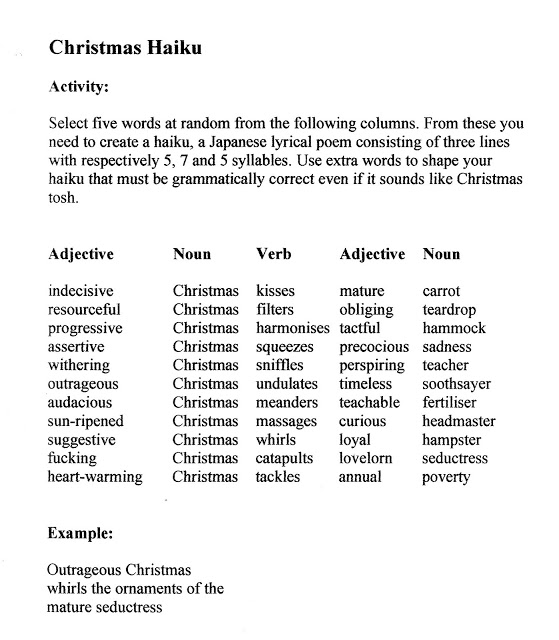
Christmas Haiku Game
Image
2

In 1995 I began writing an annual Stocking Fillers with Christmas poems and stories for teaching colleagues, initially to entertain and eventually to alleviate as well. I last posted a complete run of these in 2011 on another blog, and will post about 4 or 5 favourites from the very many over the next few days
There is no direct conflict like the threat of death or someone trying to punch your lights out.
The death of Auden’s lover left the poet with a large hole to fill.
John Clare was placed in a lunatic asylum because he was literate.
Golding abandons a group of boys on an uninhibited island.
Dill plays with himself when he is home in meridian.
William Wordsworth is a famous British poet from the lake District. He lived in Dove Cottage and visits are allowed.
I’m sure that at that time when the poem was written all the words made perfect sense, although this is not the case today.
I am Very Bothered is saying that marriage scares you for life.
The poem The Daffodils is indefinitely the most powerful and memorable poem we have to date. Its chronological order makes us feel this is an enjoyable poem to read and hear. It hits us with frivolous sights of wonder.
I am not persuaded by this poem. After all, not everyone has sex in Yarmouth.
Mr Tate’s aiming was not very precise so Atticus shot him.
I think I would be alive if I was Dickie in Examination Day after this exam.
When Damien is sad about Phillis his projection torments him. He then returns to his cottage which provides his climax and is a very old-fashioned English thing to do.
I believe that the paragraph (and I’m sorry to be possibly crude) is when they are both at their climax (sexually). “Yes” followed by a comma (which so far is the only punctuation used) seems too obvious to pass. The lack of punctuality adds to the effect of what she feels.
I believe the speaker is male and the listener female because the listener is always interrupting and criticising.
Blake accuses the rose of being evil – like a woman.
During the war the government forced people to do natural Service and they could not refuse. They were constricted.
The rhythm of Valentine makes your two hips move when it is read.
Examination Day deals with the brusque and abrupt and at every turn it reels and rocks like a roller coaster until it lunges to the ground at the end.
If you were to listen to a scientist such as Simon Armitage’s wife they would probably say that such emotions exist in order to procreate and rank love among lust and carnal pleasure.
Lennie has a leaning problem.
I AM is written in three verses of six lines, with every other line indented. If you turn the page 90 degrees clockwise it resembles castle battlements.
The Twa Corbies is written in a Scottish dialect. This adds to the suffering.
thirteen-year-olds did sex in a science lab. Grown ups would have done it somewhere else.
This poem thinks it is a sonnet but it is not.
Over the next few days I will post a sequence of these Christmas Crackers which are made up of GCSE English Literature exam ‘howlers’ from some years ago [I recently found a collection from 1999!].
To find out about the origins of these, and the spirit in which they were collected and celebrated, please read my posting here.
There will be added nuances if you know the texts actually referenced and/or being responded to, but I also think they stand on their own. Enjoy:
The author thinks that Damon is not in love with Phyllis because he thought he going to jump off the cliff he looks down and sees his torment projecting, which could have a hidden meaning and mean an erection which he got out of his passion
Walsh is saying that because of his love he would not have cared what was happening, whether it was the regional haggis-munching finals or the Boar War
What’s the point of reading this poem The Twa Corbies? I mean you can’t even understand it anyway. If I was to write like that people would say “you can’t spell and it doesn’t make sense”
Mrs Rutter is seen as a pleasing pattern with bread-like qualities
The Lowest Trees is a very unrealistic poem. I mean to say what on earth have ants and tress got to do with love? Exactly. Nothing at all. See?
The beast has an outstanding effect on Simon. It kills him
I have to say that I am persuaded by these poems and they make me feel a bit guilt myself knowing that I have helped to create this immoral world, and it makes me think that I should attempt to sort it out
I am the self-consumer of my woes. This is an image of John Clare eating himself.
In What is Our Life, the message is ‘take your life more seriously’ because you will when you are dead
George is like a father-figure to Lennie. “You crazy bastard”. This shows the father son relationship.
there is use of a slash in the wrong place
Publicly, John Clare was rejected
She makes Kerry feel underneath her
I have recently been revisiting the excellent poetry of Ted Walker – the first four volumes of his work that I have had from the early 1970s – and have just bought two more that are new to me: one burning the ivy, published in 1978, from which this poem is taken.
The title of the poem made it apt to post here now, but I do so because it is much more meaningful than that. Having also recently thought about the loss of a good friend three years ago this month, and finding out that another dear friend has just lost his wife last week, this poem in its own focus on the death of friends and how one does, or does not, deal with this obviously resonates.
I won’t analyse the poem as anyone bothering to read a post here will surely be able, if they want, to do this for themselves. I will, however, observe that whilst a complex poem in many ways, it is Walker at his very best: ruminations on personal life and nature used to reflect on thoughts and feelings we all experience, but doing so in that poignant way great writing variously awakens, challenges and sharpens our own similar emotions.
Christmas apples
Year-long, weekdays, I pass an orchard.
Mornings, where its windbreak poplars are,
The engine warms and I change into top
Toward the day. There’s nothing to see
Of fruit-tress from the road. Blossom-time,
A dry thaw of blown petals may sift
To the ditch, soon gone; and winter nights,
When I slow for the corner near home,
Sometimes I picture the stiff ballet
Of trees imploring frost from starlight:
But, back in the warmth, forget them. Once
A year – a Sunday in December –
I drive to a warehouse at the heart
Of an acreage seeming vaster than
Memory tends. Black banners, crows flutter
High over the fields. I park the car
In an empty lot, walk to the edge
Of the same, leafless plantation where,
A twelvemonth since, my face to the wind,
I laid by the sorrows of a year.
There’s been another death: though by now
It has sunk under, like the water
Of small snow that fell the day I heard.
Once again (though to remember them
Is an ice along the skull) I call
To mind the gradually dying
Who haunt, more accusing than the dead,
These days I riffle at another
Year’s end. Month by month I have screened
Their lives from mine; today each mindful hurt
That love inflicts in fostering love,
Each mindless act of chronic neglect
That dismembers a friendship alive,
I would undo. In exact patterns,
Yet frantic as drowners, apple-trees
Lift bare arms into the shortest day.
I’ll not see them bud, burst into leaf,
Bloom, or their limbs bend when summer dust
Falls: my road leads by and beyond them.
Behind me somebody slides the door
And I turn and stare blank in a blank
Hangar. An appalling fragrance spills.
I breathe apples in before I see them,
Laxtons and Coxs, rack upon rack,
Shocking as a wiped-out flock of birds.
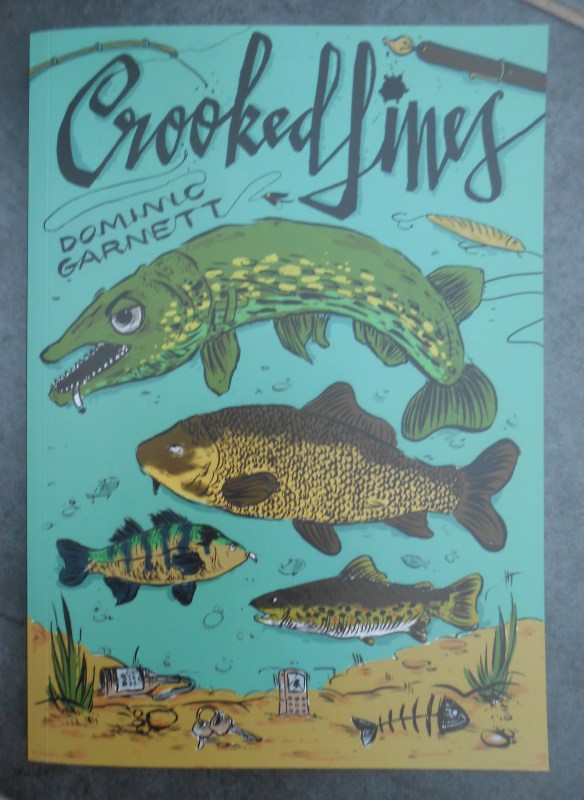
Somebody just back of you while you are fishing is as bad as someone looking over your shoulder while you write a letter to your girl.
– Ernest Hemingway.
I’ve had the pleasure of knowing the high quality of Dominic Garnett’s writing for some time, but have only recently discovered the excellence in its fishing focus – and much else – when I read his wonderful piece Memories of Manhattan in Fallon’s Angler, that article included now in this superb collection.
I’ll start my review of Crooked Lines by returning to the article, it exemplifying all that is engaging about these stories as it is a fine mixture of travelogue and fishing emphasis wherein observations about people, culture, environment, emotion, discovery, and naturally the actual fishing coalesce into vignettes of personal experience that appeal precisely because of this expansive canvas – and that writing quality.
Memories of Manhattan begins with a walk through Harlem to Central Park, …an Englishman carrying a fishing rod and it is the dual sense of being an outsider as foreign visitor but then belonging as a member of the universal fishing fraternity that absorbs. There is, respectively, that experience of being new to the place, Some smile, others just look quizzical, and the eventual fishing where observation is then on a comfortable par with his surroundings, A stocky, baseball capped man is hurling out a gaudy red spinnerbait in the hope of bass. On route to Harlem Meer, Garnett has discovered, It is a minor revelation just how green and calm it is here, and once fishing, the expertise assumes its descriptive certainties, but also does so with the vivid precision of his describing eye and voice, The rod rattles pleasingly and I bring in a pretty little bluegill, a fish which shares the spiny dorsal fin and bold biting characteristics of our perch, but with beautifully marbled cheeks; the perfect catch for a sunny afternoon in Manhattan.
The collection opens with A White Van in Wales and the witty description of Norbert Darby’s shambles of a van has a brighter humour compared with Hemingway’s bitterer comic line used to preface this review. For Garnett, arriving safely at a place to fish is a more critical requisite than the protocol of how near one fishes to another, My head is scraping the roof because, naturally, the seats don’t work. I try wrestling with the wheel thingy at the side, thrash backwards and forwards and search for non-existent levers. I’m beaten so I ask Norbert “So how do you adjust the seats?” He just chuckles. “You can’t. I mean…they don’t,” he admits. So I just sit there, head wedged in place. And again, within the general and wider evocation of the framing narrative, there is always a spotlight on fishing and fish, The wild carp is a very different creature to the fat, farmed fish we know from home. While the big mouth and whiskery barbules remain, it is a longer, sleeker creation of leathery gold scales and raw power. A strikingly long dorsal fin reaches almost right to the tail.
Elsewhere the vignettes focus more narrowly, for example on fly-tyer Leon Guthrie in Fly Life on Mars. Having established Leon’s idiosyncrasies with more descriptive bright humour – but always respect – Garnett tells us The flies themselves are random, manic treasures. They delight and baffle you in equal measure. There are flying insects, trapped in time; rows of salmon and trout flies sitting like birds. But look closer and you might also find an Earthworm, a Haggis or a Fried Egg. In The Curse of the Towpath the philosophy of angling gets its apt aphorism, As any diehard angler understands, for the possibility of sudden elation to exist there must also be the possibility of failure. There is a valiant defence of skive-fishing in Sick Leave. The closing article Escape from Dartmoor continues the successful symbiosis of finely judged description with aspects of fishing, this evoking the interest of all readers rather than just those with the topical attraction. In addressing the angler Garnett is addressing all by, in this case, linking activity with place – as he does throughout his writing – and making it clear that nothing of value to an individual takes place in a vacuum, and here the landscape is a shared significance, For the angler though, Dartmoor has a simple, primal appeal. Its boulder-strewn rivers and savagely beautiful trout take fishing back to its fundamentals: a fly rod, a few basics, miles and miles of stony solitude. The fish are easy to catch but even easier to spook, perfectly adapted to their craggy ancestral home.
This is a beautifully presented book: a great cover illustration by Lord Bunn and fantastic photographs as well as excellent production throughout. I wholeheartedly recommend to anyone who appreciates honest and skilled writing, and obviously those who know with an angler’s heart and knowledge just how near to stand next to a fishing comrade.
And what a great Christmas gift! Details for buying can be found here.
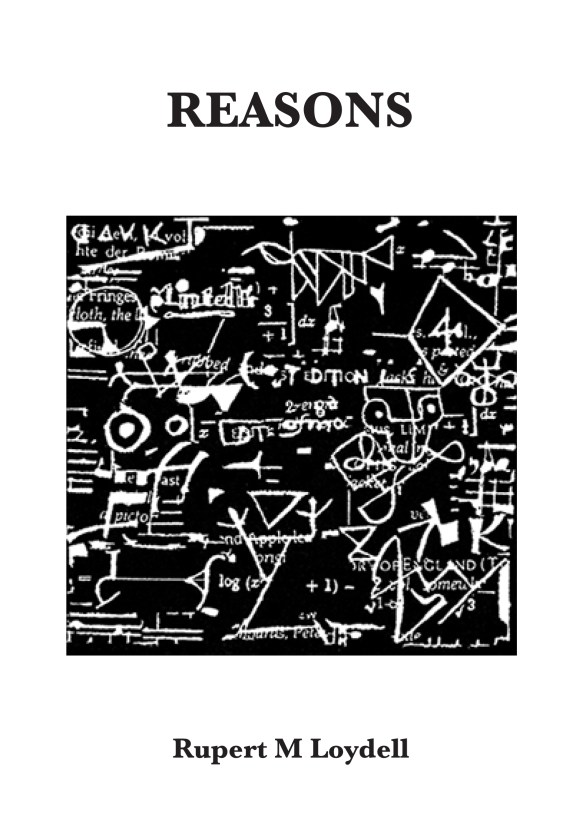
Reasons, by Rupert M Loydell – Hesterglock Press
Reasoning is to do with logic and calculation, assessing and rationalising, asking and answering, persuading and cajoling – this list could obviously go on and on. It is an essential capacity/urge. It is compulsive. It is necessary.
As ever, writer Rupert Loydell takes such a colossal element of who and what we are as thinkers and explores this through everyday poetic touchstones that resonate with familiarity and insight. His poetic reasoning confronts the variety and vicissitudes of that very mental activity so that we as readers can share in understanding his and our living.
The opening poem Reasons to Believe is perhaps the most ostensibly rhetorical. Tackling belief in God, mental health, the darkness of being – there are no answers to the many urgent questions making it seemingly unreasonable to be searching, and all that is offered isn’t much under the weight of that not knowing,
….in the dark,
waiting for a glimpse of light, moments of calm,
distant voices raised in memorable song.
The next poem Reasons to Stay Alive – as if needing these is a natural enough requisite – takes a more domestic turn down the same dark alley, speaking of a friend suffering despair too,
He’s up to his neck in it, scared and ill,
with a daughter who feels the same.
One is never sure in the reading if the poems are autobiographical or wholly externalised [though this latter seems unlikely] and I know it shouldn’t matter and doesn’t, especially as it is in the sharing of common experience – whether personal or externalised for readers – that makes them compelling to read. Thus the rumination in I Had My Reasons (Hold Tight),
……If I look back now
I had been stressed or depressed
(possibly both) several years before…
is resolved, as much as it could be, in the universal ending of,
No-one tells you life gets harder
as the days and years go by.
You obviously have to read these apparently prosaic lines within the context of their poetic narratives, but it is the very ‘ordinariness’ that makes them immediately meaningful.
Reasons To Be Cheerful begins comically cynical,
Name one!
and we are then reminded of the continuing darkness in the following poem Beyond Reason,
I should be dead soon, read his text,
but I didn’t know if it was a self-aimed
imperative, or an update from the front
line of another suicide attempt.
Turns out to have been the latter.
There is the other classically existential view that gets explored as well: all this reasoning is by its nature challenging and/or depressing and we all want an exciting way out. Therefore in The Voice of Reason,
I want to be unreasonable, want
to take a running jump from the end
of the pier, want to shout and scream
and drink too much, want my friend
to stop trying to die, my car to start
when I want it to.
From the edge of the abyss [if only pier-end high] to the vagaries of the car starting, the excitement is, Loydell reasons, always going to be largely realistic.
And it is this realism that makes these poems, as I have said, resonate. There is little point in just asking us as readers big questions if there aren’t some answers, no matter how small. The process of human reasoning happens every day for all of us and it is usually pragmatic rather than philosophical because that way we carry on. We leave it to writers like Loydell to ask himself the questions many of us avoid on that day to day basis, and in that asking we have our own voices expressed through a poetry that is his trademark: accessible but poignant, thoughtful but without being pretentious, lyrical but conversational, and confessional without fear of that honesty.
[further details and where and how to purchase can be found here]
I recently posted commentaries on Nicky Morgan’s announcements about the need to look again at national testing, including extending this to 7 year olds, as well as satirical looks at the sample Key Stage 2 Grammar, Punctuation and Spelling test for English.
If and when there needs to be a battle to prevent the proliferation of a testing regime – perhaps even a return to Key Stage 3 testing – I have been consistent in stressing that the teaching profession needs to step up to the plate and argue against it. The teaching unions and national subject organisations need to do this as well. Everyone who has an informed understanding of the dangers, both educationally and otherwise [that stress/pressure element], needs to voice their objections.
There is one other crucial and ultimately successful move the teaching profession could make to prevent these tests from happening: refuse to mark them. As an examiner of GCSE throughout most of my entire teaching career of 30 years, and now beyond this, I never marked SATs as a matter of integrity and principle, and am proud of this.
I know many brilliant teaching colleagues who have marked various SATs, and most of these, if not all of those who I respect, have done so for the payment. I understand entirely the need for this, especially younger colleagues struggling financially whilst pursuing one of the most challenging occupations, but they too need to find a way to resist providing the workforce to help make these tests a possibility. Any English teacher who has allowed themselves to be shackled by the ludicrous constraints of finite marking schemes must have felt the nonsense of it all, and the shame.
I’ll leave this part of the current commentary there.

When I self-published my novel Writing with Hammers recently, I considered not including the following chapter as I felt the removal of Key Stage 3 SATs had made it redundant. This level was the only one I had experienced and I recall genuinely outrageous times when reviewing my school’s students’ exam papers and finding wonderfully individual or creative or even incisive, if unexpected, answers disregarded because they did not ‘fit’ the prescribed and narrow mark scheme answers. This, coupled with the generally deconstextualised and therefore meaningless questions themselves, underpin and inform much of my entire rejection of them.
Or to put it more satirically, here is that chapter that I did retain – for a poignant sense of nostalgia – but should/could continue to be contemporary as a warning both in light of the current KS2 proposals and any future expansion:
SHATs Marking
I wouldn’t touch them with any kind of pole, but there are colleagues who are prepared to mark the national SHATs papers. There was a time when as a profession we collectively refused to have anything to do with these, but like a slow insidious virus, they have managed to pervade and triumph.
My opposition isn’t so much based on the narrowness of the tests, as significant as this is, but more to do with the complete unreliability of the marking process. For years, my SHATs results have fluctuated up and down like a float in a whirlpool. One year our school’s results were about the best in the country (transparently inaccurate), and in another we had no distribution curve, a term I learnt from the Head of Maths, which suggested that we had cheated in order to give all of our students virtually the same scores (but I hadn’t yet implemented the then Head’s plan for such deception).
So it comes as a major surprise when a traitor in my department, who claims she marked them out of financial despair and desperation, shows me her SHATs Marking Manual. I think the gesture is an attempt to assuage guilt, and so it should be. She’s taking a bit of a risk because these manuals are meant to be confidential and in fact aren’t supposed to be taken away from the regional training meetings. I’m delighted to get the opportunity of examining one of these rare documents, and coming on the back of receiving Norm’s illicit video, I feel like a very successful if unintentional spy.
I’m surprised at how few words there are. The instructions are given largely through drawings and so it looks more like a comic strip than a conventional training manual. There’s very little information even in this illustrative form. The main page titled ‘Marking Process’ has a sketch of a woman sitting at a table, an exam paper in front of her that she’s marking with a pen, and she is wearing a blindfold that looks like the kind people buy for sleeping or wearing on aeroplanes. The only instruction is place random ticks, no more than four, down right hand side of page. That’s all there is. I turn the page and there is a drawing of the same woman with a large smile and a bundle of presumably marked papers being placed in an envelope.
“I can understand the random ticking business,” I tell Martina, our SHATs double agent, “because I’ve seen plenty of examples of this minimalist annotating, but the blindfold idea is more weird than even I could have imagined.”
Martina doesn’t reply and instead reaches down to her handbag. She picks it up off the floor, places it in her lap and then rummages inside. Like a magician with a hat, she pulls out a blindfold and holds it up to me, smugly, as if she’s performed a very special trick.
I take the blindfold and have a closer look. It’s exactly as in the illustration in the manual. The only thing the manual doesn’t show, however, is the little tag on the outside of the right eye covering printed with Government Issue. Martina sees me reading this and all she says on the whole subject is,
“Yes, everyone calls them their GIs. It’s an in-joke I guess.”
That night at home I sit in front of my stack of unmarked essays, feeling inundated and daunted as usual about the amount of work to be done. I get through about five papers in the first hour and start to feel totally exhausted, beginning to fall asleep at my desk. It’s a familiar pattern. I’ve already had my early evening nap, but the tiredness comes back like a wave up my soporific shore. I must be drifting in and out of sleep and start to dream or even hallucinate about the SHATs marking with a blindfold. This makes me snap out of my drifting in a sudden anger, but all I can do is sit and stare at the pile of unmarked homework. Then, feeling like a reformed alcoholic about to sneak a drink, I spot my scarf hanging over the back of the chair and with a strange compulsion, decide to try this blindfold marking. I know it’s hypocritical, but I’m desperate too. I tie the scarf around my head and just get down to it. It’s peculiar at first, not being able to read the students’ work, but it is remarkably easy once in the swing of things. One or two of my early ticks miss the pages altogether, but you soon develop an instinct for where the edges are. Before I know it, in half an hour I’ve finished all of the papers.
It’s proved such a successful system that I’ve actually got time to sit down and watch a film on television tonight. As I do, I can’t help feeling like I’ve just been involved in murdering someone.
 I’m delighted to announce the publication of Yesterday’s Music Today, an anthology of poems about music in its widest possible sense, co-edited by myself with fellow writer Rupert Loydell and including a number of our poems.
There are eighteen other writers who have contributed poems that range widely in musical focus from concerts attended, to musical instruments, to pieces of music, to types of music and much beyond.
Further details can be found here.

